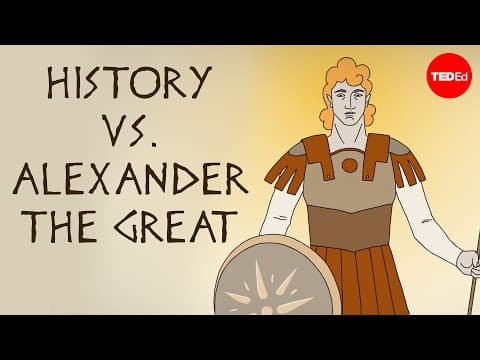
[0:01]Alexander's heart had an insatiable longing for glory.
[0:13]Order, order! Who do we have on the stand today? Alexander the Great. Well, what's so great about him? Your honor, the better question is, what's not great about him? He was the king of Macedon and considered a living demigod by Egyptians and Greeks alike. He conquered Persia when it was one of Earth's largest empires, and he was a thoughtful student of Aristotle, creative enough to untie the impossibly tight Gordian knot by cutting it in half. The Gordian Knot is a myth, just like the countless other stories invented to enhance Alexander's legend. Calling him great just plays into this propaganda and glorifies his ruthless military ambitions, such as his unprovoked invasion of Persia. Objection. Alexander invaded Persia to free Greeks. A century before his time, Persia had sacked Athens and conquered countless Greek lands. So after Alexander's father Philip expanded Macedonian control over much of Greece, he planned a final campaign to liberate those still under Persian rule. Liberates is a generous word. Those Greeks were just going from one despot to another. Not that they ever even experienced Philip's leadership, since Alexander had his father assassinated to take power for himself. Objection, your honor. We don't know for sure who killed Philip. Some evidence suggests he was murdered by a humiliated ex-lover. Oh, please, that disgruntled lover story is ridiculous. Before his death, Philip had taken a new Macedonian wife to father a new heir. So it's far more likely Alexander had his father murdered to take the throne and reap the glory from Philip's planned campaign. That's one messy family. Regardless of Philip's fate, Alexander was hardly riding his father's coattails. His tactical brilliance was essential for defeating Persia. For example, at the Battle of Issus, he strategically positioned his troops along the river bank, forcing his enemies onto a narrow plane that disrupted their formation, limited their maneuverability, and neutralized their numerical advantage. So what if he was a military genius? His power hungry conquering spree left a wake of widespread death and ruin. Actually, his conquests were neither bloody nor destructive. The Persian governor of Egypt surrendered without a fight, and after most victories, he usually expanded existing infrastructure. Not in Persepolis. He raised the Persian capital to the ground. He only did that to maintain Greek support. Raising Persepolis was considered payback for what Persia did to Athens. Besides, Persepolis was the only city he destroyed in over a decade of campaigning. Typically, Alexander founded cities. And befitting his massive ego, he named over 20 of them after himself. That's a lot of Alexandria's. And it's a huge part of why his legacy seems so impressive, when, in reality, he only conquered one empire. He just thought he'd conquered the world because he had such a narrow conception of it. He didn't even know India existed until he stumbled upon it. And when he tried his hand at conquest there, his soldiers rebelled and forced him to turn back. It's true his men mutinied after being pushed too far, but Alexander and his forces had a deep respect for each other. He fought alongside them in battle, led cavalry charges, and never asked them to do anything he wouldn't do himself. Part of his greatness was his ability to cultivate talented individuals. If only he paid similar attention to all his subjects. His attempts at cultural assimilation led to resentment and rebellion from Greeks, Persians, and Macedonians. And he left Macedon in the hands of a regent for almost his entire reign. That regent was well regarded. And in his defense, Alexander's diverse subjects all expected their king to behave in very different ways. The Macedonians saw him as a hereditary king who needed public support to remain in power, so they expected him to respect their wishes. Since the Greeks refused to be ruled by a king, they thought he should behave as a first among equals. And the Egyptians and Persians believed he should act as a semi-divine absolute monarch. It was an impossible balancing act. And since he died suddenly of an unidentified illness at just 32 years old, he simply didn't live long enough for us to judge his governing abilities. I'll be a judge of what we can judge. Of course, your honor. I just think failing to plan for his own death tells how uninvested he was in ruling. On his deathbed, he declared his empire should go to the strongest, setting the stage for decades of destructive power struggles. Now you're buying into the legends. Those final words were likely fabricated to suggest Alexander's approval for the conflicts that followed. But you can hardly judge a man by those who invoke his name to justify their own ambitions. If we want to talk about legacy, let's give him credit for ushering in the Hellenistic age. where Greek cultural influence spread across Europe and Asia. Like it or not, Alexander fundamentally transformed the world. Fair enough, but it's hard to judge anyone clearly when they cast a shadow this, well, great. Whether he was a ruthless conqueror or an embattled leader, Alexander the Great is undeniably a legend. But trying to separate fact from fiction is all part of putting history on trial. If you enjoy learning about history, subscribe to this channel. Because the lessons of yesterday can help us face the challenges of today.


