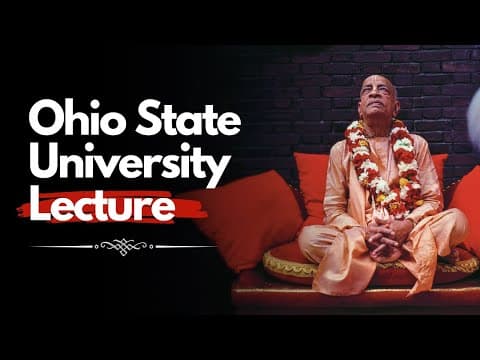
[0:13]The following is the lecture at Ohio State University given by His Divine Grace A.C. Bhaktivedanta Swami Prabhupada recorded on 12th May 1969 in Columbus.
[0:33]Om ajñāna-timirāndhasya jñānāñjana-śalākayā cakṣur-unmīlitaṁ yena tasmai śrī-gurave namaḥ. My dear boys and girls, I thank you very much for your coming here and participating with this Saṅkīrtana function. The Saṅkīrtana function, or… It is called Saṅkīrtana-yajṣa, sacrifice.
[1:12]There is a statement in Śrīmad-Bhāgavatam that Saṅkīrtanair yajṣaiḥ prayair yajanti hi su-medhasaḥ. In the Age of Kali, intelligent persons perform congregational chanting to worship the incarnation of Godhead who constantly sings the names of Kṛṣṇa. Although His complexion is not blackish, He is Kṛṣṇa Himself. He is accompanied by His associates, servants, weapons and confidential companions. In this age... As poet Ginsberg has explained to you, this is called Kali-yuga, or very degraded age. From the spiritual point of view, from material point of view also, people are reducing their duration of life and their merciful tendency, their strength, their stature.
[2:06]If you study scrutinizingly, you will see that your stature is reducing, your memory is reducing, your duration of life is also reducing in this Kali-yuga. There are many symptoms. So Bhāgavata recommends, "For self-realization in this age, simply by performing this sacrifice of saṅkīrtana." The saṅkīrtana-yajṣa is so nice that at once you get transcendental ecstasy, and from spiritual consciousness, you try to join. Even a child desires like that. This is the effect of the saṅkīrtana-yajṣa. And Lord Caitanya, the inaugurator of this movement five hundred years ago. He says that if you chant this mantra, Hare Kṛṣṇa, Hare Kṛṣṇa, Kṛṣṇa Kṛṣṇa, Hare Hare/ Hare Rāma, Hare Rāma, Rāma Rāma, Hare Hare, then the first installment of your gain will be that all the dirty things in your heart will be cleansed. Ceto-darpaṇa-mārjanam [Cc. Antya 20.12]. And when we are in clean heart, then the next stage will be bhava-mahā-dāvāgni-nirvāpaṇam: "The problems of material existence will be solved." And when you are spiritually steady on the platform of saṅkīrtana-yajṣa, then your original consciousness, Kṛṣṇa consciousness, and its concomitant joyfulness begins. This thing also is explained in the Bhagavad-gītā: brahma-bhūtaḥ prasannātmā, na śocati na kāṅkṣati samaḥ sarveṣu bhūteṣu mad-bhaktiṁ labhate parām[Bg. 18.54]. It is said there that "When one comes on the platform of spiritual consciousness, or Kṛṣṇa consciousness, at that time he becomes completely joyful." Brahma-bhūtaḥ prasannātmā. Prasanna means joyful; ātmā means soul. And the symptom is na śocati na kāṅkṣati. He does not lament, neither hanker. In the material existence we have got two diseases: hankering for things which we do not possess and lamenting for things which we have lost. But actually we don't possess anything; everything belongs to God. That is the Vedic injunction. Īśāvāsyam idaṁ sarvam [Īśo mantra 1] Whatever we see, that is the property of the Supreme Lord. And this claiming that "This is my property," "This is my body," "This is my country," "This is my home," "This is my...," "This is my...," this is called illusion. Actually we do not possess anything. So when you actually come on the spiritual consciousness, you understand that nothing belongs to you. Brahma-bhūtaḥ prasannātmā na śocati na kāṅkṣati [Bg. 18.54]. And of all yogīs, he who always abides in Me with great faith, worshiping Me in transcendental loving service, is most intimately united with Me in yoga and is the highest of all.]Kāṅkṣati means hankering, and socati means lament. Then the next stage is samaḥ sarveṣu bhūteṣu. Then you can see everything, or every living entity, on the equal status. People are trying to come to that platform of oneness, but that is only possible when you come to the spiritual platform, or Kṛṣṇa consciousness. In the material platform it is not possible. Practically we see the United Nations, they are trying to come to oneness of all nations, but they have failed. Simply the flags are increasing. Instead of being united, we are increasing our flags. So if you want actually oneness, then you have [to] come to that platform of brahma-bhūtaḥ prasannātmā [Bg. 18.54]—prasannātmā, joyfulness. Everyone is hankering after joyfulness. How that joyfulness can be attained? That is explained in the Śrīmad-Bhāgavatam. The Śrīmad-Bhāgavatam says,sa vai puṁsāṁ paro dharmo yato bhaktir adhokṣaje ahaituky apratihatā yayātmā suprasīdati[SB 1.2.6].Ātmā means soul, your self. We are, every one of us, hankering after that peace and tranquility. How it is possible? Bhāgavata says yayātmā suprasīdati. Suprasīdati means completely become satisfied. How it is possible? Now, sa vai puṁsāṁ paro dharmaḥ: "That is the first-class occupational duty by which you develop your love of God." That is first class. The test of religion... Every religion has got some conception of God. That's all right. But if by following the principles of that religion, if you see that you are developing your love for God, then that is first class. Otherwise, Bhāgavata says, it is simply wasting time laboring. dharmaḥ svanuṣṭhitaḥ puṁsāṁ viṣvaksena-kathāsu yaḥ notpādayed ratiṁ yadi śrama eva hi kevalam[SB 1.2.8].
[8:54]The Bhāgavata says that "You are very nice man. You are very honest to your occupational duty. That is all right. But if by discharging your occupational duty you do not develop your eagerness to understand what is God and what is love of God," then, Bhāgavata says, "it is simply laboring and wasting time." That is the test. And why we should try to increase our love of God? That is also explained: ahaituky apratihatā yayātmā suprasīdati [SB 1.2.6]. Ahaitukī, without any cause. We should love God without any cause. Just like we go to temple, church, with a motive. We go there: "O God, give us our daily bread. I have come to You for my bread." That is not love of God. That is love of bread. [applause]So Caitanya Mahāprabhu has given nice sample of love. He is playing the part of Rādhārāṇī. Rādhārāṇī is the conjugal consort of Kṛṣṇa. Our Kṛṣṇa consciousness is not dry. You'll see the picture, Rādhā and Kṛṣṇa.
[10:35]Kṛṣṇa is a boy, sixteen years old, and Rādhārāṇī, a young girl, a little younger than Kṛṣṇa. They are enjoying, Rādhā-Kṛṣṇa. Rādhā kṛṣṇa-praṇaya-vikṛtir hlādinī śaktir asmāt [Cc. Ādi 1.5]. There are different potencies of God. Parāsya śaktir vividhaiva śrūyate [Śvetāśvatara Upaniṣad 6.8, Cc. Madhya 13.65, purport]. In the Vedic literature you'll find, Vedas, "God has many energies." Parāsya śaktiḥ. Śakti means energy, power; vividhaiva, multi, various. Parāsya śaktir vividhaiva śrūyate svabhāva... Parāsya śaktir vividhaiva, na tasya samas cābhyadhikaś ca dṛśyate. This is the injunction of Vedas. "You cannot find anyone equal or greater than God. Nobody can be equal with God; nobody can be greater than God." Then he is not God. Na tasya samas cābhyadhikaś ca. Sama means equal; adhika means greater. Na tat-samas cābhyadhikaś ca dṛśyate. They have analyzed who is God. The great sages, the liberated sages, they are not fools, rascals, that they will accept anyone God. No. They will test. This is the test. If you find somebody that he is neither lower than anyone, neither equal to anyone, then he is God. There are other, many definitions of God. Aiśvaryasya samagrasya vīryasya yaśasaḥ śriyaḥ [Viṣṇu Purāṇa 6.5.47].Analytical study. Try to understand God. This is the only business of human form of life, not that simply eating, sleeping and mating and, I mean to say, defending. These are animal business. The animal knows how to eat, how to sleep, how to mate, and how to defend in its own way. So that is common formula for human being or animal. But there is one speciality in human society or human being—he can understand God, what is God. If I explain to a human being, however illiterate, uneducated he may be, if he has simply these two ears, he will understand what is God. Therefore the Vedic information is called śruti. Just try to hear. You haven't got to be educated or literate. God has given you these two ears, and you can learn. Simply you have to learn from the authorized sources. Then you will understand God. And when you understand God, then you develop love of God. And when you develop love of God without any motive and without any impediment, then you find, "Oh, svāmin kṛtārtho 'smi varaṁ na yāce [Cc. Madhya 22.42]"I have no more any demand. I am completely satisfied." Try to come to this platform, transcendental stage. You cannot be happy simply by material advancement. That is not possible. That is explained in the Śrīmad-Bhāgavatam: parābhavas tāvad abodha-jātaḥ [SB 5.5.5] Every one of us are rascals, born ignorant. But we have got the capacity to take the message of God from authorized information. That we have got. So Bhāgavata says, parābhavas tāvad abodha-jātaḥ: "All living entities who are born ignorant, whatever they are doing for advancement of society, culture, education, civilization, all such activities are defeat only if he does not inquire what he is." Parābhavas tāvad abodha-jāto yāvan na jijñāsata ātmā-tattvam. Ātmā-tattvam. So long one does not inquire, "What I am? What is God? What is this material nature? What are these activities? What are our relationships?"—if these inquiries are not there, then all our activities are simply defeat. Parābhavas tāvad abodha-jāto yāvan na jijñāsata ātmā-tattvam. Yāvan na prītir mayi vāsudeve [SB 5.5.6]"So long one does not develop his dormant love of God," na mucyate deha-yogena tāvat, "so long he will not be able to get out of this repeated birth and death and transmigration of the soul." This transmigration of soul, repeated birth and death, is a diseased condition of the spirit soul. That we do not know. Neither in our education system there is any department of knowledge teaching what is the soul, what is after death, what was before birth. There is no science. It is very lamentable. Education in the name of simply eating, sleeping and mating, this is not education. If my bodily conception continues... The Bhāgavata says, yasyātmā-buddhiḥ kuṇape tri-dhātuke [SB 10.84.13]"Anyone who is thinking that this body of flesh and bone is self, he is an ass." [laughter] Sa eva go-kharaḥ. Go-kharaḥ. Khara means ass [laughter].
[17:01]Yasyātmā-buddhiḥ kuṇape tri-dhātuke sva-dhīḥ kalatrādiṣu bhauma ijya-dhīḥ. And by his conceiving this body as self... They have no even common reason that "This bag of flesh, bone, urine, stool and secretion—can it be soul? Can it be self?" But they are finding out by exercising this body to find out the soul. The soul is there, but you cannot see by material instrument. It is very fine. It is one ten-thousandth part of the tip of your hair. These are explained in the Vedic literature. So how you can find with your material eyes? You cannot see it. And because you cannot see it, you are concluding there is no soul. That is the ignorance. There is. There is soul, and this body has developed on the platform of that soul, and that soul is migrating from one body to another. That is called evolution. And that evolutional process is going on, 8,400,000's of species of life—aquatics, birds, beasts, plants and so many species of life. And we have got now this developed consciousness, human form of life. We should properly utilize it. That is our Kṛṣṇa consciousness movement. We simply educating people, "Don't waste your valuable life, the human form of life. If you are missing this chance you are committing suicide." That is our propaganda. Don't commit suicide. Take to this Kṛṣṇa consciousness. And the process is very simple. You haven't got to take difficult processes like yoga system or philosophical, speculative system. That is not possible in this age. That is... I am not speaking from my own experience, but I am taking the experience of big ācāryas and big stalwart sages. They say that kalau nāsty eva nāsty eva nāsty eva gatir anyathā. If you want to realize yourself, if you want to know what is your next life, if you want to know what is God, if you want to know what is your relationship with God, all these things will be revealed to you—this is real knowledge—by simply chanting this mantra, Hare Kṛṣṇa, Hare Kṛṣṇa, Kṛṣṇa Kṛṣṇa, Hare Hare/ Hare Rāma, Hare Rāma, Rāma Rāma, Hare Hare. It is practical. We are not charging anything. We are not bluffing you that "I shall give you some something, secret mantra, and charge you fifty dollars." No. It is open for everyone. Please take it. That is our request. We are begging you, "Don't spoil your life. Please take this mantra. Chant wherever you like." It has no hard-and-fast rules you have to follow. Whenever you like, wherever you like, any condition of life... Just like we chanted half an hour before. Any condition, you felt ecstasy. Similarly, you can continue this. Chant this Hare Kṛṣṇa mantra. It is given to you free. But if you want to know what is this Hare Kṛṣṇa mantra through philosophy, through knowledge, through logic, we have got volumes of books. Don't think that we are simply sentimentally dancing. No, we have got background. So try to understand this Kṛṣṇa consciousness movement. I have especially come to your country to deliver you this good message, because if you accept this, if you can understand this science of Kṛṣṇa consciousness, other part of the world will also follow, and the face of the world will be changed. That is a fact. So therefore I request you that you take this chanting, Hare Kṛṣṇa mantra, with you, and wherever you live, in whatever condition you are, you don't require to change. Caitanya Mahāprabhu has recommended that, sthāne sthitāḥ śruti-gatāṁ tanu-vān-manobhiḥ,prāyaśo ajita jito 'py asi tais tri-lokyām[SB 10.14.3]Caitanya Mahāprabhu discussed about spiritual realization with one of His great devotees called Rāmānanda Rāaya. And Rāmānanda Rāaya placed before Him many theories expounded in the Vedic literature. And at last, when Rāmānanda Rāaya placed this verse from Śrīmad-Bhāgavatam, that jñāne prayāsam udapāsya namanta eva... Don't be foolishly try to speculate to understand the unlimited. It is not possible. By your tiny senses you cannot understand the unlimited. It is not possible. Therefore the first recommendation is that jñāne prayāsam udapāsya: don't try to be a dry speculator to understand the ultimate truth. Namanta: just become meek and humble. Namanta eva san-mukharitāṁ bhavadīya-vartām. And try to receive the message from authorized sources. Then sthāne sthitāḥ śruti-gatāṁ tanu-van-manobhiḥ: in whatever condition you are, you don't require to change. You simply hear. Then a day will come when you will be able to conquer the Supreme Lord, who is unconquerable. God is great, nobody can conquer, but if you simply follow this process, then—in whatever condition you are, simply try to hear about God from authorized sources—then one day you will be able to conquer God within your hand. This is also confirmed in the Brahma-saṁhitā:advaitaṁ acyutam anādim ananta-rūpam,ādyaṁ purāṇa-puruṣaṁ nava-yauvanaṁ ca vedeṣu durlabham adurlabham ātma-bhaktau... [Bs. 5.33]You cannot find out, simply you find out searching in the Vedas or scripture where is God. You have to conquer Him by your love. He will reveal to yourself. That is also explained in the Bhagavad-gītā: teṣāṁ satata-yuktānām bhajatāṁ prīti-pūrvakam buddhi-yogaṁ dadāmi taṁ yena māṁ upayānti te[Bg. 10.10] Everything is clearly explained there. Please try to read this Bhagavad-gītā As It Is. It is science of God. You will understand. You will realize. And chant this Hare Kṛṣṇa mantra. This Hare Kṛṣṇa mantra will cleanse your heart. And after cleansing your heart, if you read one chapter of Bhagavad-gītā, you will understand gradually what is God, what you are, what is your relationship with God. And when you understand all these things and you develop your love of God, you'll become perfectly happy. So we want to see you all happy. That is our program. Sarve sukhino bhavantu. [Let everyone be happy.] Every one of you become happy. But you must take the path how you can be happy. This is the path, Kṛṣṇa consciousness: Hare Kṛṣṇa, Hare Kṛṣṇa, Kṛṣṇa Kṛṣṇa, Hare Hare/ Hare Rāma, Hare Rāma, Rāma Rāma, Hare Hare. Thank you very much. [applause] [end]