[0:00]I am a specialist medievalist. Hello, by the way, Dr. Newman History of the English Language. I have studied the Middle Ages, um, particularly the later Middle Ages, well, central and later 1100s to the 1400s.
[0:15]If I did not specialize in the medieval period, I think I would focus on the late 1600s and early 1700s. That period known as the Restoration in the Augustan era in in literary circles.
[0:28]I think this is a fascinating period. Um, uh this is really the transition from what we might call the early modern to the modern.
[0:37]And so this video, um, in this course on the history of the English language, sometimes we're talking more about the language. Sometimes we're talking more about the history.
[0:46]This is a history video. I'm going to try to keep things brief and concise and contextualize some of the social, cultural, religious, um, technological, scientific, educational changes, um, against which the English language, uh, changed during that period, and which, um, affected both trends towards prescriptivism and towards greater regional variety and towards its spread around the world as well.
[1:12]Uh, so let's start talking about that. Here in this title slide, by the way, are English Civil War reenactors. The English Civil War took place in the 1640s, of course, not in the 1860s.
[1:25]Um, and these guys were, uh, here were members, uh, represent members of what was called the New Model Army. We'll talk about that. But they were, they were, uh, kind of the modern professional type army representing the middle class and, uh, parliamentary, parliamentarian forces against the aristocratic oilists forces. All right.
[1:47]Uh, and so, very brief overview, in 1400, Henry IV takes the throne from Richard II (Chaucer Dies). Um, we get, we get the end of the Plantagenet Dynasty and the beginning of the Lancastrian, but in the mid to late 1400s, we have the Wars of the Roses.
[2:02]A kind of dynastic struggle, um, that takes place in several phases between, uh, two successor dynasty factions to the Plantagenets. Um, George R. R. Martin's, uh, Game of Thrones is roughly based on this period of English history. That you have the Yorks versus the Lancasters, that rings a bell.
[2:25]Um, then from 1485 to 1603, we have the Tudor Dynasty (Henry VII, Henry VIII, Edward VI, Mary Tudor, Elizabeth I). A lot happens during this, but the two big things are one, the consolidation of royal power, and two, um, this is a period of religious struggle.
[2:43]Uh, England breaks with the Roman Church, there's religious persecution going back and forth. And finally, there's the establishment of the Church of England as a kind of, this is really simplifying things, but a kind of hybrid between Roman Catholic Catholic forms of worship and approximately Protestant, uh, theological views.
[3:06]Um, and then from 1603, you have, with us important break in the middle, the Stuart Dynasty of of of the various James's and Charles's. Um, so, zooming in a little bit, uh, let's look at the English Civil War briefly.
[3:20]Um, in 1625, Parliament had attempted to limit Charles I's power. Charles I was like, I want to be like a French king where they can just do whatever they want.
[3:30]Um, English kings had traditionally had less power than French kings and he tried to dismiss Parliament, but unfortunately, he couldn't raise taxes without Parliament.
[3:39]Um, and then when he went to war, uh, against Presbyterian Scotland, Parliament is recalled and it does not approve war funding, um, because he hasn't called Parliament in 10 years and they're very they don't like Charles at all. They think he's secretly Catholic and there's a whole bunch of other problems as well.
[3:55]So there's an English there's this English Civil War breaks out between a faction, um, representing Royalists, loyal to the king and loyal authority.
[4:05]These are sometimes called the Cavaliers and there's a connection here between Virginia between the Cavaliers and Virginia. This is why the, um, University of Virginia, uh, their their mascot is the Cavaliers.
[4:15]Um, and then, uh, the the Parliament is the Roundhead is the part the parliamentarian forces are associated with, um, uh stricter, um, Protestant religion. They're called Puritans or Roundheads by their enemies.
[4:30]Um, uh, they, uh, after back and forth, they end up winning. They closed the theaters, they imposed, they execute Charles I.
[4:40]They they impose a theocratic republic essentially on England with mixed success. Uh, uh they, you know, they, they get rid of bishops, but they also get rid of Christmas, which was seen as a pagan holiday.
[4:55]Um, and they didn't approve the Puritans didn't approve of it at all. Um, this this did not sit well with your average English person who was, um, roughly indifferent to theology, but really like Christmas, right?
[5:08]Um, anyway, uh, Oliver Cromwell, uh, who had been a cavalry officer, ends up kind of rising to become a kind of dictator over this theocratic Republic and is appointed Lord Protector of the Commonwealth for life.
[5:23]Good title, eh? Um, and he unfortunately for him, only lived to see and the theocratic, uh, England, uh, the English Republic only, the Commonwealth as it was called, only lived till 1658.
[5:37]Despite their rejection of a king, his son, um, uh, was appoint then appointed the Lord Protector for life, but he was basically, he was really mid as the kids say, and, um, didn't last very long and and everyone was like, you know what? Let's have the king back.
[5:53]So they attempted to establish a theocratic Republic on the model of the Book of Judges. Um, it was in fact a military dictatorship under Oliver Cromwell. There were struggles between more conservative, um, Protestants who wanted to preserve, uh, property rights and the social order roughly as it was, even without royal authority.
[6:14]And two, uh, new radical Christians who wanted to abolish the aristocracy and redistribute property. These are known as Levellers and Diggers.
[6:23]This was also a period in which new sects such as Baptists, Quakers, and others, uh, emerged, as well as the reemergence of a kind of conservatism, mostly great land owners, and all of this revolutionary period fell apart with the death of Cromwell.
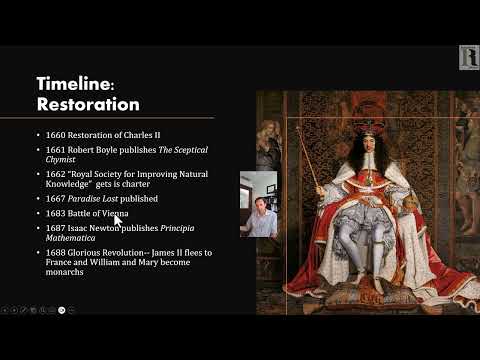
[6:37]Bringing us to the restoration when this guy here, Charles II, who had been in exile after his father's death in France, comes back and reopens the theaters and, um, uh, basically, um, London goes into a period of kind of debauchery and hedonism.
[6:59]Um, but also science. Um, so he gets restored, uh, Robert Boyle, if whose name you might remember from chemistry class, is the guy who came up with Boyle's law about gas, uh, pressure, gas and volume.
[7:13]published a work in 1661 in English, called The Sceptical Chymist, inaugurating a tradition, more and more of writing about science in English rather than in Latin.
[7:22]Um, this book is also famous for kind of elaborating the scientific method which, uh, Francis Bacon and others had, uh, kind of been, uh, working towards before.
[7:33]In 1662, uh, Charles II founds the Royal Society, the first research institution, basically. Um, and you and you get the, uh, uh, establishment of scientific journals and, uh, the experimental methods, and, um, really, this is when the scientific revolution really starts kicking to kicking into high gear.
[7:52]Um, the one of the greatest works of English poetry, though, and a very religious work, uh, Paradise Lost is is published in 1667 by John Milton. Um, in 1683, the Ottoman Turks, uh, kind of hit their high watermark and then retreat, um, slowly over the next couple centuries after losing the Battle of Vienna, um, through against a coalition of, uh, Catholic armies.
[8:18]So, um, uh, in 1687, Isaac Newton publishes The Principia Mathematica, in which he comes up with the three laws of motion, which revolutionized our understanding of space and physics.
[8:34]Uh, in 1688, um, uh, Charles II, uh, has died and his brother, James II, um, who's tried to, uh, impose absolute monarchy and and as well as being kind of more openly Catholic, um, runs at fail of Parliament.
[8:50]They remove him from power and bring, uh, um, William and Mary, cousins of the Stuarts over from Holland in order to be king and queen of England and have a, um, college in Virginia, well known for being a basketball school, named after them.
[9:07]Uh, this the Glorious Revolution is, this is sometimes called also established, um, a Charter of Rights and Freedoms for Englishmen that include that a lot of which was directly copied by our Bill of Rights.
[9:21]Um, it also established the principle of parliamentary supremacy, making the Britain a constitutional monarchy, uh, um, and it was also the beginning of parliamentary politics as well, because you get the position of Prime Minister emerging.
[9:39]Um, this is also a period that is marked by the adoption of coffee and coffee is very important in this period because coffee houses of London are where a lot of modern, um, innovations emerge during this time.
[9:54]Yes, uh, but we're going to return to that. So yeah, just a little bit. This is the period of the Scientific Revolution. Um, this there's, um, Charles being crowned by all these, uh, science guys around him, uh, for being the patron of, uh, the the this all this scientific research.
[10:13]Um, here is the, uh, first edition of Robert Boyle's skeptical chemist and very, very important, um, uh, text in the history of science.
[10:21]Um, here's Isaac Newton's telescope, uh, to be found at the Royal Society in London.
[10:30]Um, it's actually it's in, um, Greenwich, uh, which is just a little bit outside of London and this is, of course, where the, um, observatory is and why, uh, uh, zero, uh, in the world, sort of time zones is at Greenwich, because the power of of, uh, the British Empire basically for several centuries and the influence of the Royal Society within England.
[10:53]Um, that the sight of the the the observatory in Greenwich became the zero meridian when they divided the world into, uh, the degrees that are still used by your, the GPS, uh, devices in your phones. Um,
[11:09]However, this is a period when that might challenge some people's notions of what is modern.
[11:17]Newton revolution revolutionizes science to be sure, but he was also intensely interested in religion and wrote a number of commentaries on the Bible, in which he attempted to use scientific and rationalistic methods to determine the date of the second coming and the apocalypse.
[11:38]Um, this isn't something that's talked about a lot when when, you know, you're watching, uh, uh, Cosmos with Neil deGrasse Tyson or something like that.
[11:45]Um, and it's funny because, um, Archbishop Usher, who's sometimes associated with a kind of anti-science mentality that that gets associated by critics with like, you know, young Earth creationism, the idea that the Earth is only 6,000 years old.
[12:00]Um, uh, some young Earth creationists use the dating, uh, of of creation that was proposed by Archbishop Usher, um, in the 1600s, of October 22nd, 4004 BC.
[12:13]But the interesting thing about Archbishop Usher is that he was a thoroughly scientific and modern man and was trying to use all the latest innovations in science and research to, uh, determine accurately when, uh, according, uh, the date of creation was.
[12:28]So, he, neither of these guys thought of themselves as being anti-science, obviously. Um, they, they were, uh, committed, uh, to knowing as much about the world fully as as they could.
[12:43]Um, but there was a lot else that was going on at this time too. Um, as we said, in 1688, we get the, uh, uh, the Glorious Revolution.
[12:51]In 1690, we get the English Bill of Rights. During this period, we also get, um, the founding of the Bank of England, the first central bank controlling monetary policy in the world.
[13:06]During the three decade period from like 1660 to 1700 in England and Holland as well.
[13:14]Amsterdam was, uh, the Netherlands was a hugely powerful and rich country at this time, mostly from plundering Indonesia, you know, but, um, they were, they were, uh, they developed newspapers, joint stock companies, publicly traded stock.
[13:30]Insurance companies, scientific journals, all of which mostly were, um, developed at coffee houses in London and Amsterdam and a few in Paris, where there there would be a coffee house, um, where all of the people who were investing, uh, in shipping investors and shipping merchants would go to.
[13:50]That coffee house happened to be called Lloyds. Lloyds of London. And it went on to give its name to, um, one of the biggest insurance companies in the world. Lloyds of London insures insurance companies.
[14:04]So let's say you're like an insurance company in Florida and there's like three hurricanes that year and your money gets wiped out, well, you're underwritten by a company like Lloyds. Um, in 1698, the first steam engine is invented.
[14:17]Originally, to clear water out of coal mines, um, uh, and coal was being used as a heating source, as a fuel source at this point, not for industrial, um, gear.
[14:30]Uh, but, uh, let's see, 1711, Addison and Steele found the, um, the Spectator, which was an important kind of tastemaking magazine that kind of like the, the educated bourgeois would read.
[14:44]And in 1714, we get the beginning of the Hanoverian Dynasty, which really kind of, um, yeah, all right.
[14:52]And there's John Locke, an important political philosopher. Obviously, he had a lot of effect on our own, um, constitution and on the development of science and, uh, philosophy.
[15:06]Um, another, uh, important, uh, development in in society at this time was the development, um, out of courtesy, which was the a motive of behaving at court and being a courti, a kind of shifting mode of elite self-performance, to what was came increasingly to be called civility and politeness.
[15:28]And the word politeness comes from a word for being polished, finished, complete.
[15:33]This guy Anthony Ashley Cooper wrote about politeness and and how to be polite and described it as a dextrous management of our words and actions, whereby we make other people have better opinion of us and themselves.
[15:47]And we might see politeness as a kind of courtesy designed for what, um, Habermas, uh, the German philosopher, has referred to as the emergent public sphere.
[15:59]Joint stock companies, newspapers, parliamentary politics, all of this created the emergence of a public.
[16:08]Whereas power had always been exercised previously in private, in households, in courts. A court was essentially, uh, a household structure and it was a closed structure.
[16:20]It was, I think of a court as being like a Mafia type situation, like Tony Soprano at the strip club with his lieutenants kind of just sitting around counting their money and deciding how they're going to run everything, right?
[16:33]But when we get the emergence of the public sphere, then everything is sort of out in the open and and this changes how language is used and how people think of language.
[16:41]And so there's tons of of what we might we might call progress in this period. It's tons of transformation.
[16:49]It's not all positive, though. Um, at the same time as all of this is going on, there's a lot of bad stuff happening and all of these things are connected to each other.
[16:56]In 1526, of course, was the first transatlantic slave voyage from Africa to Brazil, uh, when they decided that the, um, uh, when Europeans decided that Africans, uh, would make more reliable and sturdy workers, uh, than the indigenous people who seemed to be dying from the European diseases to which they had not been exposed for, you know, the diseases had developed in Europe and not in in the Americas and so they didn't have the resistances that people in Africa and Eurasia had.
[17:28]In 1565, we get the first settlement in North America by white people, the Saint August the Saint Augustine, Florida. In 1580s, tobacco is introduced to Britain by Sir Walter Raleigh, famously.
[17:40]And in 1607, Jamestown, Virginia is established by the Virginia Company. 1608, Quebec is is founded by New France. In 1610, we get Santa Fe in what is now New Mexico, um, the first Spanish one of the first Spanish continuous Spanish settlements, uh, this is in New Spain.
[17:59]Um, 1620, you get the Plymouth Colony. Very cool. In 1625, New York is founded. Also in 1625, sugar cultivation is introduced to Caribbean by the Dutch.
[18:13]And the cultivation of sugar, um, uh, resulted was a huge trade. Sugar was the oil of the 17th and 18th centuries.
[18:22]It was a huge business. Europeans simply could not get enough sugar and it accelerated the, um,
[18:32]the removal of people from Africa to work in incredibly harsh conditions in sugar plantations in the Caribbean, um, for for a very long time.
[18:44]And but the sugar was also associated with the introduction of coffee and so the first coffee house opens in in England in 1650.
[18:52]And by all accounts, coffee was stronger and more bitter and sugar was needed, but maybe they were all caffeinated, which is why they were inventing like, you know, science and insurance companies and you know, joint stock companies.
[19:05]Like, I got an idea, you know. Anyway, um, tea is introduced to Britain from France by the Royal Family.
[19:10]I love I love the fact that that most British of things tea was borrowed from France. In 1672, Charles II, during the Restoration, recharters the Royal African Company as the English monopoly on the slave trade.
[19:27]So, all of these wonderful things are happening, but they're happening in concert with, um, terrible things. And this is just history.
[19:38]Uh, as much as we might want to always, uh, celebrate the heroic exploits, we have to look at both sides of the coin.
[19:43]As Walter Benjamin said, there is no document of civilization which is not at the same time a document of barbarism. I hope you've enjoyed this video. Um, let me know if you have any questions and we'll be back to the language part of the HL soon. Bye.


