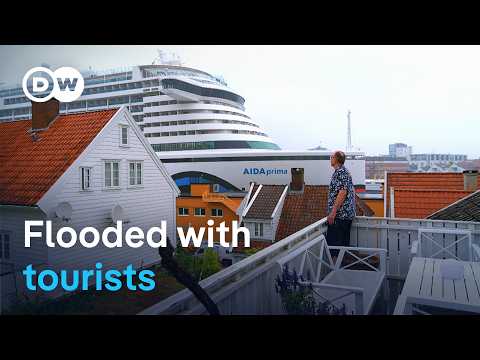
[0:01]Norway's stunning landscapes and breathtaking views are not the secrets they once were. Social media has long been drawing tourists in search of the perfect photo. In peak season, you can wait in line for almost an hour. Cruise ships drop tourists off right on the locals' doorstep, interfering with their quality of life. It's hard on your psyche. Cities like Flom and Bergen are overflowing with tourists. It's really, really crowded here. And even remote places are suffering the consequences of overtourism. It needs to be regulated. If not, the experience to travel to Norway will, will not be good.
[0:54]This is Stavanger in Southern Norway. It's morning, and already the city's central campsite is bustling with activity.
[1:05]Here's the Wi-Fi password. Check-out is at 1 p.m. The gate closes at 9 p.m., so your campervan has to be at the campsite by then. Isabella Gustavson, who has German relatives, has been working here at the campground for three weeks during her school break. My mother also worked here and I wanted to earn a little money for the summer. New guests arrive by the minute. You can't reserve a campsite, so if you arrive late, you're out of luck. In summer, in July, it's always very busy and there isn't much space, so we have to turn some people away. If you want to secure a spot, you'll need to get there before 3 o'clock, like Ivonne Teppert and Robert Solmen. They've just arrived from Germany with their son. I've driven about 1,400 km and we've just arrived. First we're going to unpack everything, then we'll take a look around the campground. This is the couple's second time visiting Norway.
[2:16]We were here six years ago, but it was a motorbike tour and we were mainly interested in nature. This time we said let's take the camper and take in the sites and cities. On their way here through Southern Norway, they could already notice it was far busier than their last visit. We were actually lucky to get such a good spot, because it fills up quickly now that it's July. Campground owner Per Arne Haar says the surge in visitor numbers is partly due to the exchange rate. The Krona dropped against the Euro and it was suddenly much cheaper for Europeans to come here, because it's usually quite expensive.
[3:04]It's still expensive, but almost 30% less than usual. That's welcome news for Yvonne and Robert. Their campsite will cost just 43 Euros per night instead of 56.
[3:21]One of the major attractions in Stavanger is the Preikestolen, a clifftop that can only be reached on foot. The 8-kilometer hike is on Robert and Yvonne's bucket list. Their tour guide is Melanie Uhl.
[3:40]This is my third time going up there this week. Yesterday at this time, it was really full. Super busy. Today there are fewer people. If we don't run into crowds like yesterday, we'll have a really great view from the top. Hopefully, there aren't too many people up there today. There are two parking lots at the trailhead, which can hold up to a thousand cars. On top of that, many arrive by bus. To avoid the worst crowds, Melanie usually starts her tour before 8 a.m.
[4:20]I thought the start would be easier, but it'll probably get harder later, right? But so far it's still okay. Paul's not complaining and we're still going strong.
[4:35]Beautiful! Are we there yet? No. But actually, a lot of guests ask me that when we've reached this point. So there's more? Yes. Okay. But you really could think that this was it. The real view is 4 kilometers away and about 500 meters uphill. And despite their early start, the trail is getting crowded. It's definitely getting busier. The cruise ship buses are all in the parking lot now and the passengers will be coming up behind us. So the later it gets, the busier it gets. Melanie offers her tours to cruise ship passengers or privately via social media. She used to work in the cosmetics industry. When she moved to Norway with her family, she changed careers. Her biggest challenge is being responsible for those on her tour.
[5:33]Of course, on every hike you worry, will everything go well? Will there be any incidents? But we have a first aid course every year, so we're prepared for emergencies. If there is an accident, a team of rescue volunteers stand at the ready. They're based about two kilometers above the trailhead. Today, Jannike Maeland and Anna Olsen are on duty. When the helicopter can't fly due to the weather, which is often the case, we have to carry all the equipment up and then we transport the injured people down. It can take up to 4 hours to bring injured hikers down the challenging terrain. Often, hikers underestimate the route. People often come not fully prepared. They think it's a walk in the park, but it isn't. We've improved the trail, but it's still a mountain hike. So you have to dress appropriately with good footwear. Ideally, you should wear boots with ankle support. Some people wear Crocs or slip-ons. They're thin and smooth on the bottom so it's easy to slip and break an arm or a wrist. Over the last three years, the number of visitors has risen sharply, as have the number of rescues, which can be up to 40 a year. Some days are worse than others. But there are days with multiple calls. There was one day when we had five or six calls, with everything from a heart attack to a dislocated knee and broken joints. It was a very long day on the mountain. Fortunately, falls or fatalities are rare. Tour guide Melanie advises her tour groups to come well prepared.
[7:38]The hiking trails in Norway are very different from those in Germany. They're much steeper and much more dangerous. A lot of people underestimate them because they're so different from what they're used to. People want to get down quickly, they want to get up quickly. Yes, some are practically jogging and they push past you. Yes, it's quite something. We're looking forward to getting there. After 200 meters more, they've made it and are rewarded with views of the Norwegian mountains and the Lysefjord.
[8:13]On the final section of the hike, the crowd squeeze onto a narrow path.
[8:23]Everyone is eager to reach the lookout, towering 604 meters above the fjord. Looking down is quite something. Awesome. Indescribably beautiful view.
[8:40]Yes, it was definitely worth it. You don't get a view like that every day. But you do have to share it with hundreds of others. I see crowds of people coming up. They stand in line, take their photo at the front and go straight back down again. In the high season, you sometimes have to wait in line for almost an hour to get that perfect picture. Not worth it for Yvonne and Robert. I think you have to take a photo, but not at any price. So, moving a couple of meters to the left of the actual peak, Melanie captures a beautiful photo of Yvonne, Robert, and Paul. All the activity with crowds at the peak presents several challenges. To assess whether the experience is diminished by the hordes of visitors, a survey is being conducted and evaluated by Helge Kjellevold and his team. We ask about the condition of the path, litter, and the overall experience. And yes, we see that on days where more than 5,000 people go up, satisfaction levels go down. Helge says 6,000 tourists in one day is the most the mountain can handle. In Norway we have the right of public access, so you can't stop people coming. There's a big ongoing debate on what to do if too many people come and it becomes unsafe. We don't have a solution yet, but it's something we're very concerned about. The right of public access in Norway grants free access to nature. You can freely hike and camp as long as you respect the environment and private property. The only limiting factor here is the available spaces in the parking lot and the 25 euro parking fee. We prefer that tourists stay longer and experience our culture and nature more fully. Cruise ship passengers contribute massively to Stavanger's crowds, with over half a million passengers sailing in every year. The most popular mooring spot is right below Gamle Stavanger, the old town center, much to the chagrin of residents like Ingrid Fjose.
[10:51]We're right by the sea. You have a wonderful view and then there's that. Just 40 meters in front of her house. Here it is, my wall, my new wall. It's there, sometimes from 7 to 7, and sometimes from 7 to 5. Sometimes 10 to 8. So all day, every year, April to September, they come almost every day.
[11:31]An unbearable situation for Ingrid. It's hard on the psyche. It's very strange. Some days it's so loud, the whole house vibrates. I can feel it. There's a kind of roar sound. And one day, I was in the kitchen and I wanted to open the kitchen cupboard to get the dishes out.
[12:07]Right now, you can't hear it, but I can show you.
[12:23]She finds it incomprehensible that the ships are allowed to dock here at all. You can't put such a giant in such a small harbor.
[12:35]She wants to see a ban on ships mooring directly in front of the old town center, and she's not alone. Her neighbor, Knut Redalen, who's lived here for over 30 years, is also fed up. We don't have a normal life. We're on display, a little Disneyland. It causes stress. Sometimes, when they turn on the loudspeakers, you wake up in your bed and you wake up to, Good morning, it's Stavanger.
[13:13]It's intrusive. It's crazy. Sabine Westner has been living in the town center for 3 years. She says the ships run their engines all day and create terrible exhaust fumes. You can see that these beautiful white houses are getting dirty over time because of the soot, of course.
[13:35]You could wash your house nearly every year. If it gets too much, people will just move away. The Airbnbs will come and it'll all deteriorate. There'll be no more beautiful flowers and decorations and everything. It won't be the same. Yes, exactly. I agree. And then no one will take care of your beautiful rock garden anymore. The residents are already in talks with the city. In response to our query, the city says the number of ships has already been reduced and that noise and exhaust emissions are being monitored. In addition, a new port outside the city center is planned for 2035. Knut hopes the ships will disappear sooner. Tourists are welcome, but not such large ships and not so close. Away from the cities and hotspots, you can still enjoy Norway's unspoiled nature. The Folgefonna Glacier is Yvonne and Robert's next destination. Only 19 kilometers from the Fjord here, going up, up the valley, up all the way up to the glacier. Åsmund Bakke has been a glacier guide for 25 years. Before he allows tours onto the glacier, he makes sure they are well informed. Norway's expanding tourism is also having an impact here. We have seen dramatic change on the glacier, which means dramatic change in the climate. This is definitely due to human activity and driven by the CO2 and so on. And then when you talk about cruise ship, then that's one one factor. But the Norwegian government has just postponed the planned 2026 emissions ban for cruise ships to 2032. Åsmund is concerned about the rising visitor numbers.
[15:31]If you have too many people in one area, it actually, it's not it's not good to be there. People need to go to toilets, people need food, we have the primary needs. And if you put too many people in one place, you cannot get the primary needs. And so that's it needs to be regulated. If not, the experience to travel to Norway will, will not be good. Finding the right balance is a challenge for everyone here in Norway. Many people make their living from tourism. But if it gets out of hand, the experience of both visitors and residents suffers. Despite growing demand, Åsmund and his team only offer tours in small groups of up to 10 people. I think this will be really cool.
[16:24]Hi, Hi. Yvonne, welcome to Folgefonna. Hi, Robert. Hi. My name is Rasmus. A little bit nervous? Yes, I'm very nervous. You don't have to be nervous, it's very safe to do glacier hiking here. Yes. Children aged 10 and up are allowed on the glacier. Robert stays back with Paul, while Ivonne gets ready for the glacier tour. You can already see where we'll be going. It looks adventurous, but I think I can do it. Covering 154 square kilometers, the South Folgefonna Glacier is Norway's third largest on the mainland. The tour costs 100 Euros per person and lasts about 5 or 6 hours. In addition to experiencing a glacier up close, hikers get a lesson in glacier formation.
[17:15]The glacier ice, it is actually made because of the snow. When the snow falls down in wintertime, the weight of all the new snow will sort of push down on layers from previous years. Within about 10 years, ice reforms on the glacier. But if there's less snowfall or if the snow melts due to climate change, the glacier will slowly shrink. Hi, guys! Look where I am, right in the middle of a glacier. It's unbelievable!
[17:46]In addition to its significance for the climate and for tourism, the glacier is also a natural water reservoir for the region.
[18:20]But preserving the glaciers will mean urban centers in Norway will need to make some changes. Due to the flood of tourists, the coastal city of Bergen enters crisis mode in the summer.
[18:37]July and August is peak travel season when most people come. It's school vacation in many European countries. In Germany, but also in Spain. A lot of guests come from there as well as from France and Italy. Bergen hosts about 3 million tourists overnight per year. On top of that, it hosts more than 600,000 cruise passengers every year. So you can see very clearly that tourism and cruise tourism is very important for Bergen and the region. Many people work in tourism, including me. In fact, more than 13,000 Bergen residents work in tourism. One of the major employers is the company based on Mount Floyen. The funicular railway is one of Bergen's most famous tourist attractions. But it's just an everyday mode of transport for Chef Bjarte Finne.
[19:30]I have to weave my way through here. There are so many people. It's not exactly the easiest delivery.
[19:38]But it is the easiest and fastest way up the mountain. We try to make as many deliveries as possible by rail. We don't want to have too much traffic up there, trucks or cars. And it doesn't take long, only 5 minutes. The round trip costs just under 16 Euros. Every 15 minutes, the rail can bring 120 people to the top of the mountain. Along with a stunning view, visitors can take in the shops, cafes, and restaurants at the peak. This is where we produce everything we need. We have four kitchens. This is the production area. Then we have the Brasserie Kitchen outside, an open fine dining kitchen, and the kitchen for parties and celebrations upstairs. 33 people work here in the kitchen.
[20:31]We can cater to between 600 and 800 guests a day, not including the restaurant upstairs and the guests outside. In total, I'd say we serve over 1,000 dishes a day. In July, the restaurant sees fewer reservations, but plenty of walk-in customers, who tend to order local food, mainly fish. In a good week, we go through a few hundred kilos of halibut. Yvonne, Robert and Paul have mainly come for the view.
[21:05]Beautiful view. It's definitely worth coming up here. The train ride was pretty cool, wasn't it? Yes, it went very quickly. It was very steep, you could look out, ideal for the little ones. The family has become used to the crowds at hotspots, but Bergen tops it all. It's really, really full here and it was pretty crowded in the city. The line for the funicular was very long. You have to like that kind of thing. Tour guide Martin Piehler is used to the crowds. Bryggen, Bergen's medieval old town, is an absolute honeypot for tourists.
[22:02]In 1702 it burned down almost completely but was rebuilt. The medieval quarter is a living cultural monument. On the ground floor you've got your cafes and restaurants, souvenir shops, galleries and artists' studios. On the first and second floors there are offices for lawyers, architects and engineers. But no homes due to the fire risk. Smoking is banned in Bryggen, but people still leave cigarette butts and chewing gum in the wall crevices. Awful. I can't understand it at all. Bernt-Håvard Øyen is General Manager of the Bryggen Foundation and is responsible for its preservation. He too finds the damage senseless. It's a pity of course. This wooden structure is it's easy to make marks on them and and we see we see some of this this tags and and marks of some of them are old but some are also quite new. Some tourists have even broken off entire pieces of the wooden facade to take home as a souvenir. It's clear, the number of visitors, along with a lack of education and respect, make protecting this place a challenge. There's a increasing number of visitors coming and to avoid that this will be a even bigger problem, we we have to start thinking about how to regulate more carefully. Bryggen Foundation has floated the idea of charging admission to the historic harbor district during the summer. They don't want to follow the example of cities in Southern Europe. What we saw in in Southern Europe was of course that that the mass tourism developed uh too quick uh without uh without regulations. And that's uh that's a problem I would say. So so trying to regulate some of the the people coming here by money perhaps but also on other ways it's it's a it's a solution that might help. Recently, a visitor center has been established in Bryggen with the goal of educating tourists and teaching them to respect the place and the people who live here. The drastic imbalance between locals and visitors is on display most fully here in the village of Flåm.
[24:24]Just 350 people live here. But more than 450,000 tourists visit every year. Many, like Ivonne and Robert, take in the village by rail.
[24:36]We're just going to relax and wind down a bit for the end of the holiday.
[24:43]Leisurely schedule. Flåm is one of the most visited tourist destinations in the country. Marta Håland is the third generation to run the campground here and has witnessed its development. Today Flåm is really just about tourism. My grandparents started here with a simple apple orchard and a few tents. Then a few RVs came and in the 1970s they built the first cabins. And after that, the site just kept getting bigger and bigger. Since the cruise ship pier was built in 2000, around 300,000 visitors arrive by ship every year.
[25:32]Of course, quality shouldn't suffer as a result of quantity. But the real question is how to control it all. There is talk of a tourist tax, which you'd pay at the destination. And there's even discussion on charging admission here in Flåm. The problem is that it's almost impossible to live a normal life in the village anymore. On the other hand, almost everyone here works in tourism, including for the Flåm Railway, a trip Ivonne and Robert would also like to take. Yes, it's already really crowded here. Construction on the Flåm Railway began in 1923 to connect the fjord with Bergen and Oslo. But what was primarily intended for freight transport quickly became a tourist attraction.
[26:24]It's incredibly beautiful. You can take in the landscape and it's much less stressful than in a car. The two-hour round trip includes a stop at Hjusfossen and a performance. Huldra is a mythical creature in Norwegian folklore. After a five-minute stop, the tour continues. A little cliché, wasn't it? The singer was cool, but the view was amazing. It's just how you imagine it. What do you think? Yes, the stop at the waterfall was really cool. We didn't know they would stop there. It gave us a chance to take some photos. It was really nice. The train runs around 10 times a day and in summer nearly every train is fully booked. And while the next passengers wait to board, Ivonne and Robert's vacation is drawing to a close. We really enjoyed the trip. It was lovely. We got to see so many breathtaking sights and beautiful places. But overall, it was too busy for us. Especially at the hotspots. We prefer it a bit quieter. So, I think on our next trip to Norway, we'll take the back roads and avoid these popular routes.
[27:42]That elusive peace and quiet can actually still be found, even at the hotspots. But only in the off season, between October and April.


