[0:16]E ngā mana, e ngā reo, e ngā karangatanga huhua o ngā hau e whā tēnā koutou, tēnā koutou, e a kioro huihui mai tātou katoa. Indigenous knowledge has value. Indigenous knowledge has worth. Most importantly, indigenous knowledge can provide answers and offer solutions to contemporary problems. By the end of my talk, you will have a glimpse into the understanding of why. And so, my story begins at the Chathum Islands. The Chathum Islands are a group of islands that lie roughly 680 km southeast of mainland New Zealand. They are known by the Māori as Wharekauri and by the indigenous peoples of these islands, the Moriori, as Rekohu. In scale, the Chathums are roughly half the size of Stewart Island, and a home to around 600 people of European, Māori, and Moriori descent. The landscape of the Chathums itself is quite spectacular. A mixture of volcanic peaks, flat swamp lands, lagoons, and sandy beaches. But to the uninitiated, the Chathums is also coldly unforgiving. Vastly deforested for sheep and cattle farming, there are few places of shelter. The weather changes quickly and bowed trees pay testament to the strong southerlies that lash the land and churn the sea. Upon visiting the Chathum, Chathum Islands, it is easy to understand how it's solitary and isolated location provided the perfect destination for the New Zealand government to exile and imprison its enemies. For what is not widely known or widely recorded in the history of our country, is that in the 1860s, the New Zealand government utilized the Chathum Islands as a penal facility. To which they exiled and imprisoned without charge or trial, more than 300 Māori men, women, and children who they had classified as rebels or in rebellion against the crown. Now these people were not just stripped of all lands and possessions, but they were exiled from their country of birth. And it was here on the Chathum Islands, without hope of escape, that they were imprisoned indefinitely. Now, why I share their story with you now, is that their story is my story. My great-grandmother was just a young girl when she was taken from her home to imprisonment on the Chathum Islands along with her parents and her younger siblings. And it was there that she would eventually lose her mother and her younger sister. Our oral traditions still speaks of the arrival of the prison bars, the Chathum Island shores on a cold and wet winter's morning. And how the prisoners arrived to no food and no shelter, as the government of the time had deemed that these various essentials the prisoners must provide for themselves. And so, in the wet and the rain and the cold, they built makeshift shelters of fern fronds and scavenge for food to feed themselves and their children. Now, in hindsight, it is not a leap of the imagination to understand the true reasoning of this imprisonment, that they had been imprisoned to die at this place. But like so many stories of our people, dying was something my ancestors refused to do. They survived, despite everything they survived. And when I first visited the Chathum Islands in 2011, and stood at the place that my ancestors had lived and died, they were washed with emotion, this was the question which plagued me in particular. How did they survive? How did they survive a hostile environment to which they were unaccustomed and ill-prepared? How did they survive the brutality of a 17th century British penal system? How did they survive the beatings, the floggings, the rapes, the forced hard labor, malnutrition and illness that claimed so many of their lives? What beliefs and values did they draw upon to survive in the darkness of their imprisonment? Now it was in contemplation of this question and others that I came to certain specific cultural understandings. Understandings of the principles I believe my ancestors utilized to survive their imprisonment, and principles which still have contemporary application and can contribute towards positive change in our lives and in the lives of others. But firstly, to understand these principles, we must understand their source. Now, my ancestors looked to the natural world, then our environment as the greatest teacher. They did this in the central understanding that their environment that surrounded us had evolved over billions of years and was operating in a state of perfection. All we needed to do was to watch and observe and incorporate those teachings, that wisdom, that truth into our lives. In doing so, my ancestors created unique knowledge systems. Knowledge systems based upon the natural flows and rhythms of our environment. Knowledge systems which place collective and spiritual well-being ahead of individual and material need. One such example was found in the flight of the Kuaka. Now the Kuaka is renowned as having the longest flight path of any bird on the planet. Flying from Alaska to Aotearoa, New Zealand every year, covering more than 17,000 km and flying non-stop for 8 days, without food, without water, without rest, without sleep. Now, the flight of the Kuaka has brought international scientific inquiry to our shores. Focused specifically upon how such a small and inconspicuous bird accomplishes such a momentous task. Now, when my ancestors looked to the Kuaka, they observed that it flew in a V-shape formation, which they named Te Kahu. They also observed that a singular bird leads this flock, which they named Te Manutuki, Te Kahu or the leader of the flock. But most importantly, my ancestors recognized that this leader does not lead for the duration of the flight. But rather, when fatigue sets in, this bird falls back and another bird rises to that place of leadership, their position of leadership. Therefore, my, uh, my ancestors understood that the Kuaka does not traverse immense distances, based upon the strength, the will, the drive of the one, but the collective strength, the collective will, the collective vision of the whole. Through examples such as the flight of the Kuaka, my ancestors defined three distinct principles. Principles that enabled a people to collectivize, to unify for common goal and common purpose. The first of these principles and most important is Kawa. Kawa may be defined in this instance as the guiding philosophy. The collective aim, the communal goal, that dream, that vision you aspire to achieve. For those prisoners on the Chathum Islands, this was merely survival, to survive the brutality of their imprisonment. This was the vision that collectivized them, this was the goal that unified them, this was their light and their darkness. In a contemporary context, Kawa may be the well-being and prosperity of your whānau, your family. It may be social or political change, but whatever it may be, Kawa is where the deep thinking must take place. For this philosophy will lead and guide every aspect of practice and endeavor that follows, and without a clear and defined vision, you were lost from the beginning. The second principle is Tikanga. Tikanga may be defined in this instance as the practice which supports the guiding philosophy. At the core of Tikanga are collective beliefs and values. Collective beliefs and values of which my ancestors had many. Collective beliefs and values are vitally important because they inform attitude and behavior and ensured that whatever endeavor was undertaken, it was undertaken in an ethical and moral way. Collective beliefs and values were vitally important for those prisoners on the Chathum Islands, for though they were from different tribes, they shared this common knowledge base. So when they engaged with their skills and their abilities, they engaged the same way. In a contemporary context, we all understand how easier it is to accomplish a goal when the people you work beside believe the same things, value the same things, aspire towards the same things. The third principle is Kaupapa. Kaupapa may be defined in this context as the utilization of these beliefs and values for specific endeavor. For those prisoners on the Chathum Islands, this was merely the everyday struggle for survival. Food, shelter, clothing, medicine. Perhaps in a contemporary context that is not too dissimilar, but what must be understood is that every endeavor undertaken must contribute towards the guiding philosophy. And though I have discussed these principles in isolation, it must be understood that they operate in unison. And seamless unison, and the intangible bond which connects them all is Waitapu, spirituality or the power of the spirit. My ancestor's spirituality was based upon the centrality and sacredness of life itself. That all life had value, that all life had worth, and most importantly, that we were connected to all life through a multitude of universal kinship ties. In a contemporary context, this spirituality of connection may be understood as a deeper feeling or understanding one has when one is focused in mind and body on a specific endeavor. An endeavor which takes us out of ourselves and connects us to others. Ideals, causes, movements, social momentum, this feeling, this understanding is a spiritual connection. And so these are the principles I believe my ancestors utilized to survive their imprisonment. Principles which teach the importance of being unified in mind, body and spirit to accomplish any great deed. And this is but one example. One example of thousands of examples held within our indigenous knowledge. Answers which are knowledge which offers answers, solutions and alternatives to contemporary problems. And I believe that now, now more than ever, our world is in need of solutions and alternatives. And I believe that this is an awakening, a realization that is happening globally. As globally people are realizing that the systems put in place by the dominant powers are broken systems. They are corrupted systems. They are systems that have caused global economic poverty and inequality. Global environmental degradation and exploitation. Globally, people are realizing that the answers to these problems cannot be found in the same knowledge that created them. And this is where indigenous knowledge has value, this is where it has worth because it is founded upon different principles. Principles which favor connection rather than isolation, which favor protection rather than exploitation, principles which offer change, principles which offer hope. Now, of course there will be those that question the value of the knowledge that I have shared, that question the worth of its contemporary application. And in response to these doubts, what I failed to mention at the beginning of my talk was that my ancestor's goal was just not to survive their imprisonment. It was to escape their imprisonment. And in July 1868, after nearly three years of imprisonment, led by the Māori warrior prophet Te Kooti Arikirangi Te Turuki, the prisoners arose in unison. Subduing the prison guard and commandeering the supply ship, The Rifleman. And despite the brutality to which they had been subject, there was no violence. There was no arson, there was no looting, there was no retribution of any kind. And three days later, on the 17th of July, 1868, the Rifleman anchored in the sheltered Cove of Waipiro Bay, on the East Coast of the North Island. Carrying in its hold and on its deck 290 elderly men, women and children, their entire prison population of the Chatham Islands. Our oral tradition speaks of how the prisoners leapt from the long boats to the shore, weeping and caressing the land as if a long lost loved one they never hoped or dreamed that they would see again. But they had returned. United in mind, body and spirit, they had survived their imprisonment. They had found their freedom. And most importantly, they had accomplished it together. No one was left behind. Now, at the beginning of my talk, I said that this was my story. But this is not just my story. This is our story. For this is but one of the many threads that make up the fabric of the collective history of our country. And my ancestors struggle and sacrifice for justice and for freedom, it deserves to be acknowledged, it deserves to be remembered. And we are no less of a people or a country for having done so. For an acknowledgement of our past, its symbols and intent for the present, and encapsulates our collective hopes, dreams and desires for the future. So in the closing of our story, I would like to share with you the words of my ancestors, whose teachings and wisdom I have drawn upon throughout. My ancestors who stand here in spirit with me now, these are their words. The words of the past to the generations of the present. He kōputahi tātou, he tāwhana he tāngata. Whiringa nuku, whiringa rangi, te whātia e te whātia e. We are born of the same womb, tied in the bonds of humanity. Tied to the heavens above us, tied to the earth beneath us, these are bonds that can never be severed. From this life, unto the next, we are but one family. Nō reira e te iwi, pāpā ki Kawa, Ngaru Aotearoa Nui a Kiwa, tēnā koutou, tēnā koutou, huihui mai tātou katoa.
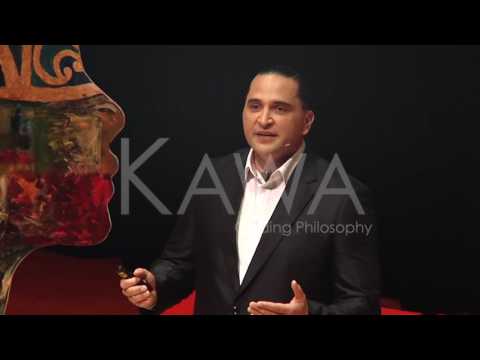
Indigenous Knowledge Has Value | Curtis Bristowe | TEDxRuakura
TEDx Talks
16m 35s2,201 words~12 min read
Auto-Generated
Watch on YouTube
Share
MORE TRANSCRIPTS