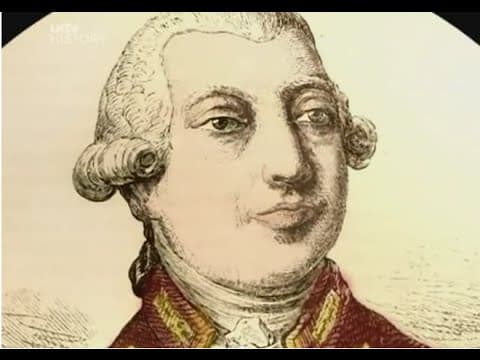
[0:11]The story of the Kings and Queens of England is more surprising than you might think. It's a fine drama, a thousand years of tales of lust and betrayal, of heroism and cruelty, of mysteries, murders, tragedies, and triumphs. And it's also quite unlike the history of other countries' royalty. The thing about the kings and queens of England is that they're totally different from anywhere else, which probably explains why they're still in business when almost everywhere else, they've either been given the chop or have stopped being regal. This program looks at England's monarchs from the death of Queen Anne to the accession of Victoria. Well, Britain's monarchs actually. And if you look at Europe at the start of this story in 1714, you'll see just what I mean. A European king is an absolute ruler, Louis XIV, Peter the Great, Philip V of Spain, Frederick William of Prussia, all men of unlimited power. It's not like that in Britain. Queen Anne has died. There are no Protestant Stuarts left. The Protestant line to the English throne now passes through James's granddaughter Sophia, who had married a German prince with the title of Elector of Hanover, and then from her to her son George Lewis, who's inherited that antiquated title. Into one quarter of the Royal coat of arms pops the amazingly complicated device of a 54-year-old German princeling. And when he comes to England for his coronation, he knows perfectly well that he's not going to be anything like those other rulers. He will be almost powerless. So it really doesn't matter that he can't speak a word of English. At the opening of Parliament, King George stood in silence while his words were read by the Lord Chamberlain. The crown that had belonged to Normans, French Plantagenets, Welsh Tudors and Scottish Stuarts had now passed to the German Hanoverians. The new king's son, George Augustus, arrived from Herenhausen to take his seat in the House of Lords as Duke of Rossy, heir to the throne. Before leaving Germany, he proudly declared, I had not a drop of blood in my veins which is not English. Rossy, of course, is a Scottish dukedom. George Augustus did share one trait with his father's English subjects, a hearty dislike of King George and for the same reason. 20 years before George became king of England, something very mysterious had happened to his wife's best friend, the dashing Count Königsmarch. His wife, Princess Sophia Dorothea, had come to detest her husband, who spent his time either engaged in endless European wars or enjoying his various mistresses. Königsmarch tried to help her escape from Hanover, he failed. The count simply disappeared from the face of the Earth. Actually, his body was shoved under the floorboards of the princess's dressing room, and the princess was banished and imprisoned. Her son George Augustus never forgave his father. In fact, father son detestation would be the defining mark of the Hanoverian dynasty, they thrived on it. The English weren't too keen on that sort of behavior either. They might have been more sympathetic if they'd approved of the two mistresses that George brought with him. But they called them the Maypole and the Elephant and decided they were simply greedy Germans with their snouts in the trough. And there were Scottish noblemen who thought that with George lacking support in England, this might be an opportunity to hand the throne back to the Stuart family and in particular to James II's son, living in France and known as the Pretender. The French thought this would be a great idea. Louis XIV's mistress, Madame de Mantanon, even presented him with a song to be sung on his accession. It had originally been written for Louis to celebrate his recovery from a surgical procedure on his bottom. She translated it for the man who should she thought be James VIII of Scotland and why not James III of England. God save a gracious King. Long live a noble King. God save the King. The song turned out to be a bigger hit than the man. Jacobite Rising of 1715 was a complete flop. And after spending a couple of months wandering around the Highlands, James went home to France. George's throne was safe. He spent every winter in Hanover and left the government of England to his ministers. His own work was done by a new figure, the Prime Minister, a politician acting as a king's substitute. The first man to take on this role was Robert Walpole. Since Walpole didn't speak German, the pair of them communicated in schoolboy Latin. King George died a sudden death in 1727 while in Hanover, aged 67.
[5:39]His son was living in Richmond, forbidden by the old man to take any part in court life or even to see his own children. When Walpole came with the news of his father's death, George II appears to have regarded it as a wind-up. That is one big lie. But the outcast prince was indeed now George II by the grace of God, King of Great Britain, France and Ireland, Defender of the Faith, Elector of Hanover, Duke of Brunswick Luneburg and Duke of Zella. When he'd been convinced, he came here to Leicester Square. At the time it was Leicester House where he'd been running his own court. And here he was attended by the Archbishop of Canterbury, who formally presented him with his father's will. Royal wills had once been the most powerful documents in the world. When William the Conqueror and Henry II died, their wills established who would rule after them. George took his father's will and instead of opening it, shoved it in his pocket. It was never seen again. To the great disappointment of his father's mistresses. George II's wife, Queen Caroline, had very firm ideas on what should happen next, and her husband was quite obedient. The result was that everyone who'd been hoping for their own promotion in a changed government was disappointed. Walpole remained Prime Minister, he'd promised her that she would get a personal grant of 100,000 pounds a year, double the offer his opposition came up with, and very little actually changed at all. That included the traditional hostility between anyone called King George and his son. The son in question was now, of course, the son of George II, Prince Frederick. According to Queen Caroline, he was the greatest ass, the greatest liar, the greatest canali and the greatest beast in the whole world, and we heartily wish he was out of it. She would have said it in German. George agreed with the Queen and refused to allow Frederick to marry Princess Wilhelmina of Prussia on the entirely sensible grounds that, I did not think that crafting my half with cock's come upon a mad woman would improve the breed. Prince Frederick's view of his father was by contrast quite balanced and objective. He's an obstinate, self-indulgent, miserly martinet with an insatiable sexual appetite. Obstinate, yes, self-indulgent, a fair point. Miserly, well, he had slashed Frederick's allowance to make him less of a social rival. Martinet, well, certainly a man of relentless and determined regular routine. And the sexual appetite, we assume that is his right. For instance, he began seriously lusting after the beautiful young wife of the Count of Wollmoden when he met her in Hanover in 1735, and he told the Queen that, You must love Valmoden, for she loves me. The popular view of the king was that he was a Randy buffoon. He seems to have been flattered by the jokes about his sexual efforts. As his father had once done, Frederick ran his own alternative court, which was far more popular than the King's. King George II didn't like that. My God, popularity always makes me sick, but this makes me vomit. The pair of them even patronized rival operatic outfits, the King and his entourage went to see Handle at the Haymarket. Handle had written George's Coronation anthems, his music was grand and glorious, altogether suitable for magnifying the greatness of a self-important royal personage. God save the King. God save the King.
[9:44]The prince and his crowd stayed away, they went instead to the Theatre Royal in Lincoln's Inn Fields. That was where opera was being transformed into popular musical theater. The biggest hit was the Beggar's Opera, a vigorous tale of the criminal classes, which lots of people said was intended as a satire on the court and Walpole's government. When you sentence you each, be cautious and sage lest the court shall offend it should be. If you mention vice or bribe, it's so pat to all the tribe, each cries, that was leveled at me. It was all very entertaining, watching royalty playing out their family quarrels, but they were not quite reduced to the level of powerless performers. King George was a fighting man, like his father, head of the army, and very much engaged in the quarrels between the rulers of Continental Europe. Walpole tried hard to keep him out of wars, but in 1739, the King got his way, and England went to war with Spain. This was the start of a steadily growing involvement in the power struggle between France, Prussia and the Habsburg Empire. Its culmination for George came in June 1743. He found himself under attack by the French at a German village called Dettingham. His horse bolted, but George stood in front of his troops, waved his sword, and made a rather ponderous but actually rather brave little speech. Now, boys, now for the honor of England, fan behave bravely on the French was soon run. And so he became the last English king to lead his troops in battle. It was a fierce fight and George emerged a bit of a hero. But he didn't rule the country. Governments and ministers came and went, not because he wanted them, but because Parliament wanted them. In fact, George called himself a prisoner on the throne. In 1745, he played no part in the battles of Preston Pans or Culloden, which were far more important to the throne than the battle of Dettingham. After all, they were battles for the throne itself. The cause of King James Stewart, the King who'd fled from William of Orange in 1688, had never been forgotten by the Scottish Highlanders. Its supporters, supporters of a Roman Catholic monarchy, were called Jacobites. The Latin for James being Jacobus. James's son, the Pretender, had tried and failed to take the throne in 1715, and now 30 years on, he was known as the old Pretender. His son Charles, born in Rome, was the young Pretender. Bonnie Prince Charlie, to his supporters. Charles Casimir was 25 years old, pale, thin, romantic and brave. And he decided that George was so unpopular, it would be a dodle to take over. He turned up at his own expense in the Hebrides and summoned the Scottish clans. Most of them responded, but out of a combination of loyalty and desperation, rather than conviction.
[12:54]But things went rather well for the rebels. They were enthusiastically welcomed into Edinburgh and proudly defeated the Government Army at Preston Pans. The news created a passion of patriotism when it reached London. The city might have lamponed the court and sneered at it, but this was different. That evening the King was visiting the theatre, the King's Theatre Drury Lane, and the orchestra struck up a tune which they'd just got hold of. God save the King. The audience loved it. None of them knew that it had been the old Pretender's music, or the King of France's. The song had changed sides and became the national anthem. Actually, it became everybody's anthem at one time or another. Frenchmen, Germans, Russians, Swiss, Liechtensteiners, Swedes, Danes, and Americans have all swelled with patriotic pride to exactly the same tune. But when God Save the King became London's big hit, it was because no one could see how the King would be saved any other way. Marshall Wade, the best officer in the Government army, said that Scotland was lost and England would fall prey to the first comer. Lord granted Marshal Wade me by thy mighty Aid, Victory bring, may he sedition hush and like a torrent rush, Rebellious Scots to Crush. God save the King. The rebels took Manchester, then Derby, London trembled, but not as much as the clansmen. They'd marched expecting England to rise in their support and the French to invade. Instead, they had no support at all. Most fundamentally, they realized that the English would never accept a Roman Catholic King.
[15:08]They'd outflanked a large English army, but it was now on their tail, and another was coming up from London. So back they went, and the clansmen were finally slaughtered in their thousands at Culloden in April 1746.
[15:25]Charles hid out for months in the Scottish Highlands, hunted through the mountains by troops and with a price on his head, but protected by tribal loyalties until he finally escaped back to France. And the clan culture of the Highlands was systematically and ruthlessly extirpated. Clans were dispersed, their leaders imprisoned or executed, plaid and weaponry and bagpipes were banned. The would be Charles III made a bizarre secret return to England in 1750, where he converted to Protestantism and expected this would encourage his supporters to have more hope. They were more impressed by his degree of attachment to the bottle. Not so much the king over the water, as the king under the table. King George was in no danger now.
[16:14]George also found his other great enemy removed. His son Frederick died in 1751. He'd been hit hard in the stomach by a tennis ball and the resulting abdominal ulcer burst and killed him.
[16:27]The new heir to the throne was a 12-year-old child, Frederick's son, George. But the great problems of the kingdom were outside the King's grasp. His country was now a great imperial trading power with huge involvements in India, the East Indies, North America, and the Mediterranean. So was France. At the same time, Continental Europe was constantly boiling over into war, and Hanover was in the middle of that. In 1756, the great powers finally locked horns in a do or die struggle that would girdle the whole world. This would become the Seven Years' War, it was truly the First World War. Britain fought in the name of its king, but that king now neither directed policy nor took part in the battles. A new world. In fact, affairs were so far out of the King's control, that when he dismissed ministers he didn't like, they came right back again. So far as the English were concerned, this was just how things ought to be. Englishmen were entitled to liberty. The despots were on the other side, Catholic France and Austria. Their whole life, commerce, industry and fighting force was directed by royal tyrants who ruled over starving and powerless peasants. And on the other side, Protestant Britain, whose commerce was run by men of business, whose industry was directed by free tradesmen, whose army and navy were run by heroes, and manned by proud freemen, and whose court was the center of society, not of autocratic power. And that was how many of the British really did see it. Of course, they were also fighting despotic Prussia. But that was a minor detail. The general perception was that this was a war of free Britain's against European despots. Poor George died at the height of the war in 1760, and it didn't matter at all.
[18:42]His grandson, now George III, was 22 years old. He had been brought up by his mother, a German princess, in her imitation of the very deferential court of Hanover. He learned the European idea of what a king should be, an enlightened despot, whose power was absolute and was to be used for the benefit of mankind. This was, of course, very far from the English notion of kingship, in which the King was the leading figure in society, but whose power was entirely controlled by Parliament. He immediately set to work as a bossy, quick speaking managerial king, deliberately foolish, I will have no innovations in my time.
[19:27]What, what? He read widely, he was fascinated by machinery and agriculture. He was a man delighted by the agricultural and industrial revolutions, and he was determined to restore the crown to what he saw as its proper position. A position abandoned in his view by George's one and two. Unlike them, he'd been born in England and spoke good English, even if his grasp of grammar was ruy, and he had no old or young pretender to challenge him. At the opening of his first Parliament, he declared, Born and educated in this country, I glory in the name of Britain. Parliament was controlled by one party, the Whigs, effectively an oligarchy of rich men who ran the country by a system of bribery, patronage, and nepotism.
[20:17]George felt that it was his job to improve matters. And so began the most catastrophic reign since James II. If it hadn't been for George III's attempt to turn back the clock, the inhabitants of New York might still be using British passports.
[20:34]And the inhabitants of Los Angeles and Miami, Spanish ones. Now there's a thought. To break the power of the Whigs, he set about creating what was almost his own political party, a group of MPs known as the King's Friends. He took back the power of distributing positions and favors from the government and did it himself. So he soon built up a collection of political dependence. His first objective was to bring an end to the war. He didn't at all share the anti-French views of the wig Prime Minister William Pitt. It took a lot of political manipulation, but in 1763, with Pitt removed from power, a peace treaty was signed. By this stage, the war had actually been won. Pitt's policies had resulted in Britain becoming the dominant colonial power in the world. Britain was more or less undisputed ruler of North America, India, the Caribbean, and much besides. And George took the credit, the glory and tried to take control. End of the Seven Years War in 1763, the King of England ruled over more of the world than any man since Gengis Khan, an empire about five times larger than Rome. Of course, he wasn't in the position of an Asiatic tyrant, or even your common or garden European despot. His control would have to be through Parliament. His power was limited to choosing ministers, and even that wouldn't work if Parliament and the country wouldn't stomach him, as George kept finding out. His solution was to do all he could to increase his own influence in Parliament, in effect, get stuck right into political intrigues. Since it was illegal to report parliamentary debates, people became very suspicious of what was going on. He spent huge sums on trying to influence elections, and would even personally go out canvassing. On one occasion, for instance, bustling into a draper shop, saying, the Queen wants a gown, wants a gown. Announcing who to vote for and rushing out again. And since George was closely engaged in politics, people naturally blamed him personally when things went wrong. When Parliament rejected a bill that would have helped the Spittlefields weavers, the weavers marched off to find the King at Wimbledon. Shades of the peasants revolt. George listened to their complaints and persuaded them to go back home. But when they realized he wasn't going to help, they rioted, and he personally ordered out the troops. He said he would put himself at the head of the army or do anything else to save his country. He also had a hand in creating the notorious Stamp Act of 1765, which tried to make the English colonists in America pay a tax on paper. This was the moment at which the whole language of politics began to change. One Virginia colonist declared, Caesar had his Brutus, Charles I his Cromwell. May George III profit from their example. The Cromwellian revolution of the previous century had certainly been driven by the connection between taxation and liberty. The issue now was that the 13 English colonies in America had their own governments, run by their own local oligarchies, and raising their own taxes. The idea that they could be taxed by the oligarchy in London, headed by the King, was totally outrageous. They would have no way to influence what was done or what they had to pay. Colonists who supported the Government were threatened by their compatriots, some were tarred and feathered. And by the time the act came into effect, there wasn't a single person who'd accepted the job of commissioner to collect the tax. It had to be repealed. There was similar alarm in England as in his attempt to control Parliament, George arrested his leading critic there, John Wilkes. Mobs rioted in the name of Wilkes and Liberty and threatened the King. Wilkes was released and it was established that there was a legal right to report and criticize what happened in Parliament. But by 1770, he had created the political system he wanted. The political parties had collapsed, and he had a docile Chief Minister, Lord North, with a parliamentary majority, through whom he could run things the way he thought they should be. George liked running things, popularly known as Farmer George, he took a very close interest in modern farming methods, developing animal breeds and new crops. These were the same modern farming methods, which by enclosing common lands and creating large self-contained farms, were breaking up village communities all over England and creating a new class of half starved landless wage laborers. Bad harvests didn't help, nor did a collapse in trade. The colonists in America were showing their anger by refusing to import anything from Britain. Lord North decided the best thing to do was repeal all the taxes on them except for a symbolic tax on tea. Three years later, he arranged another act of Parliament to try to help the East India Company sell more tea in America. And radicals in Boston retaliated with a symbolic tea party, at which men dressed as Native Americans dumped the tea in the harbor.
[25:57]The reaction in England, stirred by the popular press, was that the colonists must be punished. George certainly shared that view. Blows must decide whether they are to be subject to this country or independent. Misunderstanding the strength of feeling and of organization against them, the government tried to use too little force and triggered a full scale rebellion. The rebel colonists proclaimed their independence in 1776. And with the backing of a large part of popular opinion in England, George was determined to fight them and crush them. The result, as many less warlike Englishmen had been warning, was disaster for England. Even Lord North wanted out, but George was in charge. The American Revolutionary War became a campaign not against unjust government or English rule, but against the very principle of monarchic government. George's determination to be active in government and place himself at the heart of politics created a new Republican movement, a language in which to attack the rule of kings. The Peace of Versailles in 1783 forced Britain to recognize the United States of America. Six years later, their host at Versailles, Louis XVI of France, was himself called on by a revolutionary crowd, who carried him off and set up their own republic. The process of destroying monarchy was underway. Did George understand what he'd done? He certainly fretted about the American disaster, and perhaps it was his own sense of failure that made him display signs of mental disturbance in 1788, talking incessantly and behaving oddly. His doctor thought making him bleed would help. When that failed, the Prince of Wales took over the treatment.
[28:11]The royal physicians blistered the King's forehead to draw the poison out of his brain, forced him to take useless drugs, ordering servants to sit on the King when he resisted, and refused to let him have a fire in his room during the terribly cold winter. All this, when the country was anticipating French invasion, and radical and volunteer regiments were being formed as a desperate line of defense. Very desperate. Finally, new physicians were brought in who gave the King gentler treatment, and he recovered. In 1801, before the arguments over how the regency would function had been resolved, the King was back in charge. But not in the way he had been. The American defeat had been a personal disaster for him and dramatically weakened his political position. In an effort to reassert it, he'd installed a 24-year-old as Prime Minister and Chancellor of the Exchequer, thinking that here at least was a politician he could control. But William Pitt's son, Pitt the Younger, was shrewd, capable and fully understood that George depended on him. So he held all the cards. And it was Pitt who had to decide how to deal with the spread of revolutionary Republican ideas from America and France into England. The same ideas that had been voiced in America about no taxation without representation were being heard in England, where huge new manufacturing towns had grown up, which had no member of Parliament. Three years after the French Revolution, political reform societies called Corresponding societies were founded in England. Riots were breaking out in the Midlands, in East Anglia, in Scotland, attempts were made to kill the King. He was booed and stoned in London. And the French legislature passed a fraternal decree offering aid to all people seeking to throw off the chains of tyranny. Once war began with Revolutionary France, political radicalism was plainly treason, wasn't it? The Government decided on a policy of aggressive repression. Habias Corpus was suspended. People could be imprisoned indefinitely without trial. The Government charged people with treason for organizing public meetings calling for political reform. When they were acquitted, acts were passed which extended the definition of treason to include speaking or writing or bringing the King or his government into contempt. To back it up, a system of internal spying and agent provocateur was instituted. Postmasters were given the job of reporting to the home office anything suspicious that they heard or that went through the mail. Public meetings needed special licenses. When William Blake, the artist, found a soldier in his garden, he drove him out, shouting, Damn the King and damn all his soldiers, they're all his slaves. Bad idea. He was put on trial for sedition. The King himself was actually quite popular. He was generally seen as a kind-hearted, slightly buffish sort of a person, but he was still ultimately in charge of what was going on. And when even Pitt insisted that Catholics would have to be allowed the same rights as Protestants and permitted to stand for Parliament, George forced him to resign. The issue had come to the fore because of Ireland. If England had some potential revolutionaries, how many more had Ireland? A land where an oppressed Catholic majority were ruled by imported Protestant colonists and an ideal staging post for a French invasion. In 1801, Ireland was incorporated into Great Britain, creating the United Kingdom. It was an attempt to make Ireland more secure. The fact that at the same time the King formally abdicated his meaningless title of King of France, shows exactly where the threat was coming from. But if Ireland was to be truly united with England, there would have to be Catholic emancipation. And King George wouldn't have it. Whatever might have happened could not have been worse than what did. Ireland still bleeds now. The shadow of George III lies over the history of the world more darkly than most people realize. As with the American disaster, it seems as though one part of his mind was determined to make him feel the full weight of his responsibility, and once more, his mental state degenerated. He made a slow recovery, enough to sack his ministers in 1805 when they tried to lift the restrictions on Catholics becoming military officers. But he was becoming blind and infirm, and in 1810 his mind finally collapsed. No one's quite sure what was wrong with him, but a strain of hereditary insanity had run through the royal family ever since Henry V's marriage to Catherine de Valois. Blind and deaf, suffering from abdominal pains and dementia, his body lived on, but his reign was over. Prinney took over at last.
[33:47]He had been sent into the Navy as a young man, where he developed into a severe disciplinarian and a stickler of etiquette. After he left, he took an actress, Mrs. Jordan, as his mistress, had lots of illegitimate children, and was given to making tactless speeches with not much intelligence. He eventually had made a royal marriage to another German Protestant princess, and Mr. King and Mrs. Queen lived at Bushy to the north of London, like a quite ordinary couple. William insisted that his coronation should only cost a tenth of his brother's, and he was known to give people a lift in his carriage. All this made him rather popular, but when it came to parliamentary reform, he turned out to be as resistant as any other Hanoverian king. By now the popular pressure for changing the voting system into something more representative was virtually irresistible. Giving more men the vote, having MPs for the new towns and secret ballots. This would give the Commons more power, so the House of Lords was resisting it, and William sided with them. By 1832, there seemed a real possibility of civil war or revolution. It's possible that if the royal family were part of the aristocracy, as in every other country with a king, that would have happened. But the King and Queen had their family roots in Germany, and there was no natural alliance between them and the great aristocratic families. William was weak and was forcefully persuaded to give way, and Britain was started on the road to democracy. After the Reform Bill of 1832, with no more rotten burrows and greatly reduced scope for electoral corruption, it was no longer possible for the King to play politics inside Parliament to the same extent. The monarchy would now be forced back into its constitutional box, and it was no longer sufficiently dangerous to be worth the trouble of a revolution. When he died in 1837, William's legitimate children were already dead. The heir to the throne was the daughter of his brother Edward, a young girl of 18. She would make a demure and pretty little queen, who could leave the business of running England to the professionals.


