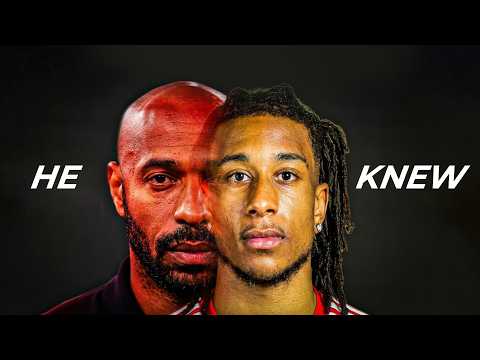
[0:00]There is a specific kind of oversight that football produces at the highest level. Not the failure to recognise talent, but the failure to pay attention to the right talent, at the right moment. But if you don't know that this guy, even at the time was a good player, then then you have a problem. But you telling me Man United didn't come for him, Man City didn't come for him. I do not understand. The sport follows the louder story, concentrates on the players it has already decided matter, and in doing so, consistently misses what is happening just outside the frame. This season, that blind spot has a name. While the conversation has revolved around Mbappé's adaptation to Real Madrid, is Lamine Yamal establishing himself as the sport's next great figure? A 24-year-old playing right wing for Bayern Munich has quietly constructed what the data now describes as the most complete individual season any wide player has produced in European football in recent memory. Not the most celebrated, not the most discussed, the most complete. And by the time this video is finished, you will understand exactly why that claim is not an exaggeration. This chart plots every attacking midfielder and winger across all six major European leagues. One dot sits completely alone in the top right corner, separated from the field, not by a marginal distance, but by a gap that makes you look at the chart twice. That is Michael Olise, 1.02 combined non-penalty goals and expected assists per 90 minutes. The highest of any wide player across all six leagues this season, built across 1,880 minutes of Bundesliga football, 19 assists, the highest in Germany, and Champions League returns of three goals and six assists across nine appearances in the Champions League, including a two-goal, one-assist performance against Atalanta in the last 16 that prompted the home crowd in Bergamo to applaud him off the pitch. Domestic dominance and European impact in the same season, is precisely what separates genuine Ballond'Or contenders from players simply having strong campaigns. Olise is producing both simultaneously. The scatterplot tells you what he produces. What it cannot tell you is how, and the how is where this becomes genuinely worth paying attention to. Olise is left-footed, on the right wing. Every defender he faces knows his movement will be inward. He used to do this one thing all the time, he does it to this day, he does like a fake shot and a ball roll. It's like you can't really stop it because it's like as a defender, you're either trying to block the shot, or you have to guess that he's going to do that. If he doesn't do that and he shoots and he scores, you like an idiot.
[2:29]If you go for the block shot, he does it either way. It is the most telegraphed intention in modern football, and it does not matter. His body is already half turned toward goal before the pass arrives, meaning his first touch is an attacking touch, rather than a controlling one, eliminating the fraction of a second defenders depend on to reorganise. The results are 157 progressive carries, 67 ending at the penalty area edge, both in the 99th percentile across the Bundesliga. He covers 120 metres per 90 in progressive carry distance, 97th percentile, under pressure in the opponent's half at full tempo. 68% of his dribbling activity occurs in the final third, where the margin for error is smallest. 99th percentile for shot ending carries. 98th percentile for carries producing a shot assist. He is not carrying to retain possession. He is carrying to manufacture a specific problem in a specific zone, and he does it more consistently than almost any wide player on the continent. The carry creates the condition for something that very few players at this level can produce with any consistency. From the right half-space, roughly 30 to 50 yards out, Olise sends the ball diagonally, curling, dropping onto the penalty spot at the exact moment a central runner arrives. Not a cross, not a through ball, something shaped purely by geometry that presents the goalkeeper with an impossible decision and the defensive line with a problem organisation alone cannot solve. 1,020 completed passes, 138 progressive, 59 shot assists, 14 goals, open play expected assists, shots assisted, and big chances created, all at the 100th percentile. Three separate creative metrics, each measuring a different dimension of output, all at the ceiling. His progressive pass completion stands at 56.3%, 89th percentile. That number is independent of who plays ahead of him.
[4:30]It reflects the quality of the delivery itself. And it confirms that what the creative numbers describe is not a product of the system. It is the player. What tends to be overlooked is the finishing. 84% of his shots come from his left foot, from that same inside right corridor, a pattern teams have studied and consistently failed to stop. 96th percentile for non-penalty goals, 98th percentile for shot quality on target. His goals minus expected goals is positive for the full season, meaning he scores more than the data predicts consistently.
[5:03]Over a sample large enough that fortune is not a credible explanation. A right winger creating at the 100th percentile and finishing at the 96th in the same season is not a profile European football produces with any frequency. And I do think for me, he's better as a ten, I will maintain it. I play him as a ten in the Olympics. But the thing is if you give him the time, even if he doesn't have the time, he sees things that you know like the pause that he takes, look at this. He waits, he has time. He always set up a great player and obviously he's coming into it, the way he plays for France, he's the number 10 for France right now. People will tell me that was the game that he had a day, he made a mistake against Iceland, he gave the ball away and they scored, but he does he's not he's not shy to give the ball, he starts stuff, he finishes stuff. The most natural comparison is Lamine Yamal. 18 years old, Barcelona, and the player the sport has largely decided represents its immediate future. Yamal's dribbling is superior. 100th percentile in completed take-ons versus Olise's 91st. In one-versus-one situations, he is among the most gifted teenagers this sport has produced. That requires no qualification. But across every creative metric, open play expected assists, shots assisted per 90, combined goal and assist threat, Olise leads. Yamal is 18 with a trajectory that remains entirely open. Olise is 24, at the peak of his development, producing numbers that sit above the player the football world has converged on as its next defining figure. That does not diminish Yamal. It simply states, without sentiment, where Olise stands right now. Michael Olise is doing, he's given them that consistency that some of the white players previously didn't. And he seems to be doing it almost on a weekly basis, be it in the Bundesliga or in the Champions League. Vincent Kompany, who played alongside Kevin De Bruyne during Manchester City's most dominant years under Guardiola, drew a specific parallel after the Atlanta victory. Not a comparison of style, but of mentality. The obsession with detail, the refusal to accept a performance when a higher level remains available. And then he arrived with a mentality that gives him a chance to be one of the best players in the world. He's um he's very detailed in the work he does and I've said it before the mentality when I when I played with Kevin De Bruyne, it is that obsession for detail and um Michael has that. It's not enough I think we have to push him to do more. But um he's on a very very good trajectory and uh it's um it's a pleasure to to witness it. Having observed De Bruyne's development from close proximity, that reference carries a weight a standard post-match comment would not. Bayern have made their position on his future unambiguous. Interest from Liverpool and Real Madrid has been declined. A contract extension through 2031 is under discussion. His valuation sits at 140 million euros. The Ballond'Or conversation no longer requires qualification, sustained excellence across domestic and European competition in the same season is historically what decides it, and Olise is producing exactly that. In a few months, he steps onto an even larger stage, entering the 2026 World Cup as one of France's primary attacking threats from the right wing, alongside the other stars France has. That conversation will have its moment when the time is right. For now, return to that scatterplot. Hundreds of dots, one completely alone, the evidence has been there all season. The sport will catch up eventually.


