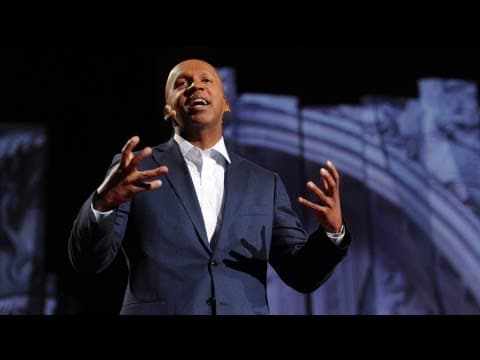
[0:16]This is a really extraordinary honor for me. I spend most of my time in jails, in prisons, on death row. I spend most of my time in very low income communities, in the projects, in places where there's a great deal of hopelessness. And being here at Ted and and seeing the stimulation, hearing it has been very, very energizing to me. And one of the things that's emerged in my short time here is that TED has an identity. And you can actually say things here that have impacts around the world and sometimes when it comes through TED, it has meaning and power that it doesn't have when it does it. And I mention that because I think identity is really important. And we've had some fantastic presentations and I think what we've learned is that if you're a teacher, your words can be meaningful, but if you're a compassionate teacher, they can be especially meaningful. If you're a doctor, you can do some good things, but if you're a caring doctor, you can do some other things. So I want to talk about the power of identity. And I didn't learn about this actually practicing law and doing the work that I do. I I I actually learned about this from my grandmother. I grew up in a house that was the traditional African-American home that was dominated by a matriarch, and that matriarch was my grandmother. She was tough, she was strong, she was powerful. Uh she was the end of every argument in our family. She was the beginning of a lot of arguments in our family. Uh she was the daughter of people who were actually enslaved. Her parents were born in slavery in Virginia in the 1840s. She was born in the 1880s and the experience of slavery very much shaped the way she saw the world. My mother and my grandmother was tough but she was also loving. When I would see her as a little boy, she'd come up to me and she'd give me these hugs and she'd squeeze me so tight, I could barely breathe. And an hour or two later if I saw her, she'd come over to me and she'd say, Brian, do you still feel me hugging you? And if I said no, she'd assault me again and if I'd say yes, she'd leave me alone and she just had this quality that she always wanted to be near her. And the only challenge was that she had 10 children. My mom was the youngest of her 10 kids and sometimes when I would go and spend time with her, it'd be difficult to get her time and attention. My cousins would be running around everywhere. And I remember when I was about eight or nine years old, waking up one morning, going into the living room and all of my cousins were running around. And my grandmother was sitting across the room staring at me. And at first I thought we were playing a game. And I would look at her and I'd smile but she was very serious. And after about 15 or 20 minutes of this, she got up and she came across the room and she took me by the hand and she said, come on Brian, you and I are gonna have a talk. And I remembered this just like it happened yesterday. I never will forget it. She took me out back and she said, Brian, I'm gonna tell you something but you don't tell anybody what I tell you. I said, okay mama, she said, now you, you make sure you don't do that. I said, sure. Then she sat me down and she looked at me and she said, I want you to know, I've been watching you. And she said, I think you're special. She said, I think you can do anything you want to do. I will never forget it. And then she said, I just need you to promise me three things, Brian. I said, okay, mama. She said, the first thing I want you to promise me is that you'll always love your mom. She said, that's my baby girl and you have to promise me now, you'll always take care of her. Well, I adored my mom so I said, yes mama, I'll do that. Then she said, the second thing I want you to promise me is that you'll always do the right thing, even when the right thing is the hard thing. I thought about it and I said, yes mama, I'll do that. Then finally she said, the third thing I want you to promise me is that you'll never drink alcohol. Well, I was nine years old so I said, yes mama, I'll do that. I grew up in the country in the rural south and I have a brother year older than me and a sister year younger and when I was about uh, 14 or 15, one day my brother came home and he had this six pack of beer. I don't know where he got it. And he grabbed me and my sister and we went out in the woods and we were kind of just out there doing the stuff we crazily did and he had a sip of this beer and he gave some to my sister and she had some and they offered it to me. And I said, no, no, no, no, that's okay. Y'all go ahead. I'm not gonna have any beer. My brother said, come on, we're doing this today. You always do what we do. I had some, your sister had some, have some beer. I said, no, I don't feel right about that. Y'all go ahead. Y'all go ahead. And then my brother started staring at me. He said, what is what's wrong with you? Have some beer. Then he looked at me real hard, he said, oh, I hope you're not still hung up on that conversation mama had with you. I I I said, well, what are you talking about? He says, oh, mama tells all the grandkids that they're special. I I I was devastated. And I'm gonna admit something to you. I'm gonna tell you something I probably shouldn't. I know this is might be broadcast broadly, but I'm I'm 52 years old. And I'm gonna admit to you that I've never had a drop of alcohol. I I I don't, I don't say that because I think that's virtuous. I say that because there is power in identity. When we create the right kind of identity, we can say things to the world around us that they don't actually believe make sense. We can get them to do things that they don't think they can do. When I thought about my grandmother, of course, she would think all her grandkids were special. My grandfather was in prison during prohibition. My male uncles died of alcohol related diseases and these were the things she thought we needed to commit to. Well, I've been trying to say something about our criminal justice system. This country is very different today than it was 40 years ago. In 1972, there were 300,000 people in jails and prisons. Today, there are 2.3 million. The United States now has the highest rate of incarceration in the world. We have 7 million people on probation and parole and mass incarceration, in my judgment, has fundamentally changed our world. In poor communities and communities of color, there is this despair, there is this hopelessness that is being shaped by these outcomes. One out of three black men between the ages of 18 and 30 is in jail, in prison, on probation or parole. In urban communities across this country, Los Angeles, Philadelphia, Baltimore, Washington, 50 to 60% of all young men of color in jail or prison or on probation and parole. Our system isn't just being shaped in these ways that seem to be distorting around race, they're also distorted by poverty. We have a system of justice in this country that treats you much better if you're rich and guilty than if you're poor and innocent. Wealth, not culpability, shapes outcomes. And yet we seem to be very comfortable. The politics of fear and anger have made us believe that these are problems that are not our problems. We've been disconnected. It's interesting to me. We're looking at some very interesting developments in our work, my state of Alabama, like a number of states, actually permanently disenfranchise you if you have a criminal conviction. Right now in Alabama, 34% of the black male population has permanently lost the right to vote. We're actually projecting in another 10 years, the level of disenfranchisement will be as high as it's been since prior to the passage of the Voting Rights Act and there is this stunning silence. I represent children. A lot of my clients are very young. The United States is the only country in the world where we sentence 13 year old children to die in prison. We have life imprisonment without parole for kids in this country. We're actually doing some litigation. The only country in the world. I represent people on death row. It's interesting this question of the death penalty. In many ways, we've been taught to think that the real question is, do people deserve to die for the crimes they've committed? And that's a very sensible question. But there's another way of thinking about where we are in our identity. The other way of thinking about it is not do people deserve to die for the crimes they commit, but do we deserve to kill? I mean, it's fascinating. Death penalty in America is defined by error. For every nine people who have been executed, we've actually identified one innocent person who's been exonerated and released from death row. A kind of astonishing error rate, one out of nine people, innocent. I mean, it's fascinating and in in in aviation, we would never let people fly on airplanes if for every nine planes that took off, one would crash. But somehow we can insulate ourselves from this problem. It's not our problem. It's not our burden. It's not our struggle. Well, I talk a lot about these issues. I talk about race in this question of whether we deserve to kill. And it's interesting, when I teach my students about African-American history, I tell them about slavery. I tell them about uh uh terrorism, the era that began at the end of reconstruction that went on to World War II. We don't really know very much about it. But for African-Americans in this country, that was an era defined by terror. In many communities, people had to worry about being lynched, they had to worry about being bombed, it was the threat of terror that shaped their lives. And these older people come up to me now. And they say, Mr. Stephenson, you give talks, you make speeches, you tell people to stop saying we're dealing with terrorism for the first time in our nation's history after 9/11. They tell me to say, you know, tell them that we grew up with that. And that era of terrorism of of course was followed by segregation, decades of racial subordination and and apartheid and. And yet we have in this country this dynamic where we really don't like to talk about our problems. We don't like to talk about our history. And because of that, we really haven't understood what it's meant to do the things we've done historically. And we're constantly running into each other, we're constantly creating tensions and conflicts, we have a hard time talking about race. And I believe it's because we are unwilling to commit ourselves to a process of truth and reconciliation. In South Africa, people understood that we couldn't overcome apartheid without a commitment to truth and reconciliation. In Rwanda, even after the genocide, there was this commitment, but in this country we haven't done that. I was giving this lecture in in Germany. I was some lectures in Germany about the death penalty. It was fascinating because one of the scholars stood up after the presentation and said, well, you know, it's deeply troubling to hear what you're talking about. He said, we don't have the death penalty in Germany. And of course, we can never have the death penalty in Germany. And the room got very quiet and this woman said, there's no way with our history, we can ever engage in the systematic killing of human beings. It would be unconscionable for us to in a intentional deliberate way set about executing people. And I thought about that, what would it feel like to be living in a world where the nation state of Germany was executing people, especially if they were disproportionately Jewish. I couldn't bear it.
[11:17]It would be unconscionable. And yet in this country, in the states of the old South, we execute people where you're 11 times more likely to get the death penalty if the victim is white, then if the victim is black, 22 times more likely to get it, if the defendant is black, and the victim is white. In the very states where there are buried in the ground the bodies of people who are lynched, and yet there is this disconnect. Well, I believe that our identity is at risk. That when we actually don't care about these difficult things, the positive and wonderful things are nonetheless implicated. We love innovation. We love technology. We love creativity. We love entertainment. But ultimately, those realities are shadowed by suffering, abuse, degradation, marginalization. And for me, it becomes necessary to integrate the two. Because ultimately, we are talking about a need to be more hopeful, more committed, more dedicated to the basic challenges of living in a complex world. And for that mean for me, that that for me, that means spending time thinking and talking about the poor, the disadvantaged, those who will never get to TED. But thinking about them in a way that is integrated in our own lives. You know, ultimately, we all have to believe things we haven't seen. We do.
[12:46]As rational as we are, as committed to intellect as we are, innovation, creativity, development comes, not from the ideas in our mind alone. They come from the ideas in our mind that are also fueled by some conviction in our heart. And it's that mind heart connection that I believe compels us to not just be attentive to all the bright and dazzly things, but also the dark and difficult things. Vockley Hobel, the great Czech leader talked about this. He said that when we were in Eastern Europe and dealing with oppression, we wanted all kinds of things, but mostly what we needed was hope, an orientation of the spirit, a willingness to sometimes be in hopeless places and be a witness. Well, that orientation of the spirit is very much at the core of what I believe even TED communities have to be engaged in. There is no disconnect around technology and design that will allow us to be fully human until we pay attention to suffering, to poverty, to exclusion, to unfairness, to injustice. Now I will warn you that this kind of identity is a much more challenging identity than ones that don't pay attention to this. It will get to you. I had the great privilege when I was a young lawyer, meeting Rosa Parks and Miss Parks used to come back to Montgomery every now and then and she would get together with two of her dearest friends, these older women. Johnny Carr, who was the organizer of the Montgomery bus boycott. Amazing African-American woman and Virginia Derr, a white woman whose husband Clifford Derr, uh represented Dr. King. And these women would get together and just talk and every now and then Miss Carr would call me and she'd say, Brian, Miss Parks is coming to town and we're gonna get together and talk. So you want to come over and listen? And I'd say, yes, ma'am, I do. She said, well, what are you gonna do when you get here? I said, I'm gonna listen. And I'd go over and I would. I would just listen. It would be so energizing and so empowering and one time I was over there, listening to these women talk and after a couple of hours Miss Parks turned to me and she said, Brian, tell me what the Equal Justice Initiative is. Tell me what you're trying to do. And I began giving her my rap. I said, well, we're trying to challenge injustice. We're trying to help people who have been wrongly convicted. We're trying to confront bias and discrimination, the administration of criminal justice, we're trying to end life without parole sentences for children. We're trying to do something about the death penalty. We're trying to reduce the prison population. We're trying to end mass incarceration. I gave her my whole wrap and when I finished, she looked at me and she said, mm mm. She said, that's gonna make you tired, tired, tired. And that's when Miss Carleen for, she put her finger in my face and said, that's why you've got to be brave, brave, brave. And I actually believe that the TED community needs to be more courageous. We need to find ways to to embrace these challenges, these problems, the suffering because ultimately our humanity depends on everyone's humanity. I've learned very simple things doing the work that I do. It's just taught me very simple things. I've come to understand and to believe that each of us is more than the worst thing we've ever done. I believe that for every person on the planet. I think if somebody tells a lie, they're not just a liar. I think if somebody takes something that doesn't belong to them, they're not just a thief. I think even if you kill someone, you're not just a killer. And because of that, there's this basic human dignity that must be respected by law. I also believe that in many parts of this country and certainly in many parts of this globe, that the opposite of poverty is not wealth. I don't believe that. I actually think in too many places, the opposite of poverty is justice. And finally I believe that despite the fact that it is so dramatic and so beautiful and so inspiring and so stimulating, we will ultimately not be judged by our technology. We won't be judged by our design. We won't be judged by our intellect and reason. Ultimately, you judge the character of a society, not by how they treat the rich and the powerful and the privileged but by how they treat the poor. The condemned, the incarcerated, because it's in that nexus that we actually begin to understand truly profound things about who we are. I sometimes get out of balance, I'll end with this story. I sometimes push too hard. I do get tired, as we all do. Sometimes those ideas get ahead of our kind of thinking in ways that are important. And I've been representing these kids who have been sentenced to to these very harsh sentences and I go to the jail and I see my client who's 13 and 14 and he's been certified to stand trial as an adult and I keep start thinking, well, how did that happen? How can a judge turn you into something that you're not? And the judge certified him as an adult, but I see this kid and I and I was up too late one night and I started thinking, well, gosh, if the judge can turn you into something that you're not, the judge must have magic power. I said, yeah, Brian, the judge had some magic power. You should ask for some of that. And because I was up too late and wasn't thinking real straight, I'd started working on a motion. I had a client who was 14 years old, a young, poor, black kid and I started working on this motion with and the head of the motion was a motion to try my poor 14 year old black male client like a privileged white 75 year old corporate executive.
[18:13]And I put in my motion that there was prosecutorial misconduct and police misconduct and judicial misconduct. There was a crazy line in there about how there's no conduct in this county, it's all misconduct. And the next morning I woke up and I thought, did I dream that crazy motion or did I actually write it? And to my horror, not only had I written it, but I had sent it to court.
[18:34]A couple of months uh went by and I just had forgotten all about it. And uh I finally uh decided, oh gosh, I gotta go to the court and do this crazy case and I got in my car and I was feeling really overwhelmed, overwhelmed. And I got in my car and I went to this courthouse and I was sitting, oh this is gonna be so difficult, so, so painful. And I finally got out of the car and I started walking up to the courthouse and as I was walking up the steps of this courthouse, there was an older black man who was the janitor in this courthouse. When this man saw me, he came over to me and he said, who are you? I said, I'm a lawyer. He said, you're a lawyer? I said, yes, sir. And this man came over to me and he hugged me. And he whispered in my ear, he said, I'm so proud of you. And I have to tell you it was energizing. It connected deeply with something in me about identity about the capacity of every person to contribute to community, to perspective that is hopeful. Well, I went into the courtroom and as soon as I walked inside the judge saw me coming in, he said, Mr. Stephenson, did you write this crazy motion? I said, yes, sir, I did. And we started arguing. And people started coming in because they were just outraged, I'd written these crazy things. And police officers were coming in and assistant prosecutors and clerk workers. And before I knew it, the courtroom was filled with people angry that we were talking about race, that we were talking about poverty, that we were talking about inequality. And out of the corner of my eye, I could see this janitor pacing back and forth, and he kept looking through the window and you could hear all of this holler, and he kept pacing back and forth. And finally this older black man with this very worried look on his face, came into the courtroom and sat down behind me, almost at council table. About 10 minutes later the judge said we would take a break and during the break there was a deputy sheriff who was offended that the janitor had come into court. And this deputy jumped up and he ran over to this older black man, he said, Jimmy, what are you doing in this courtroom? And this older black man stood up and he looked at that deputy, and he looked at me and he said, I came into this courtroom to tell this young man, keep your eyes on the prize. Hold on. I've come to TED because I believe that many of you understand that the moral arc of the universe is long but it bends toward justice, that we cannot be full evolved human beings until we care about human rights and basic dignity. That all of our survival is tied to the survival of everyone. That our visions of technology and design and entertainment and creativity have to be married with the visions of humanity, compassion, and justice. And more than anything, for those of you who share that, I've simply come to tell you to keep your eyes on the prize. Hold on. Thank you very much.
[21:30]Brian, you've, you've struck a massive chord here. You're an inspiring person. Thank you so much for for coming to Ted. Thank you. Well, there are opportunities all around us. If you live in the state of California, for example, there is a a referendum coming up this uh spring where actually there's gonna be an effort to redirect some of the money we spend on the politics of punishment. For example, here in California, we spend, we're gonna spend $1 billion on the death penalty in the next five years. $1 billion. Uh and yet 46% of all homicide cases don't result in arrest, uh 56% of all rape cases don't result in arrest. So there's an opportunity to change that. And this referendum would propose having those dollars go to uh law enforcement and and and safety. And I think that opportunity exists all around us. Now, there's been this huge decline in crime in America over the last three decades. And part of the narrative of that is sometimes that it's about increased incarceration rates. What would you say to someone who believed that? Well, actually, the violent crime rate has has remained relatively stable, you know, the the great increase in mass incarceration in this country wasn't really in violent crime categories. It was this misguided war on drugs. Uh that's where the dramatic increases have come in our prison population. And we got carried away with the rhetoric of punishment and so we have three strikes laws that put people in prison forever for stealing a bicycle or for low-level property crimes rather than making them give those resources back to the people who they victimized. I believe we need to do more to help people who are victimized by crime, not do less and I think our current punishment philosophy does nothing for no one. And I think that's the orientation that we have to change. Brian, you've, you've struck a massive cord here. You're an inspiring person. Thank you so much for for coming to Ted. Thank you.


