[0:00]Most professionals spend their entire career learning what to communicate, but the best ones spend their career mastering how. And there's a massive difference. Have you ever wondered why some people walk into a room, say three sentences and suddenly, everyone from the CEO to the interns, everyone is nodding their head in total agreement? It's not magic. It's a specific high stake communication framework used by the world's most elite consulting firms. I spent three years working at McKinsey and Company where I presented to city executives, I supported partners in high stakes client engagement, and I learned a communication system that most professionals never get access to. Consultants don't just deliver presentations, they deliver clarity, they deliver alignment, and they do it with a specific repeatable framework that almost nobody outside of these firms ever get taught. And today, I'm going to teach you the exact three-step framework that McKinsey consultants use to turn complex ideas into sharp, persuasive, room commanding communication. By the end of this video, you will know precisely how to walk into your next meeting and own it. Before we get into the three rules, there's one thing that you need to understand first, so that you are able to deliver the rules effectively. Most of us, especially high achievers, we communicate completely backwards. Think about how we were trained back in school. Every paper, every essay that you had to write, it followed the exact same structure. You will typically start with the introduction, then you have the background, your methodology, data, and then results. And finally, at the end of the report, you put in your conclusion, your answer or like the so what that you've brought out from the report. Now, that structure makes sense when you are in an academic, you know, setting like school, undergrad or MBA. You're trying to prove to your professor or your teacher that you did the reading, you did the assignment, you ran the experiment and you followed due process. You have to lay a trail of breadcrumbs from the beginning of your assessment all the way to the answer. You want to kind of show that you've earned the right to have an opinion, and so you show the data first before you show, you know, your conclusion. But here is the problem. In business, nobody has time for that. The CEO that you are trying to present to, the VP that is going to review the memo, or your busy manager who is managing like 20 people, they don't have time for that. They do not really care about the breadcrumbs. They care about the answer. They want to know what the destination is. They want to know what the 'So What' is. What do you want me to think? What decisions do you want me to make? That is what these high-level people are trying to get from their conversation with you. This shift from building up to an answer to leading with an answer is the single biggest communication upgrade most professionals need to make today. Every day you are in the data, you are conducting research, you are in the analysis, you are in what we call the weeds. Your job as a professional who wants to move up, is to synthesize all this insight, but when it comes to communicate, you have to flip it in your mind. You have to go from the bottom of the pyramid to the top, and then you need to present top down. Not bottom up, middle out, out in, top down. And that is exactly what these three rules I'm going to share in this video are going to teach you how to do. The first rule is, know your goal. Here's the difference maker. Most people know their topic. You know what you want to discuss, you've done the research for all these months. Knowing your topic means you know what the subject of your presentation, e.g., assessment of pet market in Asia. Knowing your goal is knowing what do you need the other person to think, to feel and to do by the time you are done with this communication. When you don't know the second part, when you don't know what your goal is, what happens? You ramble, you go off on tangents, you overshare, worse you under-explain. And by the time the meeting ends, nobody knows what's supposed to happen next. There's no clear next steps, there's no clarity on what decisions have been made in this meeting. In most business settings at work with your boss, with your client, every communication that you have is going to fall within these three buckets of goals. Alignment, Education, and Problem Solving. If you are seeking alignment, you need buying. You want people to say yes and agree with your position. If you are seeking education, then that means that you are trying to bring somebody up to speed. Increase their level of knowledge to what you already know. If you want problem solving or decision making, what you're trying to do is that you are bringing people together. You want them to think along with you and arrive at a decision together. There may be other like goals that you may have per time, but everything else is really a flavor of one of these three things. The next time, before you even open your laptop to begin to prep for a meeting, take a moment to ask yourself, what's the goal of this conversation? Knowing your goal helps keep you anchored, especially when things get messy. When you know your goal, when you know exactly what you are trying to achieve in that communication, you are able to acknowledge, you know, whatever redirection, and then you're able to make sure the meeting goes back on track. That's the first rule. And honestly, applying that one rule will make you noticeably better than 99% of people in the room. But then here's the part that most people completely miss. Knowing your goal is not enough if you still don't understand who exactly you are talking to. And this is much more deeper than just reading the room, or knowing who accepted the meeting invite. Second rule is, know your audience. Truly knowing your audience means understanding three specific things about the person sitting across from you. Every audience is different, not just in their role, but in how they think, what they value, how they process information. For example, for a CEO, they are time poor and outcome driven. They don't want to really hear about the journey, they want to hear about the destination, the next steps. For those guys, you want to give them the answer first and evidence later/after. Whereas, if you're speaking to a mid manager, these people are juggling multiple priorities. They need clarity, they need structure, and they need to build trust in you. If you are speaking to a junior analyst who just joined the firm, they may be brilliant, but they don't have context yet. They may need to give them more background, more examples. The communication style that works for one person will completely fail for another one. Great communicators adapt their approach based on who is in the room. Second thing about your audience is their level of context. Context basically means the amount of background information about the topic that your audience have. Now, here's a golden rule that will save you from awkward meetings every single time. Always assume zero context. Assume zero context, always! Think about it this way, you have been living inside this project for let's say three weeks. Because you have spent the time doing the research, you know every nuance, you know every assumption, every data point. But your audience, they've been in 14 meetings today, they are thinking about 1 million other things. So, establishing yourself as a leader in communication means you start every meeting with a brief, short context setter. The opposite of not setting this context is that you risk people in your meeting feeling lost, confused and frustrated. The third thing about your audience that you want to know before every meeting is their fears, their concerns and their goals. This layer is what most people skip entirely, and this is what differentiates an average communicator from an expect elite communicators. Your audience is not a blank slate. The same way you have goals coming into the meeting, your audience also walk into the meeting with their own goals and expectations. Maybe the CFO is worried about budget overrun. Maybe the CMO is worried about how toothpaste in New York would affect brand positioning. Maybe the CEO really cares about how he can double the revenue in three months by these new ideas. If you understand the concerns and goals of your audience ahead of the meetings, you can proactively address everybody's needs and structure your presentation, your meeting, in a way that everybody in the meeting works away feeling like the meeting has moved them closer to their goal. Let me give you a practical example. Let's say that you came to this meeting to, you know, recommend that the company actually launches this toothpaste line in New York. And in that meeting, you have the head of product in that meeting. Definitely, it is wise to assume that this person will be emotionally invested in your recommendation. If you start the meeting by saying, I think our current product is not working and we should, you know, cut it out from the market. You are going to get immediate defensive pushback from the head of product because it's their product. And by making that recommendation, you have called them stupid. But if you lead with we want to ensure that we are directing resources to the highest impact opportunities. And based on my research, I found compelling data that changes how we think about our priorities. What have I done? I have framed my recommendation differently. I have made it a more collaborative approach. I have the same message. I'm going to give the same recommendation, but the way I structured it is different. I have exercised empathy for the head of product. Now, empathy in communication is a superpower. It's not being soft, it's aligning your recommendation, your framing, your messaging to ensure that you are not creating unnecessary enemies, you know, in the meeting, especially in a meeting where your goal is alignment. Now that you know your goal and you know your audience, you understand their motivations, who is in the room and how to frame your conversation in a collaborative way. The next thing you need to do is to know your approach. This third rule is all about execution, and this is where two powerful frameworks that I'm going to share with you come in. Framework number one, the pyramid principle. The pyramid principle was developed by Barbara Minto, who was a McKinsey, many, many years ago, and it is arguably the most influential communication framework in the business world today. There's a whole book titled The Pyramid Principle by Barbara Minto that you can read if you want to learn about this. But here's the core idea. Whenever you have a communication coming up, always think about what you want to say like a pyramid. The tip of the pyramid is your main message, your answer, your recommendation, your so what. But below that tip, the base are the supporting argument, the data that backs up your recommendation. The problem that most people have is that most people present bottom up. They start with the backup before they get to, you know, the recommendation. When everybody in the meeting has already zoned out, people are dozing on their phone, they've lost the plot, and then you're about to land the most important part of the meeting. And this is where consultants flip the script. They start from the bottom of the pyramid, and then they work their way down. I'm going to teach you how to do it. The very first step is, start with the answer first. Imagine you're in the elevator with the CEO, and then she turns to you and say, so what's the status on this toothpaste project? They're not going to, you know, walk out through, oh, I spoke to five people yesterday, then I had a call with the manufacturer last week, and I also opened Google and Cloud and I used them. No, you're going to tell her the exact recommendation. The right answer will be, our recommendation is that you should not launch a toothpaste product in New York right now, because there are three major risks. One, cannibalization. Two, the market is saturated and there are cost challenges. I'm happy to walk you through any of those risks at a later time. That's it. You lead with the answer. You tell her high-level what the things that back it up with, and then you open up the floor for more questions. After you have led with the so what, the second step is the middle. And here, we have another framework that is called the rule of three. Have you ever noticed that whenever you hear consultants speak, either on an interview, on TV, they always have three answers. When you ask them any question, they're like, oh, yeah, there are three things. They may end up giving you four or five, but it typically start with three is because they are all following this framework, the rule of three. And here is how to apply it. Immediately you give your "So What" follow it with at least three supporting arguments. Why three? Because science has shown us that the human brain is wired for three. Three is the minimum number for pattern recognition and is the maximum number for working memory without overload. Working memory is the memory that is available for immediate like thinking. So if you are going to a meeting where you need alignment, decision-making, if you give them more than three supporting argument, let's say you give them seven. They won't be able to hold seven arguments in their head. By the time you ask them to make a decision or to align on something, they could have forgotten four of the things you've said, or completely forgotten the entire seven. But three, three feels complete, it feels short, it's easy to remember. It is what science has proven us that the human brain can hold. You sound more authoritative, clearer, and you are many times able to lead the group to where you're going, your goal. Now, here's the part that actually matters. How do you decide what three points to bring in or how to sequence the three points? The pyramid principle gives us three primary approaches for how we sequence our supporting argument. Deductive, chronological or comparative. Deductive: Organizing your arguments in a logical manner where each point leads logically to the next. Organizing your points in a deductive manner basically means you're organizing them in a logical manner. That means you put major premise, minor premise and conclusion. A good example of this is you say any company that meets this criteria is worth acquiring. Company A meets this criteria. Therefore, a company is worth acquiring. What you've done is like each of those points leads logically to the next. So you use this when your audience is analytical and they they need to follow proof. The next one is chronologically, which is arranging your arguments chronologically, step one, step two, step three. This is the natural time order sequence. You can use this when you have a process, an action plan, a transformation or a road map. You say, first, we need to stabilize the cost base. Secondly, we need to optimize operation, and then lastly, we need to invest in growth. So it is simple, it is clean and it is easy to follow. And then the last way to organize your point is comparatively, by comparing them by degree. So you start with your most important point, and this enables you to build credibility early. Again, your audience is there for five minutes, they have a short attention span. It is wise for you to lead with the most important things first, and so that way, even if they zone out or they get distracted by the second or the third point, you can be sure that your most important point has already, you know, has already landed. And you use this most times when your arguments doesn't follow a natural logic, or time-based flow. Your job is to figure out which sequencing creates the most compelling narrative for your specific audience. Now, whatever you do, make sure that your arguments are MECE. That is step three, construct MECE argument. MECE stands for Mutually Exclusive, Collectively Exhaustive. Being MECE is a core McKinsey principle that ensures that your arguments are airtight. To be mutually exclusive means that there's no overlap between your point. Your three arguments should be genuinely distinctive point, not the same idea restated three different ways. Collectively exhaustive basically means that together your three points form the full picture. If somebody can poke a hole and say, what about this? You've not considered this, then that means that your argument falls apart. Think about it like a pie chart. Being MECE means that the slices do not overlap, and together your slices form a whole pie. Build your three arguments, make sure that they are genuinely different from each other, and together they form your recommendation. That's how you deliver a bulletproof message. Now, the pyramid principle alone will put you ahead of 90% of people in any meeting. There's one more framework that takes this to a completely different level. And that framework is the SCR framework. SCR stands for Situation, Complication, and Resolution. See, the pyramid principle tells you to lead with the answer first, but sometimes, particularly in presentations that are very data heavy, or when you are managing a skeptical audience, you need to build the story a little more carefully before landing on your recommendation. And that's where the SCR framework comes in. I personally use this framework a lot of times when I was going into problem solving meetings, or when I was presenting a proposal or a recommendation to a client. In your context, there may be times when you need to take a storytelling approach. In scenarios when you need somebody to make a tough decision, applying this framework, this SCR storytelling framework is important. Let's start with S. S stands for situation. This is your context setting segment. Here, you want to start with what everybody already knows and agrees on. This is non-controversial, and you can you can just start by saying, this is where we are, you know, for example, our company has been growing steadily for the last three years, and our flagship product line has been central to that growth. The situation component should not be surprising. It should make your audience say, yes, that's right, you know, that makes sense. This is where you are building credibility, you are showing shared context. You're trying to win your audience over to say that, hey, I understand where we are and where we're coming from. Now, C is complication. This is where you introduce the problem, or the tension, why, why are we here today? Here, you introduce the issue. What is the challenge? What is the threat? What is a disruption to the situation, right? And this is where the narrative gets interesting. An example, you say, however, over the last two quarters, we've seen a 15% decline in renewal rate. And our analysis shows that key competitors have moved aggressively into our core market segment. In that complication, this creates tension in your in your audience's mind. Naturally, they are intrigued now, you know, they're sitting up that, okay, so this is a problem. How do we solve it? And the complication segment sets you up for an answer. It makes your audience ready for your recommendation. It makes your recommendation feels necessary or even urgent. So, is the build up, right? You are building up your audience to ready for your recommendation or resolution. And that brings us to the R segment. This is the resolution or recommendation. Now, you resolve the tension. In this segment, you provide them the answer, you provide them the so what. So you say, we recommend a three-part response. One, we defend our core segment through enhanced customer success investment. Two, we reposition our product as premium. And then lastly, we accelerate our partnership with other distribution channels around us. Notice that the resolution doesn't feel like it came out of nowhere. It feels earned, defended. Why? Because you started with the situation, you introduced the complication and now you are giving them the recommendation. So, it is like the recommendation feels like a logical next step. And this is what makes SCR a very powerful framework or tool when you have like high stakes communication. So you need to, you are convincing somebody to give you, you know, a promotion, you're convincing somebody to go a different direction. SCR, you know, is very powerful. It's not just logical, it's narrative. And human beings are wired for stories, they're wired for narratives. And when you make the audience feel the tension of the story, the tension of the complication, you are already making it easier for them to say yes or no when it's time to make, you know, decision. Now, if you pair SCR with the pyramid principle, you have a complete communication system that is logically bulletproof and is emotionally engaging. So, all these rules work together. If you fail to come into any meeting without knowing your goals, it'll be impossible for you to structure the meeting properly. If you struggle the meeting properly, you apply the pyramid principle, the SCR framework, but you don't know the objective of your audience, you would have a well-laid out presentation that doesn't land, that doesn't deliver results. Because you failed to apply empathy in your communication with your audience. So all these three rules work closely together. Okay, so let's bring this to life with a real life, you know, scenario. Let's assume that you're a consultant, you are presenting to the board of a retail company, and you've spent the last four weeks analyzing whether they should invest in building a direct-to-consumer e-commerce platform. First rule says, what's your goal? My goal in this meeting is alignment. I need the board to say yes to a $2 million investment. That's my not star. For every slide, every sentence, every answer to a tough question, I'm going to filter that through that goal alignment. Second rule, what's my audience? I'm presenting to board members. These are busy executives who care about ROI and risk. They do not want my methodology. They do not want my raw data. They want my recommendation. They want to know why they should trust me and what happens next. I'm going to assume they have zero context because they are busy. So I start with over the last four weeks, my team has assessed the competitive landscape. We reviewed three years of sales data and we've benchmarked 12 competitors. Today, we are presenting our recommendation on the e-commerce investment decision. Now, rule number three, my approach. I'm going to apply the SCR framework and the pyramid principle. So I start with my SCR narrative first. Situation: Retail is undergoing a structural shift to digital - online sales in your category have grown 34% year-over-year. Complication: Your direct competitors have already launched DTC platforms and are capturing first-mover advantage in customer data and margin expansion. Recommendation: We recommend investing $2M to build a phased DTC e-commerce platform over 18 months. Now I apply my pyramid principle. I'll go with three argument, and I'll sequence them by degree of importance, starting with the strongest. I will say, your addressable DTC market is $180M, with a realistic 8% capture rate in 24 months. Every quarter without a DTC offering, you're handling wallet share to competitors who won't give it back. If you make this investment, you can be ROI positive by month 14, with $4.2M projected incremental margin by year 3. We're asking for approval today to proceed into Phase 1. The team is ready to begin vendor selection within two weeks of sign-off. That's it. Clear goal, audience first framing, SCR narrative, pyramid structure, MECE argument, clean close. That's how a top consultant communicates. Communication is not a talent that you are born with, it is a skill. That means that like any other skill, the more deliberately you practice it, the sharper you get. I worked in consulting for three years, I've worked in professional services for over a decade, and I'm still learning it myself. Start simple. Before your next meeting, ask yourself just three questions. What is my goal? Who is my audience? And what approach am I going to take? What is my goal? Is it alignment, education or problem solving? Who is in the room? What do they need to hear? And how much context do they need? How am I going to structure this conversation? Am I going to use the pyramid principle or the SCR framework? Or can I use both? And how am I going to ensure that I am MECE? If you do this three times over and over, I promise you, people will start noticing. Your manager will notice. Your clients will pay attention. The people making promotion decisions will notice that you've leveled up the way you communicate. Because in a world where everybody has ideas, the people who can communicate those ideas clearly, confidently and persuasively, they are the ones who get listened to. They are the ones who move up the career ladder and are able to build wealth. I'm trusting that with the principles in this video, you'll be able to do that as well.
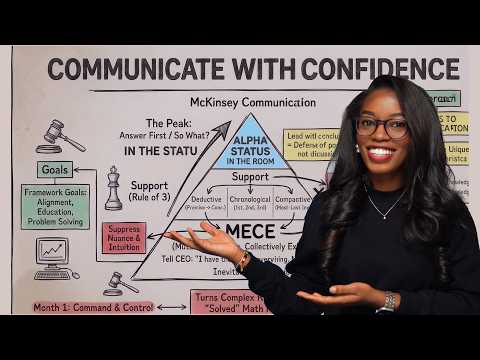
Communicate like McKinsey: top 3 consulting frameworks
O.B.A
24m 56s4,390 words~22 min read
YouTube auto captions
Transcript source
YouTube auto captions
This transcript was extracted from YouTube's auto-generated caption track. The transcript below is server-rendered so it can be read, searched, cited, and shared without opening the original YouTube player.
Pull quotes
[0:00]Most professionals spend their entire career learning what to communicate, but the best ones spend their career mastering how.
[0:00]Have you ever wondered why some people walk into a room, say three sentences and suddenly, everyone from the CEO to the interns, everyone is nodding their head in total agreement?
[0:00]It's a specific high stake communication framework used by the world's most elite consulting firms.
[0:00]Consultants don't just deliver presentations, they deliver clarity, they deliver alignment, and they do it with a specific repeatable framework that almost nobody outside of these firms ever get taught.
Use this transcript
Related transcript hubs
Watch on YouTube
Share
MORE TRANSCRIPTS


