[0:00]The city of Tomar is situated 140 km northeast of Lisbon, and is easily accessible by car, train, or bus.
[0:13]Dating back to the 12th century, Tomar Castle contained within its walls the Convento de Cristo, a UNESCO World Heritage site. The convent was founded by the Knights Templar and the castle was an integral part of the defense system, created by the Templars to defend the young Christian kingdom against the Moors.
[0:45]The main entrance to the convent, but not for visitors, is this alter piece portal with images of the Old and New Testaments. It was conceived by Giorgio de Aruda, but when he was appointed a military engineer and went to serve in North Africa, his master, de Castillol continued the work. The main visitor entrance has restricted narrow access, so visitors using wheelchairs are advised to use the entrance at the north facade.
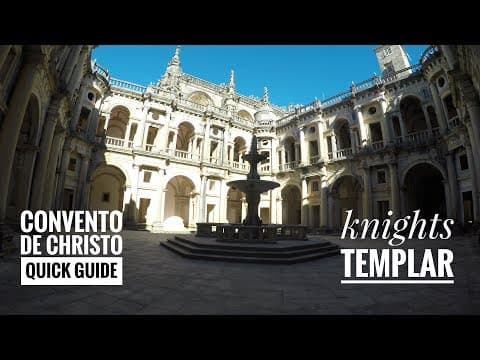
[1:15]The convent has a total of eight cloisters, and if you enter from the main visitor entrance, the first you will see is the Cloister of the Cemetery. Built during the time of Henry the Navigator and decorated with 16th century tiles, this Gothic cloister was the burial site for the knights and monks of the order. Built in the 16th century by Francisco Lopez, the New Sacristy was also the chapter house during the time of Prince Henry. The vaulting decoration displays a new cross of Christ, the armillary sphere, and the royal arms. The famous Round Church dates back to the late 12th century and was modeled following the design of the Dome of the Rock in Jerusalem. The church is characterized by its domed ceiling and the bell on its tower and is dedicated to Jesus Christ and his mother Mary. The interior of the church is magnificently decorated with sculptures and paintings, added during the renovation sponsored by King Manuel I, starting in 1499. The walls and ceilings of the surrounding ambulatory are painted with Gothic patterns and panels depicting the life of Christ. The paintings are attributed to the workshop of the court painter of Manuel I. A magnificent panel depicting the martyrdom of Saint Sebastian by Portuguese painter Gregorio Lopez, was painted for the Round Church, but now hangs in the National Museum of Ancient Art in Lisbon. The main cloister is a masterpiece in European Renaissance, built by King John III, inspired by Italian architecture and mainly based on the drawings of the Bolognese architect Sebastian Serlio. Situated outside the castle walls and surrounding the nave that his father, King Manuel I, used to extend the Templar Church.
[3:08]The main dormitory was finished between 1543 and 1545. It has 40 cells along the so-called crossing corridor, consisting of three arms of identical size along the cardinal points. One of the open cells provides a perfect view of the famous Chapter House Window. King Manuel I commissioned the work and is one of the best examples of late Gothic style, popular in Portugal in the early 16th century. The Templars were a wealthy order, and this is evidenced by visiting their cells. Each one had their own separate room, and in winter the cells were heated, thanks to a heating system directing hot air between the walls. The refectory was built during the reign of King John III and finished between 1535 and 1536. The word refectory comes from the Latin word refectorium, which means a place one goes to be restored. Just off the refectory is the Convent kitchen, built at the same time as the refectory, but by 1550 still hadn't been fully completed. The aqueduct is a monument to engineering prowess of the 16th and 17th centuries. This structure was built during the reign of King Philip of Portugal, who, by the way, was also the king of Spain at the time. During this time, Portugal lost its independence to Spain for 60 years. Thank you for watching our quick guide to the Convento de Cristo. Please be sure to like and subscribe to our page for future updates.