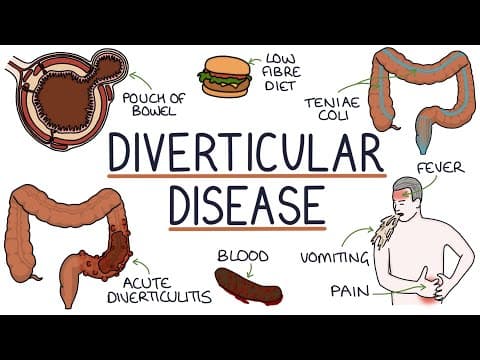
[0:12]Hi, this is Tom from zerotofinals.com. In this video, I'm going to be going through diverticular disease. And you can find written notes on this topic at zerotofinals.com/diverticulosis, or in the general surgery section of the zerotofinals surgery book. So let's jump straight in. A diverticulum, or plural diverticula, is a pouch or pocket in the bowel wall, usually ranging in size from 0.5 to 1 cm. Diverticulosis refers to the presence of diverticula without inflammation or infection. Diverticulosis may be referred to as diverticular disease when patients experience symptoms. Diverticulitis refers to inflammation and infection of diverticula.
[1:15]Let's talk about the pathophysiology. The wall of the large intestine contains a layer of muscle called the circular muscle. The points along the bowel where this muscle layer is penetrated by blood vessels are areas of weakness. Increased pressure in the lumen over time can cause a gap to form in these areas of the circular muscle. These gaps allow the mucosa to herniate through the muscle layer and pouches to form, which we call diverticula.
[1:54]Diverticula do not form in the rectum because it has an outer longitudinal muscle layer that completely surrounds the diameter of the rectum, adding extra support. In the rest of the colon, there are three longitudinal muscles that run along the colon, forming strips or ribbons, called Teniae coli. The Teniae coli do not surround the entire diameter of the colon, and the areas that are not covered by Teniae coli are vulnerable to the development of diverticula. Let's talk about diverticulosis. Diverticulosis is sometimes described in layman's terms as wear and tear of the bowel. The most commonly affected section of the bowel is the sigmoid colon. However, it can affect the entire large bowel in some patients. Small bowel diverticula are also possible but much less common. Diverticulosis is very common with increased age, low fiber diets, obesity, and the use of non-steroidal anti-inflammatory drugs or NSAIDs are also risk factors. The use of NSAIDs increases the risk of diverticular hemorrhage.
[3:24]Diverticulosis is often diagnosed incidentally on a colonoscopy or a CT scan. Treatment is not necessary where the patient is asymptomatic. However, advice regarding a high fiber diet and weight loss is appropriate.
[3:48]Diverticulosis may cause lower left abdominal pain, constipation, or rectal bleeding. Management is with increased fiber in the diet and bulk-forming laxatives, for example, ispaghula husk. Stimulant laxatives, for example, sena, should be avoided as they can make matters worse. Surgery to remove the affected area may be required where there are significant symptoms. Let's talk about acute diverticulitis. Diverticulitis refers to inflammation in the diverticula. Acute diverticulitis presents with pain and tenderness in the left iliac fossa or the lower left abdomen, fever, diarrhea or loose stools, nausea and vomiting, rectal bleeding, a palpable abdominal mass if an abscess has formed, and raised inflammatory markers, for example, CRP and white blood cell count.
[5:10]The nice clinical knowledge summaries last updated in January 2021 suggest management of uncomplicated diverticulitis in primary care with oral co-amoxiclav for at least five days, analgesia, particularly avoiding non-steroidal anti-inflammatory drugs and opiates if possible, only taking clear liquids and avoiding solid food until symptoms improve, usually within two to three days, and follow up within two days to review the symptoms.
[5:50]Patients with severe pain or complications require admission to hospital. Hospital treatment involves management as with any patient with an acute abdomen or sepsis, including nil by mouth or clear fluids only, IV antibiotics, IV fluids, analgesia, urgent investigations, for example, a CT scan, and urgent surgery may be required if there are complications.
[6:26]Complications of acute diverticulitis are perforation of the bowel, peritonitis, a peridiverticular abscess, a large hemorrhage requiring blood transfusions, fistula, for example, between the colon and the bladder or the vagina, and ileus or bowel obstruction.
[6:58]If you like this video, consider joining the zerotofinals Patreon account, where you get early access to these videos before they appear on YouTube. You also get access to my comprehensive course on how to learn medicine and do well in medical exams, digital flashcards for rapidly testing the key facts you need for medical exams, early access to the zerotofinals podcast episodes, and question podcasts, which you can use to test your knowledge on the go. Thanks for watching, and I'll see you in the next video.