[0:00]haben und sein, to be and to have. Those two verbs are very important in English and in German. In today's video, we are going to cover their main verbs form. So, without further delay, let's get right into it. Haben as main verb, not as an auxiliary or helping verb, as main verb refers to possession. For instance, ich habe ein Buch, I have a book. Similarly, sein as main verb, not as an auxiliary verb, refers to states, identity, and location, like the English verb "to be." For example, as a state, I can say ich bin müde, I'm tired. Identity, I can say he is a teacher, er ist Lehrer. And location, I can say ich bin in Berlin, I am in Berlin. So, three different situations it can refers to as a main verb, okay? An example is again, ich bin müde, I am tired. So, those two verbs as main verbs, haben refers to possession, and sein refers to states, identity, and location. You have to really know it like that because sein, if anyone is teaching you about sein, especially, they will tell you it is a verb that is used for motion. So, in case of a main verb, it doesn't refer to that, it refers to states, identity, and location. So, it's important that you know how do these two verbs conjugate. And in that sense, haben, conjugation of haben. By the way, both of those two verbs, haben and sein, are irregular by nature. So, let's look into haben first. Haben is conjugated, um, basically, it's regular in all the forms. For instance, for ich, wir, ihr, sie, but it is irregular in du and er, sie, es forms. So, you will see it here now. ich habe, du hast, er, sie, es hat, wir haben, ihr habt, sie haben. So, you can see here that in case of du and er, sie, es, it is losing the b, but in all the other cases, you have b present. You have b in case of ich, wir, ihr, and sie. That means it is only irregular in du and er, sie, es form, very important point. And it is important that you memorize this by heart because when it is irregular, there is no principle to it. You have to memorize it. So, ich habe, du hast, er, sie, es hat, wir haben, ihr habt, sie haben. And in that case, sie could be plural or it could be formal, yeah? And the formal sie could also be plural or singular. Just so you remember that, yeah? Now, let's go through some example sentences where haben is used. Ich habe einen Hund. I have a dog. Du hast ein schönes Haus. You have a beautiful house. Er hat eine Frau. He has a wife. Sie hat ein Baby. She has a baby. Es hat einen langen Schwanz. It has a long tail. Wir haben eine gute Idee. We have a good idea. Ihr habt ein Sofa. You (plural) have a sofa. Sie haben drei Kinder. They have three children. And now conjugation of sein. So, you remember haben is only irregular for for du and er, sie, es form, yeah? It was regular in all the other forms. But sein is not like that. Sein is a complete disaster. So, it's a total, totally irregular verb. That's why you have to memorize it by heart. It's the same in English as well. So, ich bin, du bist, er, sie, es ist, wir sind, ihr seid, sie sind. Again. Ich bin, du bist, er, sie, es ist, wir sind, ihr seid, sie sind. Some example sentences are: ich bin groß. I am tall. Du bist glücklich. You are happy. Er ist nett. He is nice. Sie ist Lehrerin. She is a teacher. Es ist kalt. It is cold. Wir sind zu Hause. We are at home. Ihr seid Studenten. You (plural) are students. Sie sind meine Nachbarn. They are my neighbors. So, that was it for today's video. Two of the most important verbs in English and German. Haben und sein, to have and to be. And for them to serve as auxiliary or helping verbs is also very important because perfect tense in German is the most important tense you need to to memorize and learn, and there they are used. So, this will be covered in the next video. Thank you for listening, and I will see you in the next lecture.
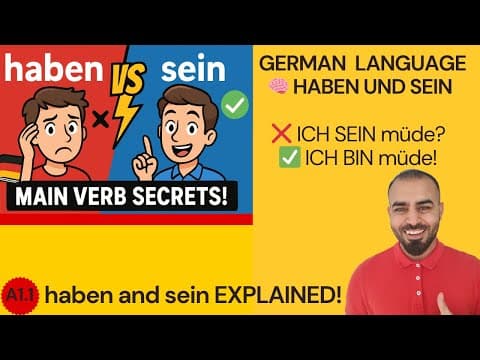
Deutschkurs Lektion 6 A1.1 – haben and sein as main verbs EXPLAINED!
Khan in Germany
6m 14s752 words~4 min read
YouTube auto captions
Transcript source
YouTube auto captions
This transcript was extracted from YouTube's auto-generated caption track. The transcript below is server-rendered so it can be read, searched, cited, and shared without opening the original YouTube player.
Pull quotes
[0:00]Haben as main verb, not as an auxiliary or helping verb, as main verb refers to possession.
[0:00]Similarly, sein as main verb, not as an auxiliary verb, refers to states, identity, and location, like the English verb "to be." For example, as a state, I can say ich bin müde, I'm tired.
[0:00]So, those two verbs as main verbs, haben refers to possession, and sein refers to states, identity, and location.
[0:00]You have to really know it like that because sein, if anyone is teaching you about sein, especially, they will tell you it is a verb that is used for motion.
Use this transcript
Related transcript hubs
Watch on YouTube
Share
MORE TRANSCRIPTS


