[0:00]Marketing budgets aren't shrinking, they're shifting faster than most teams can keep up with. I just analyzed spending data from 9,210 marketers and the patterns reveal something critical. AI SEO investment jumped 98%. Influencer marketing grew 78%, while organic social budgets dropped 64%. I'm Neil Patel, I run NP Digital, one of the world's largest independent marketing agencies. managing over a billion dollars in marketing spend for brands worldwide. In this video, I'll teach you how to read these budget signals so you know exactly where to move your dollars, which channels to double down on and which ones to cut before they drain your ROI. So that way, you can reallocate smarter and faster than your competition. Here's what you need to know. Chapter one, Budget concentration beats budget diversification. Spreading your budgets across every channel feels safe, but the data proves it's the fastest way to lose competitive ground in 2026. Here's what's really happening. We analyzed 9,210 responses. We found that 61% of B2B marketers are increasing their overall spend this year. B2C marketers, 57% are increasing. The ones who aren't increasing, majority are either holding and less of them are decreasing. So in other words, people are either increasing their budgets or keeping them the same, but the majority are increasing. And here's the thing, even the teams with growing budgets are cutting specific channels aggressively. This creates a reality that contradicts conventional wisdom. The phrase "follow the money" doesn't just mean watch where budgets are growing. It means watch where confident, high-performing teams are consolidating dollars away from low-signal channels and into high-intent environments. In my opinion, the gap between using AI and getting results from AI is where most marketing budgets are being wasted right now. The teams are experimenting everywhere instead of doubling down on what's actually compounding. Here's exactly how to use this insight. Before you allocate a single dollar, ask yourself, is this channel giving me clearer intent signals than it did last year? If the answer's no, that's your cut list. If the answer is yes, that's where you concentrate firepower. Chapter two, Organic Social becomes entertainment media and most brand aren't ready. Organic social isn't dying because algorithms change. It's separating winners from losers because it demands content creation skills most brands don't have yet. Let me show you exactly what's happening. Organic social budgets are facing the steepest pullback in our entire dataset. 64% of marketers are pulling back and decreasing. Only 32% are increasing and just 4% are holding flat. But here's what's really going on. Social media became the new TV and most brands are still treating it like a bulletin board. The platforms didn't stop working, most brands just don't have the skills to compete anymore. Think about what's happened. Social platforms transform from follower-based networks into interest-based media. You no longer competing against other brands in your niche, you are competing against the most entertaining and valuable content on the internet. That requires a completely different skill set. You need scripting and storytelling ability, video production, literacy, format creation, shows, series, repeatable angles, entertainment value, alongside educational value, and personality and presence on camera. Most marketing teams were not hired for this. They were hired to write copy, manage campaigns, and coordinate promotions. Now, they're expected to produce entertainment level content and they're getting crushed by creators who spent years mastering these skills. Social media isn't just a proof layer where people validate you after discovering you elsewhere. It's a primary discovery channel. In a 2025 Horowitz research study, 50% of consumers said social media is now a primary way to learn about new brands and products. And Sprout Social's 2025 Pulse survey found that 37% of consumers prefer going to social first when searching for product reviews and recommendations. So, here's the reality, social isn't dying, it's just exposing who can actually create content worth watching. Even if you can't produce that content yourself, the channel still works. Just partner with creators. In fact, 69% of marketers are increasing influencer spend this year because it's the fastest way to get trusted creative you can scale through paid. The brands cutting budgets aren't wrong, they're just prioritizing what's working for them now. That creates a gap competitors can exploit by finding new ways to tap into the same discovery power. Chapter three, Intent precision just became more valuable than broad reach. The biggest budget shift isn't from one channel to another. It's from broad reach to precise intent, and the channels absorbing that capital reveal exactly where buyer behavior has already moved. Let's break down what's actually winning right now. AI SEO investment jumped 98%, the single biggest growth area in our entire study. The reason is simple: zero-click searches and AI overviews completely changed how visibility works. You're no longer optimizing for a click, you're optimizing to be cited as an authoritative source inside an answer itself. At the same time, influencer marketing is growing at 78% with 69% of marketers increasing spend. This isn't about Instagram sponsorships anymore. Brands are betting that trust-driven traffic, direct word of mouth, and creator-led will convert better than cold paid clicks. Influencers create brand awareness and social proof earlier in the journey, exactly where attribution has gotten harder to track. Here's the strategic connection between these two trends. They're solving the same problem. Traditional advertising relied on interruptive reach. You showed up where attention already existed and borrowed it. But today's buyer journey is nonlinear. People discover through AI tools, validate through trusted voices, and convert when first-party data lets you sequence the right message at the right time. The proof is a sustained investment. Paid search, email, and CRO are still important. But the way those dollars work has changed. You're not buying attention, you're buying intent at the moment it's ready to convert. Here's how to use this. Audit where your attribution is actually coming from, not where your dashboard says it's coming from. Then reallocate into the channels that influence decisions, not just the ones that get last-click credit. And if you're struggling to measure your attribution, check us out at NP Digital, where we have a data and analytics team that can do this all for you, plus we can even run your campaigns in 2026 and beyond. Chapter four, Measurability became the new competitive moat. Third-party signals keep degrading, so budgets are consolidating into channels that stay measurable, and that's creating a massive competitive advantage for teams who understand the strategic value of clarity. Here's the pattern driving reallocation decisions. Paid search, email, and CRO all offer clear attribution than emerging channels. In uncertain conditions, that clarity becomes currency. When you can't prove ROI everywhere, you can protect budget in places where you can. But there's a more sophisticated move happening beneath the surface. The best performing teams aren't just defending measurable channels, they're using first-party data to make every channel more measurable. That's why email and lifecycle budgets are holding resilient. 60% are keeping spend flat, 23% are increasing. First-party data enables consistent message delivery when paid reach and signal quality decline. This is also why CRO and UX remain a priority. 52% are increasing spend. When traffic is harder to earn and easier to lose, you optimize for what you have. Fewer clicks, you need to squeeze more revenue at each and every single visit. Here's the strategic bet high-performing teams are making. Customer acquisition isn't the only scalable lever anymore. Retention is the controllable one. Retention programs stabilize margins as media costs rise, auctions tighten, and platforms stay volatile. Now, this is your exact move. Take 10 to 15% of your marketing budget and set it aside for testing new channels and tactics. Measure everything else ruthlessly. Speed of reallocation beats perfection and prediction. The teams that can shift budget mid-quarter based on real performance signals are capturing structural advantage, while competitors stay locked into annual budgets that no longer reflect reality. Chapter five, The four-part framework for defensible budget allocation. Budget decisions in 2026 aren't about chasing trends. They're about matching investment to where performance can be proven and defended. And that requires a decision-making framework built on evidence, not aspiration. Let me give you the four-part system we use at NP Digital when deciding where client dollars go. First, anchor spend in proven demand. Protect budgets tied directly to revenue and high-intent activity. These are your foundation channels. Paid search, email, CRO, SEO. If you can't defend budget here with clear ROI data, you've got bigger problems than allocation. Second, build flexibility around performance signals. Shift dollars based on real outcomes. Don't lock yourself into annual commitments for channels that aren't delivering. Set aside 10 to 15% of budget for experimentation without destabilizing what works. Test intentionally without gambling on unproven tactics. Third, separate experimentation from core investment. The most expensive mistake teams make is treating every new channel like it deserves equal budget. It doesn't. New channels earn budget by proving incrementality, not by being trendy. AI SEO, influencer marketing, community building - these should start small and scale based on results, not hype. Fourth, reallocate faster than your competitors. Speed of adjustment becomes a competitive advantage in volatile conditions. The teams winning in 2026 are reviewing performance monthly and moving budget mid-quarter when signals change. They're not waiting for annual planning cycles to catch up to market reality. Here's why this framework works. It's built on defensibility, not aspiration. You're not guessing where the market is going, you're following where proven performance already exists. Then expanding carefully into related channels that show early traction. The clear pattern's here, marketers are putting more money into channels that drive conversions and retention and pulling back from traditional ads that just aren't performing like they used to. And instead of posting more content, they're focusing on fewer pieces that hit harder. So now, think how you're investing your marketing dollars. Compare it against the patterns we just walked through. And ask yourself these three questions. One, are you anchored in channels where attribution is clear and ROI is defensible? If more than 30% of your budget is in channels you can't measure confidently, that's a red flag. Two, are you investing in channels where intent signals are getting stronger or weaker? AI SEO, influencer, email, CRO, they're all absorbing dollars because intent is clearly improving. Organic social and traditional display are losing ground because signals are degrading. Three, can you reallocate budget mid-quarter based on performance, or are you locked into annual commitments that assume market conditions won't change? The businesses that win in today's marketplace will be faster, not just bigger. Budgets are consolidating around fewer, higher-confidence channels. Efficiency and retention now matter as much as acquisition. And AI is reshaping how value gets captured, not just how work gets done. If you want to go deeper into how online marketing is evolving and AI technology is reshaping the next wave of traffic, watch one of these videos now.
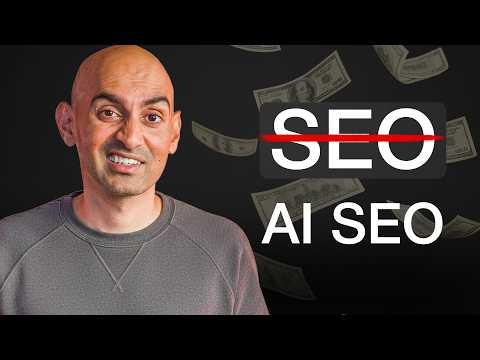
Everything you know about Marketing is changing (2026)
Neil Patel
12m 6s1,843 words~10 min read
YouTube auto captions
Transcript source
YouTube auto captions
This transcript was extracted from YouTube's auto-generated caption track. The transcript below is server-rendered so it can be read, searched, cited, and shared without opening the original YouTube player.
Pull quotes
[0:00]Marketing budgets aren't shrinking, they're shifting faster than most teams can keep up with.
[0:00]I just analyzed spending data from 9,210 marketers and the patterns reveal something critical.
[0:00]I'm Neil Patel, I run NP Digital, one of the world's largest independent marketing agencies.
[0:00]In this video, I'll teach you how to read these budget signals so you know exactly where to move your dollars, which channels to double down on and which ones to cut before they drain your ROI.
Use this transcript
Related transcript hubs
Watch on YouTube
Share
MORE TRANSCRIPTS


