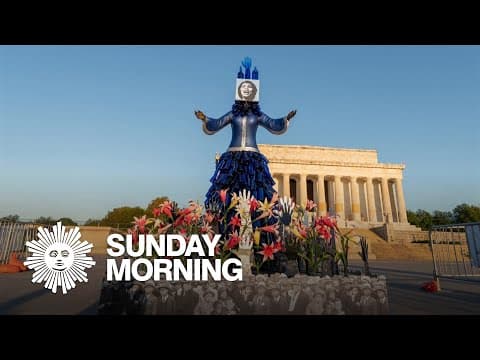
[0:01]What do you think is our most visited national park? Yosemite, the Grand Canyon? Nope, it's America's front yard, the National Mall in Washington DC. And as Fay Haley tells us, there's a new reason to visit. For over a century, the monuments on the National Mall in Washington D.C. have inspired us to witness, Remember, revere. But now we're invited to ring, to sing, to swing. This installation in the shadow of the Washington Monument is called America's playground. What do you make of the fact that kids really seem to be drawn to the rainbow part? Because the rainbow has always been about optimism. The artist, Derek Adams, was inspired by this 1954 photograph, depicting the integration of a public space just a few miles from the National Mall. He hopes the playground will offer joy and perhaps a history lesson. Maybe their parents might say to them, kids like you cannot play with kids that are right here, legally. And this is something that should not have existed, but it did. This is just one of six temporary works that comprise the first ever curated exhibition on the Mall, called Beyond Granite, pulling together. It asks the question, what stories remain untold on the National Mall? Look down and see a global map by Tiffany Chung that traces the roots of refugees from the Vietnam War. Listen and be filled with Ashante Crowley's memorial, recognizing the lives of black church musicians who died of AIDS. Our history is not just behind museum glass or on a pedestal, it's living with us. Paul Farber and Saisha Tillet are the co-curators, and worked alongside the National Park Service and the Trust for the National Mall. There's so many ways in which the pieces themselves are both mourning loss, that's part of the American story. But also testifying to the endurance of the human spirit. What do you think will surprise people the most when they witness these works of art? Just this feeling that you are recognized. When you have visited the National Mall, have you felt represented? No. Who is represented? White presidents. That's kind of what I grew up thinking. Artist Wendy Red Star grew up on a crow reservation and chose to tell the story of her ancestors. These are the names of 50 chiefs who signed treaties between 1825 and 1880. We get to know all 56 signers of the Declaration of Independence. But then the flip side of that are all these indigenous nations with important heroes of our own. The National Mall has become our civic stage. When Martin Luther King Jr. led the March on Washington, he chose to stand where opera singer Marian Anderson changed history. She performs here on the steps of the Lincoln Memorial before the first integrated crowd in DC history. Artist Vanessa German spent months recreating that moment. We can see ourselves as part of the crowd that witnessed that historical performance.
[3:55]And speaking of familiar tunes, artist Paul Ramirez Jonas offers a bell tower that plays America, my country 'tis of thee with a catch. It ends one note short, and that one doesn't play unless you, a member of the public, play it. What better gallery for art that is of the people, by the people, and for the people. None of these monuments, none of these ideas are alive, they're only alive when we embody them and participate. This song is not a song until someone plays the last note. Democracy is not democracy unless everybody votes. It's really to each one of us to participate and be a part of this.


