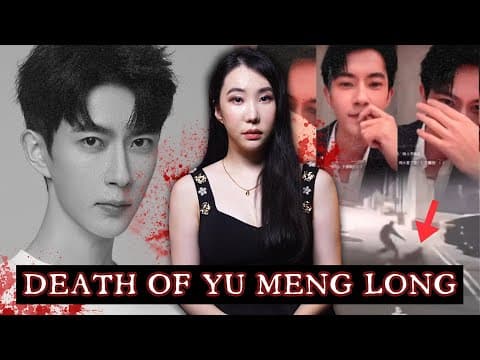
[0:09]When someone dies, especially someone famous, you expect the internet to light up with tributes, memories, grief shared across millions of screens.
[0:20]That's what happened on September 11th, 2025, when news broke about Yu Menglong. The hashtag #YuMenglongHasPassed shot to the top of Weibo, China's equivalent of Twitter. Millions were mourning together. And then, within hours, it all disappeared. And not gradually. The hashtag was scrubbed from the trending page. Screenshots people had taken of the memorial posts started vanishing. Tribute videos got taken down. Posts expressing grief were deleted as fast as people could upload them. And think about that for a moment. When someone tries to raise collective mourning, when they're working that hard to make people forget, it tells you something. It tells you there's more to the story. And that's exactly what millions of people across China began to suspect. Before we go further, I need to be clear about something. This account is based on publicly available information and media reports. The investigation is technically still ongoing and details may change. Nothing here confirms any specific allegations. This is about examining what we know and what doesn't add up. So, let's begin.
[1:43]On the morning of September 11th, 2025, around 6:00 AM, a resident walking their dog at the Sunshine Upper East residential complex in Beijing's Chaoyang district made a horrifying discovery. At the base of the building, in a pool of blood, lay the body of 37-year-old actor Yu Menglong. Emergency services were called immediately, but there was nothing they could do. Yu was already gone. Above, on what was reported as either the 27th floor, or possibly the 5th floor, depending on the source, a window screen was damaged and the window stood ajar. Within hours, local authorities had arrived at their conclusion. This was an accidental fall, they said. Yu had been drinking. Poor judgment. Case closed. And they meant it. Within twelve hours, the investigation was officially over. Except the case wasn't closed for millions of people online, because of what came next. In the days leading up to his death, Yu had sent several desperate messages to his mother. These messages have since been shared widely online, and they paint a very different picture from an accidental fall. One message read: "Yes, mother, the money they transfer, I want to vomit. It's dirty money. I'm not joking. I'm not hallucinating. They may kill me." Read that again. "They may kill me." This wasn't some vague anxiety. This was specific fear. Then, in what would be his final message, sent just hours before his death, Yu wrote: "I have to say goodbye now, they might kill me anytime." Now, here's where it gets complicated. Yu didn't name who "they" were. He didn't explain what the money was for or where it was coming from. But he was clearly terrified of something, or someone. And whatever it was, it involved money he described as "dirty" and people he believed wanted him dead. To understand why this case has captivated so many people, you need to understand who Yu Menglong was. He wasn't born into fame or privilege. He came from Ürümqi, a city in Xinjiang, in western China. Born on June 15th, 1988, he grew up in what you'd call a modest but supportive household. His mother was a music teacher who nurtured his early talent, teaching him piano and encouraging his singing. His father was a fitness coach who instilled discipline and work ethic. Yu started making a name for himself through reality shows and singing competitions. In 2007, he participated in "My Show! My Style!" In 2013, he competed in "Happy Boys," a talent competition where he placed in the top 10. And that's where he became close friends with Hua Chenyu, who would go on to win first place. That friendship would become important later in this story. From there, he transitioned into acting in 2011. It wasn't overnight success. He built his career slowly, role by role, earning a reputation for bringing emotional depth to his characters. His acting career took off in 2015 with "Go Princess Go," where he played the 9th Prince. His breakthrough came in 2017 with "Eternal Love," where he starred alongside Yang Mi. He followed with "The Legend of White Snake" in 2019 and "The Love Lasts Two Minds." But here's what people consistently said about Yu: despite the fame, he stayed humble. Reserved, even. He was described as professional, dedicated, intensely private. He wasn't the type to court controversy or get involved in scandals. He kept two dogs, Fuli and Huotui, whom he considered family. In the months before his death, Yu had been incredibly busy. He'd spent most of the previous six months on set, completing filming for a fantasy period drama called "Journey to the End of the Night" in late June. He had two films waiting for release: "The Fated General" and "Traditional Chinese Medicine." By all appearances, his career was thriving. Which makes what happened next even stranger. On September 10th, the night before he died, Yu attended a private gathering at a friend's apartment in the Sunshine Upper East complex. About a dozen people were there, maybe a few more. Accounts vary, but most sources put the number at around 16 attendees. To anyone watching from the outside, it probably looked like a normal evening. Friends hanging out. Nothing unusual. But the people who were there later said Yu seemed off. Tense. Or a little withdrawn. Like something was weighing on him. This was notable because Yu was known to have a low tolerance for alcohol, and he had a shoot scheduled for the next day. It wasn't like him to drink heavily before work. At some point during the evening, he separated himself from the group entirely. He went into a bedroom and closed the door. We don't know what he was doing in there or how long he stayed. We just know he isolated himself. Then, in the early hours of September 11th, just after 2:00 in the morning, something happened on that terrace. According to witnesses, they heard a scream. Then Yu fell.
[7:27]But here's where accounts start to diverge. Videos that circulated online appeared to show Yu being moved from Beijing's Bulgari Hotel to the residential complex. Other footage, allegedly showed him being dragged, appearing weak and injured. Some claimed to hear voices demanding he be forced to drink alcohol. None of these videos have been officially verified, but they spread widely enough to become part of the public narrative. At 6:00 AM, that dog walker made the grim discovery. Police arrived. Emergency services confirmed what was already obvious. By late morning, authorities had their story: accidental death caused by intoxication. Within twelve hours, the case was officially closed. Twelve hours. For a case involving a famous person, a fatal fall from a high-rise building, and messages about fearing for his life. Taiwanese lawyer Yan Ruicheng, who later analyzed the case publicly, said it plainly: it's impossible to properly close an investigation like this in just twelve hours. The speed alone raised immediate red flags. Let's talk about what wasn't included in that investigation, or at least what wasn't made public. The CCTV footage from the building? It was reportedly unavailable. Either it wasn't working or it was erased, depending on which account you believe. Autopsy results? Never released to the public. Witness statements? Also not made available. But there's more. According to claims that spread online, hospital staff allegedly leaked surveillance footage from the emergency room. The leaked information suggested Yu was brought to the hospital at 2:58 AM. By 3:12 AM, resuscitation efforts had failed. He was already deceased on arrival. At 3:20 AM, his agency reportedly came to collect his belongings. And at 3:45 AM, a masked woman was allegedly seen rifling through a trash bin outside the hospital. If accurate, this timeline raises questions about who knew what and when. Five days after Yu's death, on September 16th, his studio released a statement purportedly from his mother. In it, she said Yu had accidentally fallen after drinking alcohol, that police had informed the family of their investigation findings, and that she urged people to view the incident rationally and refrain from speculation. She asked that he be allowed to rest in peace. Then, on September 21st, the Chaoyang Branch of the Beijing Municipal Public Security Bureau issued an official police report. They reiterated that the death was accidental, that it occurred after drinking, and that they had ruled out any criminal activity. They said their investigation included on-site inspections, forensic examinations, interviews, and video surveillance. The family had been informed and raised no objections. But the statement didn't stop there. It announced that three women had been detained for fabricating and spreading false information online. Yuan, 29, allegedly fabricated claims that Yu was "hung from a building, had his nails plucked, cut open, and was thrown off." Xu, 41, allegedly spread rumors that "surveillance was destroyed" and "Yu's mother is being controlled." Zheng, 40, allegedly created fabricated videos. The message was clear: spreading theories about Yu's death would result in arrest. The reaction online was immediate and intense. People weren't buying the official explanation, especially after Yu's final messages became public. Users were demanding transparency, asking why the investigation had been closed so quickly, questioning every aspect of the official story. And just like the original mourning posts, these questions started getting deleted. Systematically. Posts would go up and come down within minutes. Accounts that kept posting about the case got suspended. Hashtags were blocked or redirected to other content. It was censorship in real-time, and it only made people more suspicious. Because here's the thing about trying to silence the internet: it usually has the opposite effect. International petitions were launched on platforms like Avaaz.org and Change.org, demanding that foreign media cover the story and calling for an independent investigation. Okay, now let's dive a little deeper into the speculations surrounding this case. Before we continue, I need to be clear that what I'm about to present are just rumors and allegations that have been circulating most widely across China and international platforms. These are unverified. None of this has been proven in a court of law. So why am I presenting them? Because to understand the full picture of this case, you need to understand what millions of people believe happened and why they believe it. The scale of public suspicion, the aggressive censorship response, and the questions that remain unanswered, all of these are part of the story. Whether these allegations are true or completely false, they represent a significant moment in how Chinese citizens are questioning official narratives. With that said, let's talk about the allegations surrounding that dinner party, because this is where the story becomes incredibly complex. People online started investigating who else was there. They identified roughly sixteen attendees, and two names kept coming up in discussions before being scrubbed from platforms almost immediately. The names were Xin Qi and Cai Yijia. To understand why these names matter, you first need to understand one person who wasn't at the party, but whose shadow allegedly looms over the entire case. His name is Cai Qi. And no, that's not the same as the other names I just mentioned, different people, but pay attention to the surname. Cai Qi is one of China's seven most powerful officials. He's a member of the Politburo Standing Committee, which is essentially China's ruling council. More specifically, he's the person in charge of ideology, propaganda, and censorship for the entire country. And think about what that means. If anyone in China has the power to orchestrate a nationwide cover-up, to scrub information from the internet in real-time, to close an investigation in twelve hours, it's Cai Qi. He literally controls the country's entire information apparatus. And according to widespread online allegations, two people who were at that party are his illegitimate sons. The first name is Xin Qi. He's described as a "second-generation red", Chinese slang for the children of Communist Party elite. Claims suggest he held a government position at just 18 years old, which is virtually impossible in China without powerful family connections. And here's the strange part: all information about him has been systematically scrubbed from the Chinese internet. Try to search for him, and you'll find nothing. But here's what makes Xin Qi relevant to Yu's story. He's alleged to be the controller, or the power behind, Tianyu Media, the state-owned company that managed Yu Menglong's career since 2013.
[15:31]He allegedly organized fan groups to manipulate Yu's opportunities and trapped him in restrictive contracts that prevented him from leaving, even when major opportunities came along. Then another name emerged, and this one caused even more speculation: Cai Yijia. Cai Yijia is a young actor born in June 1996 in Fuzhou, Fujian Province. Now here's where the timeline gets interesting. Cai Qi, the powerful official, was pursuing a master's degree at Fujian Normal University in Fuzhou from 1994 to 1997. Exactly when and where Cai Yijia was born. But there's more. They share the surname "Cai", which is culturally significant in China. Men often ensure that even illegitimate sons carry their family name. Cai Yijia's birth name, Cai Zhengjun, literally translates to "Politics and Military", a name that suggests powerful family connections. Netizens started comparing photos and noted what they described as a striking physical resemblance. Despite having what observers call average talent, Cai Yijia has received abundant acting opportunities with backing from established stars. But here's the most telling detail: media investigations have been unable to trace his family background. In China's heavily documented society where everyone has household registration records, that level of mystery is only possible if someone very powerful is protecting that information. And the censorship? Any mainland discussion linking Cai Yijia to Cai Qi is deleted within minutes. His social media accounts no longer allow comments. Some online theorists believe both Xin Qi and Cai Yijia are Cai Qi's illegitimate sons from different mothers. The theory suggests Xin Qi, being older, controls the political power and business operations behind the scenes, while Cai Yijia, being younger and in the entertainment industry, was more directly present that night. But it wasn't just alleged political elite at this party. Several entertainment industry figures have been named in online speculation. Actress Song Yiren lived in the same building as Yu. They were neighbors. According to leaked information, she's been described as someone who allegedly helped organize these types of gatherings. Unverified video allegedly shows her recording what was happening. The theory is that she used her friendly relationship with Yu to lure him to the party. She has publicly denied all involvement, and her lawyer has threatened legal action against those making these claims. Actor Fan Shiqi faces particularly brutal allegations. Claims suggest he tricked Yu into attending, and that unverified video shows him catching Yu when he tried to escape, beating him, and dragging him into a car. The theory about his motive? Jealousy. After Yu's death, Fan would inherit his professional opportunities. But his shows now face massive boycotts. He has not been charged with any crime. Now let me walk you through the theory about why anyone would want to harm Yu, because this is where all these pieces allegedly connect. Reports began circulating that business registrations had been found in Yu's name, not just one or two, but dozens of them. These weren't companies Yu had started or businesses he was running.
[19:10]They were registrations that used his name and phone number, tied to shell companies with vague or unclear purposes. Some of these companies had unusual classifications. Categories like "firearms" and "pyrotechnics." Now, why would an actor need his name on companies dealing with weapons or explosives? The obvious answer is he wouldn't. Which suggests his identity was being used without his full knowledge or consent. This kind of thing isn't unheard of in China's entertainment industry. There's been long-standing scrutiny about how celebrity names and identities get used to legitimize business operations that aren't exactly above board. Essentially, you take a famous person's name and credentials, register companies under their identity, and suddenly your shell company looks legitimate. The celebrity might not even know it's happening until it's too late. If Yu discovered that his name was being used this way, if he found out he was unknowingly connected to illegal financial activity or worse, it would explain his messages. It would explain the fear. It would explain why he told his mother the money made him want to vomit. Now we get into territory that's even harder to verify, but it's been discussed so widely that it needs to be addressed. According to claims that spread across Chinese social media, a USB drive was allegedly recovered from Yu's body after his death. According to these unverified accounts, audio recordings allegedly surfaced online. In one, voices could reportedly be heard demanding that Yu's stomach be cut open. Phrases like "Spit it out!" and "Cut open his stomach for me!" were allegedly captured. Another audio file purportedly featured a weakened male voice thought to be Yu, with someone saying "Don't worry, he won't die." The theory goes that if Yu knew he was in danger, if he believed people were coming after him, he might have swallowed a USB drive containing evidence. The theory claims that September party wasn't casual. It was allegedly a meeting about money laundering operations involving billions of yuan, disguised as "movie investment" discussions. And Yu allegedly discovered what was happening. He realized his identity was being used for illegal activities. More critically, he allegedly gathered evidence on a USB drive: recordings, documents, proof of the money laundering network. At that September party, Yu allegedly refused to participate anymore. He wanted out. He had the evidence. If Yu went public with this evidence, he wouldn't just expose money laundering. He could implicate the alleged sons of one of China's most powerful officials. That could mean prison for everyone involved, and a massive political scandal for Cai Qi. In this theory, Yu became a liability that needed to be eliminated. And the people allegedly involved were powerful enough to use Cai Qi's control over China's censorship apparatus to cover it up afterward. In what appears to have been Yu's final livestream before his death, some viewers noticed something disturbing. They reported seeing hand gestures that looked like distress signals. Specifically, what's known as the "540" signal, an internationally recognized sign that someone is in danger or being abused. The signal is subtle, designed to alert others without drawing attention from an abuser or captor. It involves specific hand movements that victims can make on camera to call for help. Beyond the hand signals, viewers said Yu appeared to have visible bruising on his body. And according to some accounts, he made statements during the stream suggesting that if something happened to him, people shouldn't believe it was an accident. He was trying to warn people. Then the stream cut off. Just ended abruptly. And like so much else connected to this case, the video was later removed from platforms entirely. If this is true, if Yu was sending distress signals and warning people in advance, it suggests he knew something was coming. He was trying to leave evidence, trying to tell people he was in danger, using the only platform he had left. And this might be one of the most unsettling aspects of the entire case. After Yu's death, his mother came to Beijing to handle the funeral arrangements. This is a woman who had received those desperate messages from her son. Messages about dirty money, about threats to his life, about fear and danger.
[24:03]The statement released on September 16th was attributed to her, asking people to accept the official explanation and stop speculating. But since then, she hasn't made any additional public appearances or statements. She's essentially disappeared from public view. Maybe she's grieving privately. Maybe lawyers advised her not to speak. But given the desperate messages her son sent her about fearing for his life, her total silence has made people deeply suspicious. Online campaigns like #WhereIsYuMenglongsMother emerged, demanding to know if she's safe and free to speak. But like everything else, these hashtags faced heavy censorship. The rumors that led to Xu's arrest, that Yu's mother was being "controlled", may have been false, but the question of why she's remained completely silent continues to haunt the case. And perhaps one of the most explosive allegations involves the residents of the Sunshine Upper East complex itself. According to claims that spread online, dozens of households in the building allegedly received substantial payments to remain silent about what happened that night. One alleged whistleblower claimed that residents received hush money twice, with each payment totaling roughly one million yuan, which is about $140,000 USD. If this spread across dozens of units, the total would reach hundreds of millions of yuan. The same source claimed that one resident admitted to seeing Yu's body and later being paid tens of thousands of yuan with instructions not to speak out. When asked if they heard anything that night, the resident allegedly replied that yes, there was an extremely loud sound like something falling, but property management told them it was just a family throwing things around and not to worry. Other reports suggested that residents who considered speaking out received threats. Red paint thrown at doors. Car tires slashed. The message was clear: stay quiet. What's undeniable is that after Yu's death, more than 100 households in the complex suddenly listed their apartments for sale. People wanted out. And when reporters tried to conduct on-site interviews, residents responded with near-uniform silence, refusing to speak and denying access to any surveillance footage they might have had. And that synchronized silence only deepened public suspicion that residents had either been paid off or threatened into keeping quiet about what they knew. But not everyone stayed silent. Hua Chenyu, Yu's close friend from Happy Boys, found a subtle way to mourn. At a music festival in Foshan, he performed with stage visuals showing a white figure falling, shattered glass, an hourglass, and scattered clock pieces. In the background, a hand reached out as if trying to catch the falling figure. Fans immediately understood, this was Hua's tribute. But speaking out came with risks. Actor Li Tingzhe, who urged attendees of that final dinner to come forward, received threats. Hua had his family background doxxed and personal data leaked. Yu's Taiwanese mentor, Sun Derong, who demanded justice, received a "death countdown threat." Fearing for his life, Sun issued an "I Will Not End Myself" statement. The message was clear: supporting Yu Menglong publicly came with risks. Productions connected to people at the gathering faced delays or cancellations. Cast members from "Love's Ambition" faced intense scrutiny. Fans boycotted content associated with anyone potentially involved. Property values near Yu's apartment dropped. The Bulgari Hotel mentioned in some accounts saw its reputation affected. Public distrust manifested physically; people didn't want to be near anything connected to the case. Now, let's talk about the systematic effort to control this narrative, because it's been extraordinary. Posts about the case are removed within minutes. Accounts get suspended. Hashtags are blocked. Even Netflix got drawn into the controversy when they reportedly removed Yu's name from the cast listing for "Eternal Love", further fueling speculation about pressure to erase his existence from public memory. And this isn't passive moderation, it's aggressive censorship requiring significant resources. Authorities framed it as part of the "Clean Net 2025" campaign to combat "rumor-mongering." But users adapted. They moved to encrypted platforms like Telegram and Signal. They used international forums Chinese authorities can't easily control. They developed code words to discuss the case without triggering censorship. Every deletion, every arrest, only convinced more people something was being hidden. International media picked up the story. Foreign Policy, BBC Chinese, and other outlets covered it. Analysts noted patterns: investigations closing too quickly, missing evidence, silenced witnesses, sustained censorship campaigns. And this wasn't the first controversial celebrity death in China, but it highlighted fundamental questions about transparency and accountability. When evidence disappears and questions go unanswered, it undermines trust in the entire system. And now, we are left with more questions than answers. Why was an investigation into the death of a famous person, who had sent messages about fearing for his life, concluded in just twelve hours? Why is the surveillance footage from the building unavailable? What was the nature of the dirty money Yu referenced in his messages to his mother? Who were the people he was afraid of? Why did his mother completely disappear from public view after one statement? What happened to the alleged audio and video evidence that circulated before being removed? Were residents of the building paid to stay silent, and if so, by whom? Why did over 100 households suddenly try to sell their apartments?
[32:46]Yu Menglong deserves better. His family deserves better, and we all deserve better. That's all for today. Thanks for watching.


