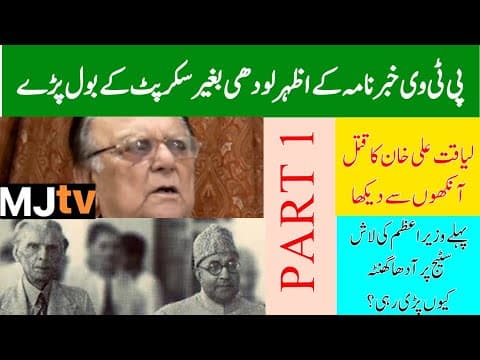
[0:00]Assalamu Alaikum Matiullah Jan MJtv. Today we are with a very special guest. I am very grateful to Mr. Azhar Lodhi, who is an eyewitness to history and a big name of an institution like Pakistan Television. And for people of our age, who are of our generation, who are us, since childhood, we have been imitating Azhar Lodhi Sahib and have come into media, started reading news in radio, then reported in PTV. So he was a great inspiration for our generation in terms of broadcasters. And then the generation before us, he was also an inspiration for them in terms of news. Pakistan Television was the only source of news about the political and constitutional history of Pakistan. And by listening to that news, we grew up, and our elders grew old. So today, Azhar Lodhi Sahib is with us in this special program of MJtv. We will only request him that Lodhi Sahib, the whole world has heard your news, the news you read, the whole of Pakistan has heard it, Pakistanis also know it, we have also heard it, but there was a lot behind the news. And you were not just a big face of Pakistan Television. You yourself saw the Pakistan Movement with your own eyes and you are also an eyewitness to the big events that followed. So if we go back to history before Pakistan Television, at the time of the creation of Pakistan, tell us those things that you might not have told till today. About the creation of Pakistan, and then the events that followed, so where will you start your story of experiences? In the name of Allah, the most merciful, the most compassionate. Assalamu Alaikum, ladies and gentlemen. I am personally grateful to Matiullah Jan, who came and spoke to me, a sinner, about what happened until now. A lot has happened, and there is a lot to say. They have also tried to say it, and I feel that I was very sad, I was hurt that there are very few people left who speak the truth, among whom Matiullah Jan's name is at the forefront. And when I found out what happened, it's a strange thing, there are many things in my heart to say, but when I want to say it, I get scared because I'm at that age where I want to leave peacefully. The respect that this nation, this country, this television, this Radio Pakistan, Pakistan Television has given me, I cannot forget that. Azhar Lodhi is Azhar Lodhi because of Radio Pakistan and Pakistan Television, otherwise Azhar Lodhi is nothing. Lodhi Sahib, our nation, our young generations, the generations to come, you owe them, and we also owe those young generations, so pay off that debt, tell us what you want to tell. I think that the amount of words you have to tell the whole truth, no one else has that, so with such a treasure of words, you should tell the truth in some beautiful way. Matiullah Jan, the thing is that we start with the history of Pakistan. What did you see?
[4:28]I was in Delhi, studying in fifth grade. And at that time, slogans were being raised, 'Leke rahenge Pakistan', 'Dena padega Pakistan'. 'Pakistan ka matlab kya? La ilaha illallah'. From here, the beginning is made. Quaid-e-Azam comes and addresses a public meeting at Ajmeri Gate. I had the honor of listening to that meeting. And I got that respect. I listened to Quaid-e-Azam three times. Once in Delhi, at Ajmeri Gate, when I was a child, studying in fifth grade. And then after that, in Lahore, there was a meeting in University Ground, where Quaid-e-Azam delivered a speech. I had the honor of listening to that. After that, he came here to Army Stadium. Here, he gave those honors. Rawalpindi, Rawalpindi. So there, in Sadar, there, I had the opportunity to listen to his speech. So, I started this because we were small, and then we lived in Delhi until 1947. My father was posted in Delhi, at Thana Hauz Qazi. There was an office of the editor of Jang, a place called Lal Kuan, where there was a small office. And Mir Khalil-ur-Rehman (late) used to come on a bicycle with newspapers and became friends with my father. And he used to bring newspapers and loved me very much. And the result of that love was that when General Zia-ul-Haq (late) went to deliver a speech in the General Assembly, where the recitation of the Holy Quran took place. There, in the Roosevelt Hotel, I, Muslehuddin (late), and the then Director News, and Mir Khalil-ur-Rehman, we were staying at the Roosevelt Hotel. And before that, the Iran-Iraq war had broken out. In that war, for the peace mission, Zia-ul-Haq (late) decided that I should go. Between two Muslim countries. Lodhi Sahib, we also come to the era of Zia-ul-Haq (late). Pakistan was formed, Quaid-e-Azam passed away, and then the events that followed, if we go there. After that, we then went to my grandmother's house in Jalandhar City during the summer holidays in 1947. We were small. We had no one big. Those who were big, they were shouting 'Leke rahenge Pakistan, dena padega Pakistan'. They were enduring the hardships of imprisonment. And were in jail. Anyway, my father managed to escape somehow, and a truck arrived in Lahore. In Lahore, my grandfather was the AIG Punjab Police. No, your father was in the police, you said. He was also in the police. He was posted in the station in Delhi, in Hauz Qazi. Your grandfather was AIG Police. AIG Police was in Lahore at that time, before partition. Okay. Then we, they came to Lahore, and there, my father's transfer was to Lahore on August 14, 1947. On the same day. On the same day, on the same day. Where was he transferred from? From Hauz Qazi station. Hauz Qazi station. Okay. And after that, he was transferred to Lahore. In Lahore, he came and saw that my uncle, there were two brothers. My uncle was a traffic inspector in the railway. He was the head. So his bungalow was in Westridge. So he told grandfather that my transfer should be made from Lahore to Pindi. He said that there are stones there, your land is not there. We had a lot of property. There was a whole village, where Chaudhry Muhammad Ali became the Prime Minister. He was his roommate. Chaudhry Muhammad Ali. So then he said that he should be transferred to Lailpur, which is now Faisalabad. Or Montgomery, which is now Sahiwal. So he said no, he is my brother, so we came here. We came here and then we came to Thana Sadar Baharuni, near Kachehri, which is the biggest police station in Pindi. He was posted there. So there, in Jhanda Chichi, there is a place nearby, there we got a small government residence. We got some utensils from some lawyer, some food, some other things. Now let's move forward to another major event, the assassination of Liaquat Ali Khan. Yes, at that time I was studying at Islamia High School, Murree Road, Rawalpindi. At that time, Murree Road was small. And this was Company Bagh. Liaquat Ali Khan (late) came to address a public meeting in Company Bagh. We went from school to the meeting. Which class were you in at that time? I was in, uh, this was 19, uh, 53? No, 51. 51. In 51, yes, 51. I was probably in sixth or seventh, seventh. Yes. Because in 47 you were in fifth. I passed matric in 1950. Matric first division. Then we went to the meeting. Liaquat Ali Khan (late) came to the meeting with a simple sherwani, old, worn out, and on his head he had the same cap. And you were close to him in the meeting somewhere? A little space in front of him was empty. Behind that, there was all the public. And on my side, there was a person named Syed Akbar, who had fired the shot. He was standing three yards away from me, on the right side. He was eating something. I saw, he had a small beard, and he was young. When he fired the first shot, the welcome speech was given. After the welcome speech, when Liaquat Ali Khan, there was only one chair on the stage, one table, one rostrum, one mic, that's it. No other worker was there, no officer was there, no other person was there. Liaquat Ali, the Prime Minister of the country, the first Prime Minister of the country, alone on the stage, and no one else was present there. In your opinion, were these also pre-planned things? These were pre-planned things. What I see is this. That he was made to stand alone on the stage. He said, 'Biradaran-e-Millat'. His tongue was thick. When he spoke, he couldn't pronounce 're' properly. 'Biradaran-e-Millat'. 'Biradaran-e-Millat'. He said 'Biradaran-e-Millat' and there was a 'thak' sound. I saw a shot was fired, so people clapped, thinking it was a welcome. After that, there were continuous sounds of 'tar tar tar tar'. The firing started continuously. So, more than one shot was fired at him, or was there any retaliatory action?
[14:17]Yes, more than one was fired, then. At the first shot, I myself, when the second shot was fired, his sherwani, from there, smoke rose, as if cotton was rising. Like that. And he fell. There was no one on the stage. He fell. People ran. They ran by lying down, because bullets were flying constantly. I saw that person standing. A young man in white clothes from behind shot him. He was a government employee. He looked like a government employee to me. So, no one asked him later, was he caught? No, for half an hour, the Prime Minister of the country lay alone on the stage. And no one went up. No one went up. For half an hour. Because for half an hour, no security came. So, all of them were scared that if we go, we will also be fired upon. I don't know what would happen, what wouldn't happen, because Company Bagh was empty. And in Company Bagh, caps, and coats, and mufflers, and everything was scattered. It was empty. People ran, they ran by lying down. My head was split open. The mark is still there. My head was split open, and blood was flowing. After that, I came back from Murree Road to see. At that time, he was lying down. Foam was coming out of his mouth. Where was he lying down? On the stage. Oh, okay. So, people had gone and were running away from him. No one came. People ran away. So you came back. How long was he lying there helpless? Almost half an hour. Oh, okay. So, his security, who was deployed there? I don't know who was deployed there. But there were police personnel, obviously, or some other people. I can't say that. I don't know. I only know that he was shot by the one, I also saw him. Then later, people came when an ambulance arrived after half an hour. At that time, he had already passed away. After half an hour, the ambulance arrived. Yes. There was no ambulance there. This is one major role of the ambulance in our history. In our history, Quaid-e-Azam's ambulance, and Liaquat Ali Khan's ambulance, to bring him. It's all in front of you. But I saw this with my own eyes. Then what did you find out later, who did this? From some sources, from some people, from some of your acquaintances, did you find out anything? You know that whoever conspires against the country, we don't need to say, people know who is behind this and who is not. You know more than us, you are a journalist. But the thing is that there must be some way to remove someone. There must be some fist shown, right? You remember, his picture was also circulated. Liaquat Ali Khan's fist. And he said that these are four provinces and this is Kashmir. Yes. Four fingers were shown for four provinces and this thumb for Kashmir. Yes. This was continuously on posters. Okay, now I'm going to ask you a question. Because your family, your grandfather was in the police, posted in Lahore. Your father was posted in Pindi. So your father or your grandfather, were they part of this inquiry or investigation, or did they ever share anything with you about what happened? No, it's not possible that they never discussed such a big event. No, I will tell you now. At that time, Najaf Khan was an SP. My father, my father's English was very good. Because he was posted in Shimla, so he was in the Viceroy House, in the police station. When he came to Delhi, he was first posted in the Viceroy House. He stayed there for quite some time. His English was very good. Najaf Khan, his English was like that. What was he? He was an SP. SP. Yes, it happened during his time. This police in Rawalpindi, in Rawalpindi, the murder happened, and his reader was appointed. Okay, all your father's postings, drafting, etc., he used to do all that. Your father's. What was his name? Agha Ali Ahmed Khan. This is my father's picture. Okay, I will show it, yes. This is my father's picture. So Ali Ahmed Khan Sahib, along with SP Najaf Khan, was posted as a reader. So what did Ali Ahmed Khan Sahib tell you? Since I was small, and these things are administrative, and these are not shared with children. Never later, when you grew up, sometimes it happens, some things that, after that, you know that an inquiry was held. Yes, you remember, there was a general. Was he General Sher Ali or something? Who was doing the inquiry? Yes, who was doing the inquiry. That whole inquiry report, along with the plane, the plane was also crashed. It was destroyed. It was destroyed, right? It was said that the whole file record was also burnt. The whole file record was burnt. You know all these things. Who was the General Sahib who, General Sher Ali or something, who was doing the inquiry? Yes, who was doing the inquiry. That whole inquiry report, along with the plane, the plane was also crashed. It was destroyed. It was destroyed, right? It was said that the whole file record was also burnt. The whole file record was burnt. You know all these things. There is a saying in this country, right? There is a saying. That is a very easy way. Because the plane is the only incident where nothing is found. God forbid. No, the first Prime Minister of the country, who was murdered in broad daylight. Not that people didn't know. People knew. It was common knowledge. So anyway, SP Najaf Khan, what do you think was his responsibility in such a big incident? His responsibility was because all the arrangements were, obviously, under the SP. All the deployment, this and that, everything. He had told him, I should tell you one more reason. My father's last posting, my father was not promoted. And the reason for not being promoted, Mir Khalil-ur-Rehman was told in Delhi that he should be arrested and put in jail. He was an Englishman, he was an SP. I have forgotten his name now. No, he didn't. Because it was a matter of friendship. And then he worked a lot for the Muslim League. So he gave such news that he got angry, the Englishman who was the SP. So your father, what was his rank? He was the in-charge, right? ASI or SP? He was an inspector. Inspector. Yes. Because he was in Hauz Qazi and Fawara Chowk. Two police stations, the biggest police stations in Delhi. Okay. So when this incident happened in Rawalpindi, after that, how long did your father serve in the police? When did he retire? Yes, my father, in the police, no, he took retirement. Okay. That's what I was going to tell you. Najaf Khan's brother, who was a soldier in his time. He became an SP. He came as an SP, and he took charge of the police station in Jhelum. That was his last posting. And there, Najaf Khan's brother became an SP. He gave his resignation. Okay, what year was this? This was, was it Ayub Khan's era? This was Ayub Khan's era. It means after 51, Najaf Khan's brother kept getting promoted, and Ayub Khan's era came in 58. In 58, it's in front of my eyes. Yes. I did my matriculation with Ayub Khan. So your father resigned during Ayub Khan's era. So it means that during Ayub Khan's era, Najaf Khan's brother was brought up and was made an SP. An SP. Promoted him. Promoted him. Okay, so would you call that a reward or for some reason? I can't say that. I didn't go that deeply into this. But I know that he said that, what job to do now. So as an inspector, he resigned. Okay. So after resigning, did you ever talk to your father? Obviously, you would have talked. Did he tell you any stories? No, he never talked about politics. But about such a big incident, he never talked about it? No, he never talked about it. He didn't include his children in it. In 58, you then, during Ayub Khan's era, you then went to college.