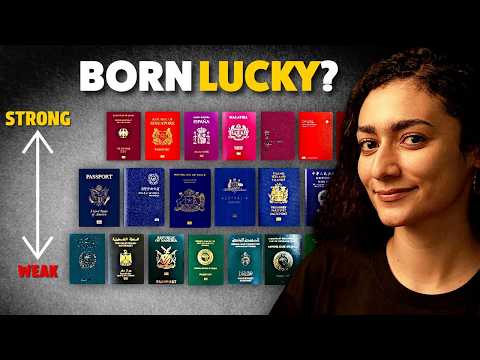
[0:00]Your passport isn't just a travel document. It's a ranking and a global hierarchy. Every year, millions of people are denied the freedom to move, not because of anything they've done,
[0:15]but because of where they were born. Let's say you were born with an American passport. Number 10 in the world. You've rarely had to apply for visas, an experience shared by most people in the Global North. I'm going to the place I've been dreaming about my whole life. Woo!
[0:37]But the way this allows you to move through the world, is not the case for most people. When you have a weak passport, the world is not your oyster. To have a better quality of life, to be able to travel, to get equal opportunities, we need to change the color of our passport, unfortunately. See, there's something called a passport index, which ranks passports based on their visa-free access. Per this ranking, the more orange the country, the more powerful the passport.
[1:13]The bottom half of this index is full of countries from the Global South, where movement across the world is made difficult at best and humiliating or impossible at worst. This is not a coincidence. This system was inherited from a time of colonialism. It's just so demeaning. I have cried multiple times. My entire life, for as long as I can remember, has been shaped by visa processes. So why does the accident of birth determine who gets to move across the world freely and who doesn't? And where did this system come from in the first place? Hi everyone, it's Tara. Before we dive deeper, we want to give a special thank you to our supporters on Patreon. Doing this work takes time, resources, and editorial independence, so it wouldn't be possible without our supporters online. If you believe in what we're doing and want to be a part of this with us, you can join our Patreon. It's how we keep this going. Now, back to the video. With a US passport, I can get into 179 countries without having to first apply for a visa. With a British passport, 182, German 185, and a French one, the same. That's the top of the list. Let's see the bottom. With a Palestinian passport, 39, Yemeni, 31, Iraqi, 29, Syrian, 26, and at the bottom of the index, Afghanistan, with 24. Not to mention everyone else on the list, and the 4.4 million people who are stateless. So what does applying for a visa typically look like? First of all, applying for a U.S. visa is the hardest thing in the world. The Canadian visa process is extremely complicated and long. The European visa system is actually designed to humiliate and strip you from whatever dignity you think you have. Step one is paperwork. You may be asked to submit bank statements going back months, salary slips, employment letters, flight bookings, and hotel reservations for hotels you may never stay in. Giving someone, some stranger, my bank statements for the last six months, seems like an invasion of privacy. I was once asked to upload a selfie of me and the friend that I was visiting in the country that I wanted to get a visa for. They requested documents like my parents' marriage certificates and the payment of our next school year's fees. They wanted me to list all the trips I've made in the past 10 years from the date of the application, including who I traveled with, where did I stay, who financed the trip. “Have you been a terrorist?” “Have you killed people?” “Are you part of a terrorist group?” And that sh*t is so funny. Even if I did, would I admit that? Many, many documents. Like hundreds of pages. Then there's the visa fees. So visas are very expensive. It ranges from about 100 to 300 dollars/euros, depending on the country you're applying to. The average salary in Egypt monthly is about 120-180 dollars. It's not just the visa fee which itself can be hundreds of pounds, it's all these hidden costs that you have to incur just to build an application. What happens to the money you paid if you don't get the visa? Well, they, well, they keep it. Obviously. In 2024 alone, African countries lost an estimated 67.5 million dollars in non-refundable Schengen visa application fees. Step three is getting an appointment. The moment the website is open, all the appointments are gone. It's more difficult than getting a Taylor Swift ticket. These can be so difficult to find that there are now AI bots that you can pay to ping you when an appointment is available. If you manage to secure an appointment, you'll probably need to take the day off work to go sit and wait for hours and potentially be interviewed about why you want to visit this country. At the appointment, usually we're like cattle. You're just sitting and you're being interviewed in front of basically everyone around you. So everyone can see you and everyone can kind of hear your answers. And the officer there asked me: “How come you have a Lebanese document, but you're Palestinian?” And I told him: “Because of the history, you know, 1948 Nakba.” He said: “I don't understand. Please write everything you know about this issue in a paper and give it to me.” It was funny, but sad at the same time. You shouldn't feel this nervous, you know, for a visa. They ask you questions that are at some points really intrusive. It got to a point where I even have to choose specific colors to the interview because I know that psychologically, I don't want to wear something that could trigger a threat in them. And if you're missing a document or something is wrong, you may need to come back in again. Travel hasn't always looked like this. Travel documents have existed for a very long time across the world, but the current system that we have in place is actually quite new. Passports originally appeared in Europe as a kind of letter of introduction for the elites that could travel. Each empire or territory had their own version. There was no border control or immigration, and there wasn't really any continental system in place. But by the late 19th century, mobility had changed. Railways made movement accessible to far more people, and the old system, or lack thereof, became too complicated and increasingly irrelevant, and was largely abandoned. That would soon change with passports, as we know them today, arriving in a very different Europe. One marked by suspicion, new borders, and new nation-states. This began with World War I. Tensions had been simmering throughout Europe for years between the six empires. Passports were supposed to be a temporary measure to mitigate espionage, stop laborers and soldiers from deserting, and to monitor borders. At the same time, European empires were breaking down into new nation-states, creating new borders, refugees, and stateless people. And this is also a time when racialized immigration policies are starting to emerge.
[7:59]By the time the war was over in 1918, the map looked different. Europeans were no longer defined by imperial belonging, but by nationality. And with nationality and borders came tighter monitoring and control over movement. As for Europe's colonies, movement had already been restricted. But now, those controls became more formal and systematized. The newly founded League of Nations held a conference on the fate of passports.
[8:30]Many in Europe had been unhappy with them and wanted to go back to how things were before the war. In Europe, that is. But despite calls to abolish passports, the system was deemed necessary to continue and the passports was standardized. Since then, these documents have evolved far beyond a simple proof of identity. The passport went from being an object of identification to an object of suspicion. And the corresponding visa system has only become more invasive and dehumanizing, widening the gap between freedom of movement for some and immobility for others. And while the system has changed, the victors have not. When you look at today's passport index, the empires that once traveled freely and pillaged the world now have strong passports that open most borders. And it's the countries that were once colonized, invaded or occupied, that now occupy the lower ranks of the global mobility indexes. They're the ones that are waiting to hear back on their visa applications.
[9:44]While your passport is held at said embassy, your travel plans and all the payments you've made are just on hold. Finally, you get your results. They send you an email saying your passport is back, you go there, get the envelope, you open it, inside the envelope is your passport, and you have to go through all the pages to see if you got a passport sticker or not. You can see everyone that gets rejected on the spot, and sometimes you can see the happiness in people's faces when they get accepted. When you get the visa, you feel like you succeeded, like you just finished a diploma, and you start calling your friends to tell them like, "I got the visa!" But many visas will be rejected, and without any clear explanation. I have only been rejected. I've been rejected countless times. They don't explain anything. They just say they weren't convinced by your application, and you have no way of asking for a reason. I have three sisters that went and studied in Canada and they remained there. I have tried several times to apply for a visa to go see them, and I've gotten rejected or I just didn't hear back every time.
[11:03]We just watched all kinds of people from all walks of life just pass through the immigration process and pass through security. And we were just sitting there waiting. And he's looking at my passport, my Syrian passport, and he's looking at me and he says something along the lines of: "If you dare to stay in this country, I will personally try to find you. It's just so demeaning, condescending and belittling, and straight up racist, discriminatory, whatever you want to call it, as if you're drooling to integrate into their society. And even with a visa, you could still be denied entry to the country. Friday, immigration officers at Boston Logan Airport deported an incoming Harvard freshman because of posts on his social media. The feds have revoked hundreds of student visas. And the home office decided to cancel my student visa after I spoke up at a pro-Palestine protest. Now this kind of treatment isn't limited to having a weak passport. Even if you have a so-called strong passport, your place of birth matters. Some countries may still stop you, question you, and even turn you away because of it. When I flew into a country with my Canadian passport, they didn't let me in because my birthplace is Lebanon. And it's important to know that despite this mostly happening to weak passport holders in the Global North, they could still be mistreated and have a very tough time with visas across the Global South as well. Why is it that somebody who was born and raised in the U.S., who could end up being like a mass shooter, you know, shooting down kids in schools, why is it that this person doesn't have to be vetted, doesn't have to prove anything, and can just go anywhere the f*** they want, but I, who has zero criminal record anywhere, still have to prove everything.
[13:06]Those newspapers from the 1920s still stand correct. The passport system really is a farce. If the idea is that passports and visas and the screening that goes with them protect nations, they don't. Passports can be bought, faked, or bypassed completely. And people with strong passports can pose just as much danger to society as people with weak ones.
[13:38]If you don't like the country that you live in, there are 11 countries that will let you join for money. Meanwhile, the rich of the Global South, and the rich of the Global North, if they're looking to evade taxes, can just buy themselves a new passport for hundreds of thousands of dollars and purchase the freedom to move. All this system does is make mobility incredibly difficult for the underprivileged of the Global South, many of whom risk their lives trying to escape this system that's designed against them. I had to work extra hard to achieve something great in my life and change the status quo that my grandparents and even my parents had to struggle with. But if I was born with a different nationality, I wouldn't have had to carry this burden on my shoulders as a child. The irony is that so many of these strong passport nations were built through mass immigration or the reading and pillaging of other nations. And while capital and even animals can flow freely across the world, people cannot. This isn't just about people not being able to go see the places that they're curious about. This is about people missing out on scholarships, on seeing loved ones, on incredible work opportunities, on getting essential medical care. Mobility has become a privilege that you're either born with or you're not, or you buy.
[15:03]Instead of what it actually is, a basic human right. This is an accident of birth. People from the West go to travel in our country. It's easy, they're welcome. It just makes me feel less than. Whereas they can just come have an exotic oriental holiday without anyone asking questions. The system today is a colonial inheritance built in a specific moment of empire and preserved long after empire supposedly ended. Inshallah, when I have kids, I want to give them a better life. I want to give them more opportunity. I want to give them freedom. And all of that comes from, frankly, a useless piece of paper. How has this system impacted your life? Oh my God. Oof. Throughout my life, I have always been seen as a threat, even as a child. You know, people have goals to like get married or to get their dream job. For a lot of Sudanese, their dream is to get another passport because it's just impossible sometimes to really do anything. My whole life was shaped by this. Like we grow up with the mentality or mindset that, oh, we have to emigrate. We have to migrate, not because we don't want to live in our country. We do want to live in our country and we want to do stuff for our country, for our people, but literally to have a better quality of life, to be able to travel, to get equal opportunities as other people who are perhaps way less capable or way less talented. We need to change the color of our passport, unfortunately. To be reminded all the time that you have to put in the work to prove these things versus other people who just can show up in virtually any airport in the world and be welcomed in on a f***ing red carpet. That is exhausting. It's a constant reminder that you are lesser than. It's ridiculous because it's something you're born with. You don't choose to have a passport, or you don't choose how the power structures in the world work, and you just have to be punished for the crime of being, I think.


