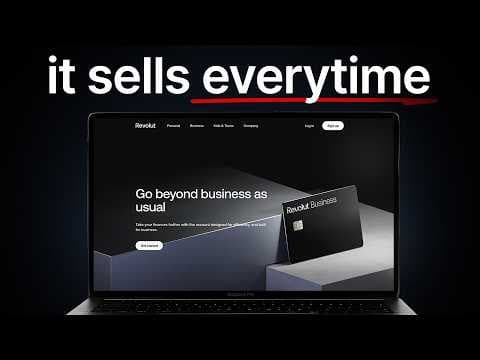
[0:00]We've all felt it. You land on a website and within seconds you just know it's premium. It's not just one specific thing you can point to. It's a feeling, that sense of quality, trust and authority. But what if I told you that feeling isn't an accident and instead is a deliberate result of applied psychology? Recently, I made a video explaining the what. But today we're going deeper. I'm going to reveal the three core psychological principles that separate cheap-feeling websites from premium ones. Show you how the world's top brands use them and give you a framework to apply them to your own site. The first and most important principle is all about first impressions. Studies have shown that it takes a fraction of a second, about 50 milliseconds, for a user to form an opinion about your website. And that opinion determines whether someone will stay or whether they'll leave. This is driven by a cognitive bias called the Halo Effect. Now the Halo Effect is our brain's tendency to let our initial impression of something color our judgment of everything that follows. If the first thing a visitor sees on your site looks professional, clean, and high-quality, then their brain automatically assumes that your products, your services, and your company as a whole are equally high quality. And that is why the top part of your homepage, the hero section, that part you see without scrolling is the most important real estate on your entire website. A cheap-looking header, a cluttered layout, or quality imagery in that first view, it creates a negative halo. Even if the rest of your site's brilliant, the visitor is now looking at it through a lens of skepticism. Premium brands are masters of the positive halo. They don't just design a homepage, they engineer that first impression. Principle number two is about making things easy. The truth is that our brains are inherently lazy. They're designed to conserve energy and when they're faced with something that's confusing or hard to understand, the brain has to work harder. This is called cognitive load. A website that creates a high cognitive load feels stressful and unprofessional. A website that is simple, clear, and intuitive creates what psychologists call cognitive fluency. It's easy to process. Our brains interpret things that are easy to process as being better, more trustworthy, and of a higher quality. Think about it. A cheap-looking website is often a chaotic mess of competing elements. Your brain doesn't know where to look and it feels overwhelmed. A premium website on the other hand, is a master class in clarity. It uses white space generously to give content room to breathe. It has clear visual hierarchy, guiding your eye exactly where it needs to go. The navigation is simple and predictable. But there's a very important distinction that you need to understand and this isn't just about aesthetics, it's about psychology. And by reducing the mental effort required to use the site, premium brands make you feel calm. They make you feel in control and they make you feel confident in their professionalism. The third principle is where the real magic happens and it's about those tiny details. I'm talking about micro interactions. These are the small, often quite subtle animations and feedback loops that happen when you interact with a site. A button that subtly changes color when you hover over it, a form field that gives you a gentle confirmation when you fill it out correctly, a smooth transition as you scroll down the page. These might seem insignificant, but they have a huge psychological impact because of something called the peak-end rule. This rule states that people don't remember an experience as an average of every single moment. They remember its most intense points, the peaks and how it ended. Micro interactions are designed to create small peaks of positive emotion. That satisfying click, a smooth animation, a helpful piece of feedback.
[3:47]These are the moments that spark joy for the user. Cheap websites are static and lifeless. They do the absolute bare minimum, sometimes even less to be honest. Premium websites feel alive because they're full of these thoughtful little details. They signal that the creator cared. They cared about the user's experience enough to obsess over the smallest moments. And when these moments are sprinkled throughout your website, they add up to create a powerful overall feeling of quality and craftsmanship. All right, so let's look at how the best brands in the world apply these principles. First, Apple. They are the masters of the Halo Effect. You land on their site and you're greeted with a stunning full-screen product shot and a single bold headline. It's minimalist, it's confident, and it immediately signals premium. The cognitive load is near zero. It's impossible to be confused on Apple's website. And their micro interactions from the way the pages scroll to the way the menus open are famously smooth and satisfying. Now, let's look at a luxury fashion brand like Hermes or Bottega Veneta. They use extreme white space to create a feeling of exclusivity and calm. This isn't empty space, it's a psychological cue that says, We are so confident we don't need to shout. They reduce the cognitive load to an absolute minimum, focusing your attention only on their beautiful products. Finally, look at a top-tier software company like Stripe or like Figma. Their sites create a powerful halo effect of innovation and trustworthiness. They use clear logical layouts to reduce cognitive load and make their complex products feel simple and approachable. All of these brands understand that their website isn't just a brochure. In reality, it's more of a psychological experience. So how do you actually apply all of this? Here's a simple three-step framework that you can use to make your website feel more premium as soon as today. Step one, engineer your first impression. Don't just design your homepage, obsess over the top half of it. Ask yourself, what is the single feeling that I want a visitor to have in the first 50 milliseconds? Is it calm? Is it confidence? Is it excitement? Build your entire hero section around creating a powerful, positive halo effect. Then, step two, declare war on cognitive load. Go through every single page of your site and ask, what can I remove from here? How can I simplify my navigation? Increase your white space, create a visual hierarchy with one primary goal for each section. Make clarity your number one priority. Remember, what feels simple to you might still be confusing to a first-time visitor. Step three, hunt for micro-interaction opportunities. Look for every single place that you can add a small moment of delight on your website. How do your buttons feel when a user hovers over them? What happens when a page loads? How does your site respond as you scroll? These details aren't extras. They are the very essence of a premium experience and they show that you care. The psychology of a premium website isn't based on using tricks or manipulation or any of that. It's based on respect. It's all about respecting the visitor's time by being clear and simple. It's about respecting their intelligence by providing a well-crafted experience. And it's about respecting their emotional response by creating moments of delight. If you want to learn more about how you can do this yourself, click here to watch the next video where I walk you through exactly how to build a website so premium that people will be begging you to buy no matter what you sell.


