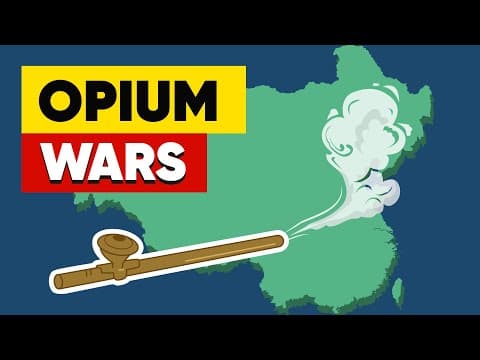
[0:05]In the late 18th century, Britain, one of the major powers of Europe, just walked out of the American Revolutionary War with the expensive cost of losing not only much of its national Treasury, but also its 13 American colonies. The Empire, therefore, seeks ways to find new sources of revenue, new trade opportunities, and then it finds one possible target, China. China, the Middle Kingdom, as it called itself, has been one of the dominant actors in the world for more than two millennia. As Emperor Chan Long in the letter to King George III in 1793 wrote, our Celestial Empire possesses all things in prolific abundance and lacks no product within its own borders. And then the wars waged between Britain and China in the 1800s have changed many things and left indelible scars in China. These wars, as we all know, are the Opium Wars.
[1:03]The Opium Wars in the mid-19th century were two armed conflicts waged between the Qing, a dynasty noted for its initial prosperity and tumultuous in its final years, and Western countries, namely Britain. In the 18th century, China enjoyed a favorable trade balance with Great Britain, exporting porcelain, silk, and tea in exchange for silver. This trade on the contrary was not balanced on the side of Britain, as millions of pounds of silver were flowing out of the British Empire and into China, forcing it to seek ways to counter trade, and then they did. Opium. In the late 18th century, the cultivation of opium in British territories in Bengal was expanded and Britain started exporting opium from British controlled India to China. By the early 19th century, the recreational use of opium skyrocketed, followed by an addiction crisis and serious social and economic disruption in China. A ban on both the production and the importation of opium was attempted, and in 1813, smoking opium was outlawed. However, these actions could not halt the opium trade. The Chinese government then implemented more serious measures. Opium dens were closed and many Chinese dealers were executed. A large amount of illegal opium seized from British traders were destroyed at Humen under the auspices of Lin Zexu, an Imperial Commissioner of Qing China. The tension increased after that. Some drunken British sailors brutally murdered a Chinese man but were not sentenced under the Chinese extradition. In response to this reprehensible incident, Lin halted the British food supply and ordered the Portuguese to expel all British from Macau, forcing them to move to a barren island off the coast, present day Hong Kong. Taken together, these actions escalated the standoff between two sides. And in November 1839, Chinese warships clashed with British merchantmen on the Pearl River Estuary in Hong Kong, leading to the outbreak of the First Opium War. In early 1840, the British government decided to use military force against the Chinese. The first hostile action was sending British warships and merchantmen to Hong Kong, and then proceeding up the Pearl River estuary to Canton. Within the next year, the British forces with its naval and gunnery power, inflicted a series of decisive defeats on the Chinese Empire. After months of negotiations and fighting, in late August 1942, the British managed to capture Nanking, putting an end to the war with the Treaty of Nanking. The treaty forced China to cede Hong Kong to Britain, pay an indemnity of $21 million to Britain and open five treaty ports at Shanghai, Canton, Ningpo, Fuzhou, and Amoy to British merchants. The supplementary Treaty of the Bogue in 1843 gave most favored nation status to the British Empire and added provisions for British extraterritoriality.
[4:17]The Second Opium War resulted from the failure of the Nanking treaty to satisfy British goals of improved trade and diplomatic relations. In October 1856, some Chinese Marines in Canton seized a British operated cargo ship, Arrow, arresting several Chinese crew members. This incident gave the British the excuse they had been waiting for to use military forces against China once again. But this time, Britain had French supports as the murder of a French missionary in China forced France to side with the British. In early 1858, having already captured Canton, French British forces headed to Tianjin. Once arriving at Tianjin, a treaty was once again proposed, and unsurprisingly for the Chinese, these treaties were even more unequal than the last one. The treaty included the opening of 10 more Chinese ports to foreign trade, permission for foreign legations in Beijing, and Christian missionary activity, and the legalization of the Opium trade. Although the Chinese signed the treaties in 1858, it took two more years of fighting, which ended with the capture of Beijing before the Chinese government was disposed to ratify the treaty. That's when the Beijing Convention was reached, granting Britain and its allied countries even more rights and privileges. But on top of that, this gave the British what they had fought so hard for, the legal trade of opium with China.
[5:53]The humiliating defeat of the Qing army by a relatively small British French military force was a shocking blow to the once powerful and prosperous Qing Empire. The Opium Wars not only provided convincing evidence of weakened China, but also made a further contribution to this weakening. And most importantly, the conflicts were believed to contribute to the ending of China's 5,000 year imperial dynastic system. And the beginning of what is now referred to in China as the Century of Humiliation. Thanks for watching. If you find this information useful, please give us a thumbs up and share it with your friends. Don't forget to subscribe to our channel for more videos of history.


