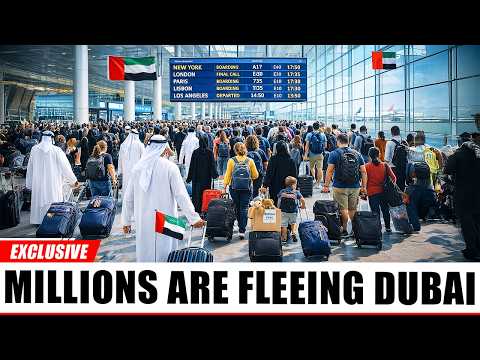
[0:01]Dubai, it is a place where millions of Americans look at and think of it as a symbol of ultimate wealth, where gold is cast into vending machines and supercars are abandoned on the streets.
[0:13]But now, there is a frightening truth being hidden. The richest are quietly leaving.
[0:20]A series of million dollar Villas are hanging for sale signs, and huge bank accounts are being drained. Why are those who hold the fate of the world fleeing from this paradise?
[0:30]And the most concerning thing is the collapse model of Dubai may be accurately reflecting what is about to happen to the American economy.
[0:39]If you think you're safe on the other side of the hemisphere, you're mistaken. Today, we will dissect the reasons why the desert dream is crumbling and how it will drain the wallets of Americans.
[0:54]If you stroll around Dubai Marina right now, everything still looks very Instagram. The skyscrapers still sparkle, but if you look closely at the windows at night, you'll see them dimming.
[1:07]This is not a power outage. This is a migration. Dubai is suffering from an illness that the wealthy call a correction, but in reality, it resembles more of a financial dengue fever.
[1:20]So what are the symptoms of this fever? First is the rent. Imagine you are living in an upper class dream, then boom.
[1:28]The landlord knocks on the door and announces a 40% rent increase overnight, not because of better amenities, but simply because they like it that way.
[1:39]In Dubai, greed seems to have been legalized under the guise of growth. The middle class families, the engine driving this city, are being drained.
[1:49]When the cost of living becomes an arms race, one realizes, here you don't live, you are just renting a temporary existence. But that's just the mildest symptom.
[2:01]A wave of migration among the super rich is what truly shakes Dubai. They often say that rats are the first to leave a sinking ship.
[2:11]But in Dubai, the first to leave were the big businesses. Saudi Arabia is opening up with more attractive offers, while Singapore is more stable.
[2:20]Dubai used to be the only pampered child in the Middle East, but now their neighbors have started to learn how to play this game. When the big corporations pack up, they don't just bring money, they bring assurance as well.
[2:33]And more importantly, it is the promise of stability, something that Dubai once took the most pride in presenting to the world that has begun to show signs of wavering.
[2:44]Dubai's visa system is like an ambiguous relationship. They want you to stay, but they never commit long term. You might be a golden resident today, but if your account falls below the required level tomorrow, you're just a stranger with a passport.
[2:57]The lack of a practical immigration pathway is turning Dubai into a luxury stopover rather than a lifelong destination. Some people say Dubai is like the latest iPhone, beautiful, sleek, and makes everyone crave it.
[3:12]But the battery drains incredibly fast, and the repair costs are enough for you to buy a house elsewhere. This is not a random event. This is a trend.
[3:22]A system built on superficial glamour is starting to show cracks at its foundation. People don't leave because they hate Dubai. They leave because this system has stopped working for them.
[3:34]You see, when a city is built to serve the wallet, instead of serving the people, when that wallet is threatened, the people will be the first to disappear.
[3:42]But wait, if you think just moving somewhere else will solve it, you're mistaken. Because what is happening in this desert is actually a prophecy for America itself.
[3:53]But housing prices are not the biggest issue. What is really putting an end to the Dubai dream is much scarier than that. What is it? Let's explore it right now and don't leave.
[4:13]Most of us often think that the rich are attached to a place because of skyscrapers or parties on yachts, right? Wrong. The rich are not loyal to locations.
[4:22]They are only loyal to optimization. Look at this fact. More than 4,000 millionaires flock to the UAE in just 2022, but that number is not a permanent commitment.
[4:36]It's a calculation. When you have five citizenships and a team of top tax lawyers at your disposal, the concept of home becomes very flexible.
[4:46]You don't stay because you love the desert sand. You stay because of three pillars: zero tax, absolute safety, and unlimited opportunity. Just one of these three pillars shaking loyalty will evaporate faster than ice under the summer sun of Dubai.
[5:05]Let's talk about taxes first. Dubai used to be a place that kept the rich because of its zero tax rate. That means 100% of what you earn is yours.
[5:18]But be careful. In June 2023, the UAE officially implemented a 9% corporate income tax.
[5:27]This figure may seem small compared to the US, but for the ultra wealthy, it is a symptom. It signals that the era of free has ended.
[5:36]Once the government starts dipping into your pocket, they won't stop at 9%. This is the first breaking point. The rich don't leave Dubai because they are getting poorer.
[5:45]They leave because Dubai is no longer the best option on their Excel spreadsheet. Now, let's talk about safety, which is currently seen as a gamble with Dubai.
[5:55]In the past, people felt safe in Dubai because of the low crime rate. Yes, but the real safety that the rich need is political stability.
[6:06]When tensions in the Strait of Hormuz escalate and neighboring countries no longer remain idle, Dubai is no longer a separate oasis.
[6:17]A piece of data that few people notice: the cost of political risk insurance in this region has skyrocketed. The tycoons can tolerate losing sleep over noise, but they will never accept the risk of losing their assets due to a geopolitical upheaval beyond their control.
[6:33]Now then, ask yourself, if you had five citizenships and enough wealth to live for 10 lifetimes, would you stay in a place where rent is increasing by 40% and taxes are being introduced?
[6:46]Of course not. You will fly to Singapore, go to Saudi Arabia, or return to some island in Europe. Dubai is learning a valuable lesson.
[6:55]You cannot build a sustainable community based on transient residents who are always ready to pack their bags when they see a better offer.
[7:03]This is not the collapse of a city, but the failure of a business model that centers on glitz. Dubai has not collapsed. There is no financial crisis yet.
[7:14]There is no scene of panic, but there is something quietly disappearing, and that is the most dangerous thing. We will talk about that right now.
[7:24]Have you ever wondered what really keeps the skyscrapers in Dubai standing firm on the sand, not reinforced concrete nor oil? That is faith.
[7:34]Dubai doesn't sell real estate. They sell a promise of absolute safety and unlimited opportunities. But there is a harsh rule in the financial world.
[7:43]Trust takes decades to build, but only a few months to evaporate. Many people who have lived in Dubai share a common feeling.
[7:53]This place is beautiful, but empty. An unreal beauty conceals a soulless nature. When you scroll through the comments of those who have just left, the phrase that appears most often is, greed destroyed everything.
[8:06]Suetam Lam duong Hu Jung Lam Hong tat Cha. Data shows the occupancy rate of Class A offices in some new areas has dropped below alarming levels.
[8:19]Why? Because when core values are replaced by exploitation, those with a long term mindset will withdraw. They realize they are in a Ponzi scheme of glamour.
[8:30]The new ones come in to pay for the luxury of the old ones. Look at those shimmering skylines. They are symbols of success or glass tombstones for an oversized dream.
[8:42]A city does not collapse when it loses money. It collapses when it loses trust. When the cash flow withdraws, it is a financial loss.
[8:51]But when high quality human resources, the brains operating the system, leave it, is the collapse of an ecosystem. Another shocking piece of data.
[9:00]The number of applications for business license transfers from Dubai to other free economic zones in the region has increased by 25% in just the first half of the year.
[9:12]This is no longer a market adjustment. This is a vote with their feet. There is a deep irony here.
[9:18]Dubai tries to become the center of the world by pleasing everyone, but in the end, it makes the most important people feel like they are just cash cows.
[9:29]You cannot build a homeland on the foundation of short term rental contracts and conditional residency cards. I want to ask you a question.
[9:37]If stability is just a light show, would you dare to bet your entire career on it? The ultra rich have answered by leaving. They don't hate Dubai.
[9:47]They just no longer believe in the script that Dubai is playing. The collapse of trust is like a crack in glass.
[9:54]At first, it's very small, but pressure will make it shatter in an instant, and this is the truly dangerous part. Because if you look closely at the cracks in Dubai, you will start to see similar reflections right in New York, Los Angeles, or Miami.
[10:11]And if you think this is just Dubai's story, then you're mistaken. Because what is happening in Dubai may not be a distant story, but an accelerated version of what is gradually emerging in your own life.
[10:37]Let's start with something very familiar, the cost of living in Dubai. Housing prices have risen to the point where many people are forced to leave, not because they want to, but because they can no longer afford to stay.
[10:50]And if you look at the United States, you will see that this is not unfamiliar, as housing prices in many major cities have doubled in less than a decade.
[11:00]And a thought provoking statistic is that over 60% of young Americans today cannot afford to buy a house in the very place where they work. This creates a rather ironic paradox.
[11:10]This creates a rather ironic paradox. You can earn more money, but it becomes increasingly difficult to live in the place where that income is generated.
[11:17]And when the cost of living rises, the first group to be affected is not the wealthy, but the middle class, those with stable jobs and income, but not enough to get ahead.
[11:32]Like standing on an escalator moving in the opposite direction, the harder they try, the harder it is to stay in the same place.
[11:40]Meanwhile, another figure shows that nearly 70% of Americans live from paycheck to paycheck, with almost no significant savings, meaning they don't really have many options if the system starts to become more expensive or unpredictable.
[11:57]And then a bitter truth gradually emerges. When the ship starts taking on water, those in first class always have lifeboats.
[12:04]The super rich in Dubai are not stuck. They simply change their phone area code and move their assets to another country to optimize taxes. But what about you?
[12:17]One piece of data that makes us ponder. The number of Americans applying for a second passport or residency card in Europe has surged by 300% in the past three years.
[12:27]Why are those living in the land of freedom looking for a way out? Because they realize a paradox.
[12:35]The rich are not loyal to the national flag. They are loyal to the safety of their assets. When America is no longer the only safe haven, smart money will flow away.
[12:47]And when that money leaves, they leave behind an empty economy for those who have no choice but to stay. Dubai once sold a dream of stability.
[12:56]The same goes for the US. But ask yourself, is a country truly safe when its public debt has surpassed $34 trillion US dollars?
[13:06]Each American citizen is shouldering a debt they never borrowed. We mock the artificiality of Dubai, but forget that our own economy is also being inflated by virtual numbers on computer screens.
[13:18]The exodus of the ultra wealthy from Dubai is a costly lesson in trust. If those with the most choices, the holders of data and power start to leave, then the problem is not in Dubai, but rather in the system itself.
[13:33]They have seen the end of the growth model based on debt and hyperinflation. They are looking for a way out, while we are still engrossed in debating superficial issues.
[13:45]I don't want to draw an absolute conclusion. I want you to self reflect. Is America truly stable, or are we just a larger version of Dubai, with older buildings and even bigger debts?
[13:58]Let me know your thoughts in the comments. Do you think Dubai is a harbinger, or just a minor incident on the path of human development?
[14:06]And most importantly, what have you prepared for the day when your own paradise starts sending out the bills? We have gone full circle from the glamorous boulevards of Dubai to the empty rooms and the silent outflow of money.
[14:21]There is a harsh truth. The system never saves those who remain. It only saves itself. Dubai can recover. The towers could be bustling with people again, and the supercars could be gleaming on the streets.
[14:35]But the real question is not whether Dubai exists or not. The question is, when those with the most choices, the brightest minds, and the wisest wallets have decided to leave, will they ever come back?
[14:49]And if they don't come back, what remains in Dubai might just be a magnificent shell of a bygone golden era. Look beyond the desert. Look at the very city you live in, at the economy you place your trust in.
[15:02]Do you think what we just discussed is merely a temporary market adjustment, or is this the first sign of a larger shift in order that America and the world are about to face?
[15:13]Don't just see this as a story about a distant city. This is a test of your own preparedness. And you do. You choose to stay and believe in the system's promises.
[15:24]Or have you started looking for an escape like the ultra rich are doing? Please leave your comments in the section below. I read everything and would love to know your perspective on this silent storm. Don't forget to like and subscribe.
[15:42]If you find this video offers a perspective that mainstream media is ignoring. The content in this video is analytical, informational and personal in nature, intended for reference and discussion.
[15:54]This is not financial advice, investment advice, or an absolute assertion about any country or market. Each person has different circumstances and perspectives.
[16:05]So please consider and verify the information before making a decision. Thank you for watching until the end. See you in the next videos.


