[0:00]Hi, my name is Otto, and in this video, we're going to discuss agent skills. Agents today are pretty intelligent, but they don't always have the domain expertise you need for real work. And skills help solve this. You can think of skills as organized folders that package expertise that Claude can automatically invoke when relevant to the task at hand. And most importantly, these skills are portable across Claude Code, the API, as well as Claude.ai. And the way skills work is, at startup, only the name and description of every installed skill is loaded in the system prompt. This is going to consume about 30 to 50 tokens per skill and make Claude aware of the skill's existence. Then, when a user prompt matches a skill's description, Claude is going to dynamically load the full skill.md file into context. And finally, if the skill references other files or scripts, they are also progressively loaded and run as needed. This progressive disclosure allows you to install many different skills to perform complex tasks without bloating your context window. But let's see how skills fit in with the other Claude features. While skills teach Claude how to do specialized tasks, Claude MD files tell Claude about the specific project. Things like your tech stack, coding conventions, and repo structure. Claude MD files live alongside your code in the repository. A Claude MD file may say things like, we use Next.js and Tailwind. But skills, on the other hand, are portable expertise that work across any project. So, a front-end design skill can teach Claude your typography standards, animation patterns, and layout conventions and activate automatically when building UI components. MCP servers on the other hand provide universal integration, a single protocol that connects Claude to external context sources like GitHub, linear, Postgress, and many, many others. MCP connects to data, skills teach Claude what to do with it. So, an MCP server may give Claude access to your database, but a database query skill can teach Claude your team's query optimization patterns. Finally, sub-agents are specialized AI assistants with fixed roles. Each sub-agent has its own context window, custom prompt, and specific tool permissions. Skills provide portable expertise that any agent can use. So, your front-end developer sub-agent can use a component pattern skill. Your UI reviewer sub-agent, on the other hand, can use a design system skill, but both can load and use the same accessibility standards skill. And the best part is these capabilities are designed to work together. Your Claude MD file sets the foundation, MCP servers connect the data, sub-agents specialize in their roles, and skills bring the expertise making every piece smarter and more capable. At the end of the day, skills let you package workflows into reusable capabilities like helping onboard new hires to your team's coding standards, ensuring every PR follows a specific security best practices, or sharing your data analysis methodology across your team. And that's how skills can help you achieve more with Claude. We encourage you to give them a try and see how they can improve your workflows.
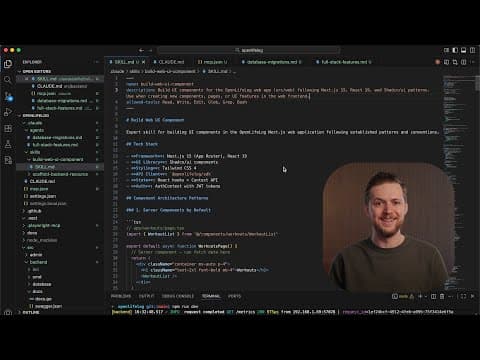
Claude Agent Skills Explained
Anthropic
3m 12s519 words~3 min read
YouTube auto captions
Transcript source
YouTube auto captions
This transcript was extracted from YouTube's auto-generated caption track. The transcript below is server-rendered so it can be read, searched, cited, and shared without opening the original YouTube player.
Pull quotes
[0:00]Agents today are pretty intelligent, but they don't always have the domain expertise you need for real work.
[0:00]You can think of skills as organized folders that package expertise that Claude can automatically invoke when relevant to the task at hand.
[0:00]And most importantly, these skills are portable across Claude Code, the API, as well as Claude.ai.
[0:00]And the way skills work is, at startup, only the name and description of every installed skill is loaded in the system prompt.
Use this transcript
Related transcript hubs
Watch on YouTube
Share
MORE TRANSCRIPTS