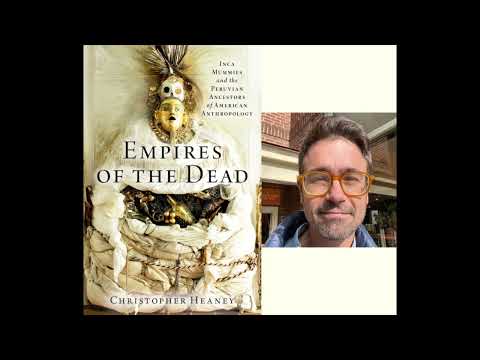
[0:00]Welcome to the podcast of the Consortium for History of Science, Technology and Medicine. I'm Bob Akishrafi. Today is October 13, 2023, and I'm speaking with Christopher Heaney. He's the author of Empires of the Dead, Inca mummies and the Peruvian ancestors of American anthropology, which has just come out from Oxford University Press. Thanks for joining us, Chris. Thank you so much, Bob. I'm very happy to be here. I had a cox fellowship back in 2012, which took me to Philadelphia and was completely transformative for what the dissertation and then now book became. And so, it's lovely to be able to come back here and share a little bit of it with you. Well, it's a wonderful book, and I'm glad we could help a little bit. Why don't we start with what is a Peruvian mummy and how does it differ from the images of Egyptian mummies with which we might be familiar? It's a wonderful question. Mummies as a term and as an idea, really come to us through Europe's encounter with Egypt and the Near East in the 16th, 17th and 18th century. And so, that's left a mark on Egyptology and archaeology, but also popular culture. So that when most of us think about a mummy, maybe the thing that flashes into our minds is King Tut, Tutankhamun, or maybe more realistically Boris Karloff as the mummy and, you know, a Universal horror creature feature or more recently Buffy the Vampire Slayer. But in Buffy the Vampire Slayer, what's lovely about that, that is actually a proven mummy, even though it's kind of depicted like an Egyptian one. And I'm sure the listeners will be able to call that up in their minds, you know, a body lying supine, wrapped up, bound together, looking well preserved but certainly more dead than alive. Peruvian mummies and Andean mummies are mummified ancestors actually reflect a very different Andean understanding of what a past ancestor was, which is not just somebody who's dead and gone, but still socially active and involved in the lives of the living. So, uh, for the Incas, this meant uh that they were seated and were carried about on litters and um sat in their palaces. And in general, this sort of translates in is in the Inca example is the product of a longer Andean culture of interring ancestors and the dead in sort of seed-like bundled positions. Sometimes it's been likened to being wrapped up like a fetus, as if in death they were approaching how they were when they came into the world. But also in positions that suggested that, you know, they were there to be interacted with, spoken to, and when they end up in museums, which is what one of the things that my book is about, they are sitting, sometimes gazing at the visitor and viewer, uh communicating a very different idea. Not death, but life and continuity between between these different stages. When you say they're alive and active, can you say more about why these bodies were preserved and how they were used or understood, especially in the expanding empire of the Incas before the Spanish invasion of the mid-16th century? Absolutely. There is a very deep history of ancestors and remains being mummified in the Andes and in South America. The oldest artificially mummified remains in the world are from the Chinchorro people and what is today Chile or Arica on the uh South American coast. And when they began mummifying um their dead or preparing them to have a a longer and more stable afterlife, they actually started with their children. And we can understand that as being an extension of grief and an extension of loss that sought to turn maybe the hardest thing into something that could be born. And also, and this is where I'm drawing very much from anthropology and how they think of it as turning turning kin, and children, and then later on ancestors, older members of society, into things like beings like seeds that could be offered food, beverages, could be given offerings to then communicate with the environments to support a society, um the living and their descendants. And over the um the next 7,000 years, sort of these different techniques of mummification, many of which relied upon Andean climates, very dry in some places, very cold in others, to turn ancestors and kin into stable members of society. At least for a little while, there isn't one long mainstream of of mummification and even talking about it as Andean means sort of a level of generalization that didn't happen until colonialism and the Republican period. But nonetheless, by around 1000 CE or AD, we see the development of what archaeologists sometimes talk about as the Andean cultural package of of ancestor veneration. Particularly in the Highlands, um in the mountains, where ancestors are preserved in seated positions like I mentioned before, but placed in open tombs or entombments or palaces where they're accessible and where they can be visited and wrapped and re-wrapped and asked questions of to guide society. And the Inca Empire elevated these techniques to the level of political authority and control in almost a universal sense. This is one of the ways that we can think about them as an empire, as something comparable to imperial forms elsewhere. They took their own ancestors or their own emperors in particular, but also their wives, consorts, empresses. And after they died, preserved them in seated positions using a combination of botanicals, but also anatomical interventions similar to what our listeners might know of how Egyptian mummies were made. to turn their emperors into essentially everlasting beings, who continued to own property, continued to own their palaces, continued to own the places they had conquered in life, that then supported themselves, their cult, but also the family members who continued to interpret their desires. Many of whom have seemed to be women, priests towards the mummies, seems to have enjoyed a fair amount of political authority and control over relationships to those mummies.
[6:35]And the last thing I'll say about it is that some archaeologists go so far as to suggest that Inca imperial expansion spreads some of these techniques of more permanent preservation to some of the people that they incorporated or sometimes tried to conquer. And the idea behind this theory is, I mean it's it's shown in in how archaeologists and anthropologists have engaged with changes in preservation from before an Imperial horizon and afterwards. And after the Imperial Horizon, some subject ancestors become much more firmly preserved, which they used to sort of think about, well, how did that serve the empire? Maybe the preservation of a subject's ancestor was a way of essentially signing a contract, showing, this is the person that local noble that was conquered or incorporated and our speaking here is the Incas are respect for this local venerated ancestor is what binds you reciprocally to the empire. That you are responsible for delivering tribute and labor to the Empire because of this relationship, these hierarchies of preserved beings. I lied, there is one other thing to say about it, which is that another way we can think about the Incas as an Empire is through sometimes the collection of their own subjects. venerated ancestors that if a subject's ancestor preserved ancestor was sacred enough or spiritually efficacious enough, sometimes the Empire would adopt it and take it to Cusco, the Imperial Center to join the house of the Inca Emperor, who subjugated or incorporated them. And command them in a way that one archaeologists George Lao has suggested is similar to the Imperial Museum practices of uh European empires. And which is an aspect I think is particularly important for thinking about what happens after the Spaniards arrive. So let's talk about that once the Spaniards arrived, and the Empire obviously changes, and there's the indigenous communities, but also the Spanish communities and the Creole as well. So how did the understanding and use of these artifacts change after the arrival of the Spaniards? When the Spanish arrived, one of the first things they noticed was this practice of treating with and attending to and to the extent of venerating the ancestral dead, both among the Incas and then in many of the um temples and sacred spaces that they looted on the way to Cusco. At first, they focused more on the fact of these Andean ancestors' wealth in the case of the Inca emperor that he and and the empress were covered with gold and silver that could be stolen. But they also attended to how well preserved they were, and this is where, you know, one of the chief interventions of my book, I hope, for the first third, is to show how this invasion and attempted conquest by the Spanish was as scientific as it was spiritual when it came to the Inca and Andean dead. They wanted to know exactly how in the word that the Spanish used, how the Incas were quote embalmed. In describing them as embalmed, they were attaching it to this old world tradition of treating the remains of kings and queens and uh wealthy people as well in the early modern period, but also in antiquity with botanicals, materia medica, that extended the life of a body. And the Spanish were incredibly impressed by the Inca remains when they saw them. They interpret them as as whole and preserved as if they had just died the day before from the 1530s, 1537, 1538, the Spanish Crown is already asking for samples of quote balm of Peru. Which was the material that the Spaniards associated with Inca and balmy practices. And this was to monetize them, to turn that practice into something that could be sold, but it was also a way of trying to desacralize Andean Empire and take it from a realm of the cosmic, where Andean ancestors outlived their sort of expiration of breath. Could command the the affections of their of their kin and shifted into the realm of the scientific, saying, it's not because that they were spiritually powerful. It's because they were treated by an Andean or Inca facility with anatomy with botanicals. And so, I think this is when the arrival of the word mummy to the Andes, helps us think about power and control and how scientific terms really try to simplify things and sometimes do violence to an original understanding of the dead. Because to to refer to the Andean and Inca ancestors as dead or mummies really tries to box them in a realm of anatomy, of science, of comparison with Egypt. When Andean peoples and the Incas had their own many different words for who these beings were. For the Incas, they were Iapa, which connected them to the lightning bringing gods. They were hardened, they were shining for one group of their subjects in the area of Kahatambo, they called them Malquis, which likened the Andean dead to roots, or fruit, or cuttings that could be replanted, a more vegetal uh metaphor. But the labeling of the Incas and Andean dead as mummies, particularly after the 16th, 17th century invasion, means that in the 18th century, Europeans who are reading about Peru, and they were reading a lot about Peru from the 16th century, was one of the chief drivers of what we would call today ethnological or ethnographic scholarship in the 16th and 17th century. Outsiders reading about them came to expect that if you wanted to look at mummies in the new world, in the Americas, that Peru was the place to look. And that the Incas, at least according to the Inca chronicler Garcilaso de la Vega, that the Incas had perhaps better preserved mummies than anybody else on Earth. Um, which became a point of pride for Peruvian Creoles and uh Patriot as in the word that Jorge Canizades, uses, Patriot epistemologist. Uh, people who are imagining Peruvian independence in the late 18th, early 19th century. This becomes something they can grab onto as part of a pre-colonial national tradition that Peru is the hearth of anatomy and also scientific sovereignty in the Americas. Which leads to, and this is a story in of itself, but I'll give a space for questions after this to the uh the South American patriot Jose de San Martin. After declaring Peruvian independence in 1821, he announces that independence to England and to Great Britain by sending King George IV of England a so-called Inca mummy to go in the British Museum. Which was a sort of statement of um scientific purpose as well as sovereignty that connected the new Peruvian nation to this long tradition of Andean science and Inca identity, though not necessarily or actually not at all living Inca and Andean people. What about indigenous communities? Did the production of mummies continue under Spanish rule, and how did the understanding or use of mummies by indigenous people change after the Spanish arrived? Andean people continued to preserve and enter their dead, as they had before the Spanish arrival, it seems through the early 17th century. This was partly because the evangelization in the Andes for the at least the first 30 or so years, really sought to find points of contact between old and or like European Christian understandings of death and the afterlife and Andean ones. And so, in the 1890s, for example, the archaeologist Adolf Bandelier found a mummified body bundled up with a copy of a Papal Bull close to its chest, showing that in this period of transition, communities were continuing to enter their dead according to original practice,
[15:01]but in ways that reflected new Andean Christian identities. The hard and difficult line is that from the 1570s on, Spanish colonial and religious authorities tried to crack down as part of the counter-reformation and as a method of eliminating religious and political competition from the Incas and old Andean leaders. In the early 17th century in particular, Spanish religious orders conduct expations of idolatry in the Andean Highlands, which forces many communities who had converted to Christianity, were worshipping in churches on the day of worship, but the day before we're still visiting some of the ancestors and still moving occasionally individuals who died from the church into the countryside. And in still other places, it was a combination of those things, where, you know, if you came across a tomb in the countryside, it might be appropriate to or possible to to remove a pot or a ceramic, but in return, you don't disturb um the remains and you leave them an offering. And so it's an incredibly complicated set of relationships that that to this day uh shape the practice of what we'd call archaeology, but, you know, one of the things my book tries to show is that archaeology is as much an extension of colonial looting and extirpation as it is a science. That certainly didn't arrive in the 19th century and I think it arrives and takes shape in the 18th century.
[19:22]You mentioned San Martin sending mummies to Britain. And of course, a large number of mummies were dug up and collected by foreigners, but you also tell us in your book about Peruvians collecting these remains and sending mummies and especially skulls abroad. Can you say more about why Peruvians did that? Yeah, thank you. This is one of the more challenging points that took me a while to sort of understand and wrap my head around, because one of the narratives that I think we have for from the realm of the history of archaeology and the history of museums and cultural patrimony is that in these contexts that we might see as like post-colonial or as still colonial, Um the assumption is that it's the exterior market or imperialism that is pulling archaeological remains or indigenous remains. And this is true in many settings, particularly in talking about the United States and how settler colonialism and slavery shaped the collection of ancestors and kin in the Americas and in museums. But the side of it from Peru is that with San Martin, there is also a precedent for electing to represent the nation, to represent science, to represent also Peruvian history and indigenous history via the dead, that it wasn't necessarily as racialized objects, but as representatives of a longer history that had been interrupted by colonialism. And this flies in the face of some narratives that we have about archaeology and cultural patrimony and museums in 19th century Latin America, where, particularly in Peru, where sometimes the narrative can be there was a failure to protect. That this was a period of extraordinary looting, and it certainly was. This is a moment where, particularly on the coast, the influx of outsiders, but also Peru's reconnection to the international economy, means that there's new opportunities to loot and new incentives for doing so. Particularly if you can sell it to a foreigner or abroad. But there was also a early 19th century and mid-19th century scientific liberalism that seems to be embodied by many of Peru's early scientific actors, where the goal of the museum isn't just to be a showcase for the nation. It is to be increasingly universal, that what Peru's National Museum originally is supposed to include, and historian of science Stephanie Ganger's work is excellent on this, it's meant to have objects from all over the world. From Egypt, from Italy, from Great Britain. And one of the ways that the Peruvian state and its technocrats seek to achieve that is by encouraging trade. Peru has the scientific resource of mummified ancestors, and if that's a slightly horrific sentence for you, it is for me too. But nonetheless, it's one that um helps us understand the historical difference of this moment. That Mariano Eduardo de Rivero, the the first director of Peru's National Museum and its founder, was assisting foreigners in collecting samples of guano and doing other expeditions to collect other scientific resources and promoting mining in Peru. The idea being that what Peru needed was more interaction with outsiders and economies. And that there was a value in making sure that ruins weren't looted, but that there was a sociability and sort of peer equality that came from sending a mummy from Peru's National Museum to, for example, the Museum of Ethnography in Vienna. And that hopefully the Museum of Ethnography in Vienna will send something back and thereby enrich Peru's National Museum. By the late 19th and early 20th century though, it's a slightly different value. And by that point, Peruvian scholars and the state are becoming aware that, you know, the looting has been massive and that there are real reasons to sort of extend laws that make it harder for foreigners to export remains and artifacts. But nonetheless, you still have some Peruvian intellectuals and scholars exporting now less mummies but now more skulls to engage with 19th century and early 20th century Americanist anthropology. Sometime in a way that sort of fueled some of the the racialist hierarchies that that anthropology trotted in. But also occasionally to challenge them. The last chapters of my book focus on trepation, which is a surgery that seeks to relieve pressure on the brain by elevating or removing a piece of skull. And we know of its global antiquity because in the mid-19th century, a series of Peruvian antiquarians proved it. Proved that before the Spaniards arrived, Inca and Andean people were practicing trepation. In fact, um it turned out by the late 19th century, they could argue that the Incas were more successful at trepation than any other person worldwide including Europeans through the late 19th century. And then in the uh the last chapters of my book, focus on a Andean archaeologist named Julio Cesar Tello, who was probably Harvard's first student from Peru. But he started his career as a surgeon and realized that his own father had provide a trepan skull to a Lima doctor and anthropologist who then sent it on to Chicago and then Washington D.C. And he realized that there was a larger debate happening over Andean society through these trepan skulls that he wanted to be involved with. That for him, was a way of showing that people like himself, a person of Andean scent, had a history of science and medicine that in some cases was superior to that of Europe. And so, he brought his massive collection of trepan Andean skulls to the United States, ultimately selling them to a Harvard alum, which is why they're in the Peabody Museum today. And so that story also challenges our understanding of what is exactly happening in the export of remains. That of course, it fits into this longer history of race and extirpation that made non-Christian tombs in the Andes more vulnerable to looting and appropriation. But you also see Peruvians and people of Andean descent trying to turn these original violences into something that could heal and also carve a place for them in the larger landscape of the history of science and museums in the Americas and the world. So now, some 500 years after the start of the story as you tell it, is the story of the Andean dead finally over? Not at all, and it's been going on for over seven millennia in some cases and we'll go on even longer. The Peruvian writer Gabriela Wiener writes about visiting one of the museums in Paris that has the Andean dead inside of it, the Ethnography Museum. And she writes about coming across an empty museum case that has a single label saying mummy of an infant child from Peru. And the impulses that take over her in that moment, she imagines if that child were there, breaking open the glass and running with it out into the street. And I think it's important to understand and to emphasize that these beings and individuals that have been collected for scientific reasons, but also for colonial and extory reasons, for a very long time still have the ability and effect upon the living. They have relationships to Andean and Peruvian descendants who are discovering how many of their ancestors or kin were exported abroad. Sometimes it's can be framed as, you know, provoking different kinds of nationalism. Peru was not an entity that existed formally until the 16th century, uh Spanish started referring to the Inca Empire as Peru. But nonetheless, it captures something, which is a relationship to individuals that sometimes are discriminated against as indigenous or Andean. But that more and more Peruvians are identifying with after, you know, a period of extraordinarily marginalization and exclusion of Andean people. The period that continues, but that I, I see it in Peru in in the writings of Peruvian scholars and writers. I'm thinking in particular of the essays of Marco Aviles, who writes about Cholidad and the reclamation of indigenous and Andean identity within Peru's cities. There is an impulse to understand these ancestors as not just objects and as scientific things that belong in museums, but as kin, that I think is affecting how museums are being built and used in Peru. It certainly means that, you know, local communities sometimes build their own museums to contain and display ancestors or kin or sometimes more complicated names for pre-Hispanic remains in the countryside. It shapes questions of how in the United States, we might think about like what museums are. The Peruvian government historically hasn't taken an interest in the restitution of human remains and ancestors in general sense from abroad.
[29:07]In fact, they have sometimes promoted the state and its science by sending them abroad, as in the example of San Martin, but still happening in the 1990s with the export of Juanita, the so-called Ice Maiden. This means that a number of institutions in the United States, while they engage in questions of how did they come to have so many ancestors and kin from other people and places, are going to be wondering what to do about the Andean ancestors that they have. Is it something that the Peruvian state would take an interest in? Or is it something that is an opportunity for these museums to engage with communities in the Andes, not just the state, but some of the specific places that these mummies and ancestors came from.
[30:16]It's also an opportunity to engage with Peruvian Americans, and have that stake be recognized in how the story of science, but also, as in the case of trepation, healing and anti-racism, in the history of anthropology, how all that could be represented in American museums and institutions.
[30:59]And this is true of, I think, most any ancestor or individual that is turned into one, that, you know, their lives continue after they stop breathing, and um they continue to have spiritual meaning.
[31:47]But it's especially true for these ancestors and kin and dead from the Andes, that it's, you know, short of an entire repopulation of the countryside.
[32:02]The return of all of these individuals and remains to where they were originally found, which may or may not be practical, practical, it's not for me to say, short of that, I think we have to, you know, to choose the words of Donna Haraway here. Stay with the trouble, that this is a place where the history of science and the history of museums benefits a lot from saying, you know, it's rushing to a solution isn't maybe the right choice here.
[32:51]The point is to listen and to listen to all the different ways that this literal dead that US institutions has gathered up in the name of science, how it makes them responsible to the living, as well, to other countries, other histories of ancestry of the sacred and science, and waiting to be asked to do something more. Well, thank you Chris, for making this history a living story for us and for sharing your work and your perspectives with us. Thank you so much, Babak. Christopher Heaney's book, Empires of the Dead, Inca mummies and the Peruvian ancestors of American anthropology, from Oxford University Press, is available now from wherever you get your books. You can find more resources for exploring this topic, as well as others at www.m.org. This has been a podcast from the Consortium for History of Science, Technology and Medicine.