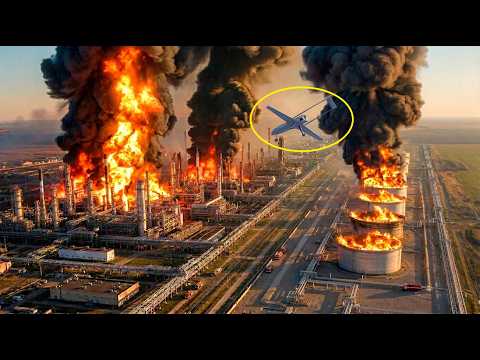
[0:00]At 04:20 hours, at secret launch sites in Odessa, Ukraine's UAV cruse began preparing for a strike against the Afipsky oil refinery, a target located about 370 miles away in Russia's Krasnodar region. Afipsky is an important oil refinery with a capacity of about 6 million tons per year, equivalent to 4% of the total refining capacity of the entire Russian Federation. More importantly, it is also a key link in supplying fuel to Russian military units fighting on the southern front and in Crimea. In just two more hours, this refinery would no longer be able to continue refining oil. And ironically, Russia's own oil would be turned into the very fuel that ignited a gigantic sea of fire engulfing this facility. At exactly 04:30 hours, the cruise began launching the first AN-196 Liuchy drones from a secret runway. The first one raced down the runway at about 60 miles per hour, then quickly accelerated to 120 miles per hour to maintain stability before leaving the ground. Every 20 seconds, the remaining 19 LiT drones continued taking off toward the southeast, where the giant Afipsky refining machine was operating at full capacity. About one mile from the launch area, the crews immediately withdrew as fast as possible along secret roads in the darkness. Switching off all lighting systems and moving only with night vision devices. They understood very clearly that just a few minutes later, once Russia detected these unusual signals, the launch area would immediately become the target of fierce retaliatory fire. But Ukraine's SBS forces had anticipated that. They always prepared multiple different options to ensure the mission would be completed. In many other areas, drone launches were carried out in a similar way. From old factories in Zaporia, along the major rivers in Kherson, and even from disguised container trucks on the Crimean Peninsula. In total, 280 drones were launched in a sequence whose timing had been calculated with extreme precision. However, the most sophisticated and strategically important part of the entire strike lay in the final operation, codename Black Artery. This was the last wave to be launched, deployed only after all the other Ukrainian drones had already left their launch points. It also had to travel the farthest distance from the safest location, because this was the true decisive thrust, the killing blow of the entire campaign. To ensure their approach to the target was perfectly synchronized, the drones in operation Black Artery had to fly faster at a maximum speed of 120 miles per hour. Even though that meant consuming more fuel. Meanwhile, the drones assigned to strike closer targets only needed to maintain a speed of around 100 miles per hour to optimize flight efficiency. It was precisely this reverse timing calculation that allowed all 280 drones to converge on the target area at nearly the same moment. Immediately afterward, the entire oil infrastructure across the Krasnodar region was placed on red alert. From oil refineries, trans shipment and export ports to pumping stations and the oil pipeline network, every site could become a target for Ukraine. That forced Russian air defense commanders into a problem that was almost impossible to solve. They had to decide which target should be protected, while having no idea which direction was the real attack, and which was merely a decoy, meant to stretch their defensive system. What happened next clearly exposed why Russia's defensive forces were judged to be inexperienced and unsuccessful against a strike that had been organized so systematically. Just seconds after the launch waves began, Russia's radar systems at Armavir, a location long regarded as one of the most fortified and secure areas, detected signs of targets appearing. These were extremely sensitive radars, capable of tracking even an object as small as a golf ball at a distance of 36 miles. On their screens, the 40 drones climbing into the air looked no different from ordinary training targets. The data was immediately fed into Russia's integrated air defense network, then passed on to command centers for analysis. In Novorosisk, computer systems began calculating interception options. At many bases across Southern Russia, fighter pilots also rushed toward their aircraft to prepare for takeoff. But not long afterward, they would realize that Russia's entire defensive doctrine carried within it a fatal weakness. The problem was that Russia's air defense system had been designed to deal with far more expensive and dangerous targets, such as cruise missiles worth millions of dollars. A single missile from an S-400 system could cost as much as $5.5 million. While each hour of fighter aircraft operation also consumed about $12,000. Meanwhile, one AN-196 Liuchi drone costs only about $100,000 to build. It was precisely this cost disparity that overturned Russia's entire defensive calculation. Because from that moment on, every option they had led to losses. If they used expensive missiles to shoot down cheap drones, they would drain their own resources in an asymmetric confrontation. But if they allowed them to slip through, they would then face the risk of losing oil refineries worth billions of dollars. That was the trap Ukraine had set. A problem in which, for Russia, every possible choice came at a price. Combined with that was the fact that the AN-196 Liuchi is guided by a system sophisticated enough to keep operating even in a heavy jamming environment. It does not rely only on satellite signals, but also combines inertial guidance with the ability to fly along complex pre-programmed routes, allowing it to stay on the correct approach to the target, even when the enemy is conducting electronic interference. This is a propeller driven, gasoline powered UAV, with a fuselage more than 13 feet long, a wingspan of nearly 23 feet, carrying a warhead of about 110 pounds, and in some variants, that can increase to as much as 165 pounds. Its range is often publicly stated as more than 500 miles, and in some cases it can reach roughly 1,240 miles. What matters is that Ukraine does not need excessively expensive systems to create a strategic strike. They turned a UAV that costs far less than a cruise missile into a weapon capable of striking deep into oil and gas, military, and logistical targets far inside Russian territory. It is precisely the combination of long-range, flexible guidance capability, and a warhead powerful enough that has made the AN-196 Liutyi an especially dangerous strike tool. By 04:45 hours, the attack groups had merged into one large swarm, all heading east at once. On Russian radar screens, around 250 targets were simultaneously converging along dozens of different directions. The question was whether they had enough capability to stop the entire strike, and which ones were decoys and which were the truly dangerous targets. By 05:25 hours, the Black Artery spearhead had crossed the Curd Straight. The main UAV swarm with around 250 drones, continued moving southeast toward the port of Novorosisk and the Krasnodar region. This was the decisive phase of the entire operation. Within that formation, 40 UAVs split off toward the east, slipping through the defensive layers around Tuzla Island and Russia's interception patrol zone. Once they separated from the main swarm, if they were locked onto at this point, they would immediately become isolated and far easier to destroy. For that reason, the Ukrainian operators quickly maneuvered these UAVs into a diamond formation. At the highest flight layer where the AQ-400 Scythe decoy UAVs, they climbed to a maximum altitude of 13,000 feet, deliberately exposing their signatures and becoming easy targets to spot on radar screens. That was almost their primary mission. The AQ-400 Scythe is a long-range strike UAV with a payload of about 95 pounds, a publicly stated range of around 466 miles, and a cruising speed of nearly 90 miles per hour. Some carried real warheads, while others were configured to serve as decoys. But what they all had in common was that they forced the enemy to react. At the medium flight layer where the UJ-26 Bober UAVs, operating at an altitude of around 7,000 feet. This is a long-range strike UAV with a speed of up to about 124 miles per hour, a range of 620 miles, and usually carrying a warhead of roughly 44 pounds. Their role was to hold the middle position, forcing Buk-M3 and Tor-M2 air defense systems to fire, thereby draining interceptor stocks and stretching the entire defensive network. At the lowest layer where the AN-196 Liutyi UAVs, they dropped to only about 250 feet above the ground, and kept changing altitude constantly to create confusion. Hugging the terrain to blend into radar ground clutter. The Liutyi is well suited for this critical position with its high speed, maneuverability, and heavy explosive payload against important targets. At such extremely low altitudes, they became much harder for ground-based radar to detect. At that altitude, radar signals are reflected chaotically off trees, houses, vehicles, and ground terrain, creating a layer of background clutter dense enough to hide small targets. Not only that, but the curvature of the earth also helps create a natural blind zone for radar. Radar travels in straight lines, while the surface of the planet is curved. So low-flying targets often disappear from observation relatively early. It was precisely those physical limits that created a natural shield for the attacking formation. And that was exactly why this formation was built with such sophistication. Each altitude band was used to put pressure on a different layer of Russia's defenses. The AQ-400 Scythes at the upper layer forced long-range S-400 air defense systems to react first. The UJ-26 Bobers in the middle layer continued pulling fire from tactical air defense systems. Meanwhile, the low flying AN-196 Liutus slipped through the gaps forming between the interception layers. It was precisely that vertical layering by altitude that made it extremely difficult for the defender to use any single response to deal with the entire attack all at once. A missile climbing to hunt targets at 13,000 feet cannot at the same time hit a target flying just 250 feet above the ground. From Krymsk military airfield, Su-35S fighters took off carrying the Irbus E radar, one of the most powerful radar systems ever fitted to a fighter aircraft. Designed to track large targets such as strategic bombers at distances of up to 250 miles, it is almost without rival in long-range engagements. But that very strength became a fatal weakness. The Irbus E radar uses a narrow beam, optimized for detecting targets at high altitude and long distance. When forced to search for small UAVs flying close to the terrain at tree top height, it becomes far less effective like using a sniper scope to look for a mosquito. The pilots quickly locked onto the AQ-400 Scythes flying at higher altitude, but combat doctrine still required visual identification before opening fire. And it was precisely that moment of hesitation that made the difference. By the time they confirmed the threat, the real strike force had already stretched out its formation, creating gaps of up to 20 miles. The decoys that worked perfectly, forcing the interceptors to climb high, while the actual strike UAVs weave through at low altitude, hugging the terrain to avoid detection. Yet ahead of them stood one of the densest air defense networks anywhere. The S-350 Vityaz battery on Tuzla Island, with a radar system capable of tracking dozens of targets at once and guiding multiple missiles simultaneously. But what Ukraine understood clearly, and Russia failed to realize, was that even this seemingly invincible system had one fatal weakness. At 06:05 hours, the Black Artery group approached the area of Port Kavkaz, about 120 miles from the Afipsky oil refinery in Krasnodar. The 50N6A radar of the S-350 Vityaz system immediately began locking onto targets. This is one of Russia's most modern air defense systems, capable of tracking multiple targets at the same time and guiding 9M96 missiles with extremely fast reaction speed. On paper, it gave the enemy almost no chance of slipping through. But Ukraine had discovered one tiny weakness in this system from earlier strike waves. Every 10 seconds, while the radar resynchronized its processing cycle, a very brief gap appeared, lasting only about 500 milliseconds. Half a second may sound like almost nothing. But in modern warfare, that is still enough time for a target to disappear from the screen. One AQ-400 Scythe was pushed up to a maximum altitude of 15,000 feet, deliberately exposing itself to trigger the enemy radar. The S-350 reacted almost instantly. A 9M96 missile shot upward, worth $4.2 million, heading straight for a decoy UAV that cost far less. But in the final two seconds before it was destroyed, the AQ-400 Scythe had already managed to transmit the radar scan rhythm and operating timing back to the entire strike network. The very moment it was shot down, delivered the synchronized data Ukraine needed most. 30 seconds later, at the exact moment the radar entered its processing gap, the remaining UAVs all dropped at once to just 50 feet, pressing themselves tight against the ground. For that exact half second, the entire UAV swarm almost vanished from the radar picture. When the signal returned, they had already blended into background clutter and terrain reflections. The Russian crews could now see only faint traces, possibly birds, possibly atmospheric interference, but not clear enough to produce a confident firing order. Black Artery had slipped through the first defensive layer at the exact moment the system was blinded. But immediately afterward, they entered another threat, quieter still. Russia's electronic warfare zone, where the Krasukha-4 system began heavily jamming the entire spatial awareness of the UAV swarm. Within minutes, the positioning data received by the drones had become almost useless. Signals were distorted, headings were pulled off course, and the displayed positions no longer matched reality. But Ukraine had prepared for that situation in advance. The AN-196 Liutyi drones immediately switched to backup navigation mode. Instead of continuing to trust satellite signals, they used magnetic heading together with counting power, transmission lines, pumping stations, and fixed infrastructure landmarks along the Krasnodar-Novorosiysk port access. Those things could not be moved, and they could not be faked by electronic jamming. The UAVs were no longer flying by signal now, but by the very framework of Southern Russia's energy infrastructure itself. Even so, that journey was far from perfect. Three UAVs passed through an area of strong magnetic interference that threw their compasses off by as much as 45 degrees. Five others mistakenly followed a power line that drifted away from the planned route. But the lead aircraft still counted the correct number of infrastructure markers, exactly as in the original plan. It was still heading the right way toward Port Novorosiysk and the oil facilities around Krasnodar. The entire swarm, now down to only 12 UAVs, continued cutting through the thick morning fog. Flying so low they nearly merged with the horizon, then gradually driving toward the clusters of industrial lights glowing ahead. That was not only the destination of the entire journey, but also the center of the very energy corridor Ukraine wanted to strike straight through. At 07:15 hours, the smoke columns of the Afipsky oil refinery came into view. This was a large capacity refining complex operating almost continuously day and night. But to reach this target, the Ukrainian strike formation had to break through a dense defensive layer made up of six Pantser S1 systems, arranged in a hexagonal pattern around the entire refinery area. The remaining 36 UJ-26 Bober UAVs were divided into six groups with six drones in each group. And all of them charged simultaneously at six different Pantser S1 batteries. On their control screens, the Russian crews were immediately pushed into a situation that was almost impossible to handle in full. In theory, their systems could track all 36 targets. But in reality, each radar and fire control system could guide no more than four missiles at the same time. To fire a second salvo, they had to wait for a two-second launch interval, plus another six seconds of reaction time and six more seconds to aim and lock on to targets. In other words, each system needed about 14 seconds before it could carry out a second salvo. Ukraine had turned the very precision and rigid engagement procedure of the Pantser S1 into a fatal weakness. 24 57E-6E missiles were launched almost simultaneously. Their rocket plumes tearing bright across the pre-dawn sky like an artificial sunrise. The UJ-26 Bobers began maneuvering to evade, but the speed of the interceptors was overwhelming. In only moments, 24 Bober drones were blown apart at once into balls of fire. That sacrifice was not in vain. It was precisely the 14 second span during which the Pantser systems had to pour all of their processing capacity into the first interception wave that created the precious gap for the AN-196 Liutyi strike group to punch through. By the time the Bober drones were destroyed, the AN-196 Liutyi UAVs had already closed in far enough to enter an extremely difficult interception zone. After two successive salvos against the Bobers, the Pantser S1 batteries needed at least 28 more seconds to reorganize their fire, while the Liutyi UAVs needed only about 22 more seconds to reach the target. In terms of engagement timing, Ukraine's drones had now gained a clear advantage. Realizing this, the Pantser S1 cruise immediately changed tactics and switched to their 30 mm 2A38M cannons with their extremely high rate of fire. The fire control computers continuously calculated the approach speed, dive angle, and crossing trajectory of each UAV.
[22:36]It did not need programmable air burst ammunition like a 57 mm system, the sheer density of fire from 4 23 mm cannons was itself enough to turn the airspace in front of it into a real metal wall. The Shilka family is noted as being effective against aerial targets at ranges of up to about 1.55 miles, using 4 23 mm guns with an extremely high combined rate of fire. The first burst ripped through the air in front of the lead UAV at an altitude of 656 feet. Tracer line swept across like chainsaws, cutting layer after layer in front of its diving nose. The UAV banked sharply to evade, but it was too late. The second corrected burst tightened in. The third burst completely covered its flight path. A 23 mm high explosive fragmentation round tore through the fuselage, followed by a chain of successive impacts. The light air frame was almost instantly shredded apart. The fuel tank was ripped open, the engine was torn from its mount, and the lead UAV tumbled through the air before spiraling down, scattering debris across the refinery complex. The second UAV immediately dropped lower to slip beneath the curtain of fire. It descended to 394 feet. The Shilka M4's turret tracked it smoothly, the radar still held it, the electro-optical site still held the lock, the gun barrels depressed further, continuing to press the target. At 361 feet, the burst was still tracking close. At 344 feet, the stream of fire had almost entered the kill window. One more squeeze of the trigger, and that UAV could have been torn apart in mid-air. But right there, the system stopped. Not because the Shilka M4 could not see the target. It could still see it very clearly. The radar still tracked it, the site still held the lock. The problem lay in the target's position itself. At such a low altitude, directly above the tank farm and the refinery's flammable structures, the 23 mm rounds, if they continued sweeping downward, could punch into the storage tanks, pipelines, or processing units below. The fire control system had calculated that the risk of the anti-aircraft fire falling onto the very facility it was supposed to protect had now exceeded the safety threshold. It automatically cut off the firing sequence as the target dropped into the low zone directly in front of the refinery. The gunner could see all of that. He tried to keep the target in his sight. He tried to force the barrels lower. He tried to switch to manual control. But in that brief moment, the fire control computer had already made its choice. Preserve the tank farm from the risk of being hit by its own anti-aircraft fire, rather than continue firing to the very end. And that decision opened the final gap. The remaining eight UAVs drove straight through that dead zone. A situation beyond saving. At 07:20 hours, the first AN-196 Liutyi slammed directly into the fractional distillation tower complex of the Afipsky oil refinery in Krasnodar region, exactly at the point Ukrainian intelligence had identified. This was the heart of the refinery, where crude oil is separated into the basic fractions that feed the entire downstream processing chain. The 60-pound, high explosive charge detonated at a velocity of about 26,000 feet per second, generating enough pressure to tear apart the central equipment area. The aging support frames and heat resistant pipelines around the distillation complex collapsed almost immediately. Crude oil being heated to around 720 degrees F under nearly 450 pounds per square inches, burst violently from the ruptured pipes. The superheated hydrocarbon stream met the air, vaporized almost instantly and formed a dense fuel cloud. Only seconds later, that cloud ignited, causing a fuel air explosion that swept through the entire central processing zone, further destroying pipelines, cable trays, and auxiliary control systems. The refinery was no longer facing just an industrial fire, but the cascading collapse of its entire technological core.
[26:59]This strike carried major significance for both sides. Not only in the flames rising from Afipsky, but in everything that followed afterward.
[28:47]When the fractional distillation tower complex, the operational core of the refinery, was knocked out, Russia did not just lose part of its refining capacity for many months, but also had to face a much broader pressure. Every day of shutdown meant more repair costs, more production losses, and more pressure to protect industrial facilities deep in the rear. But the damage went beyond the numbers. An important target in Krasnodar could still be hit, even though Moscow had repeatedly denied the scale of the losses beforehand. That created a clear crack in the image of safety Russia wanted to maintain, while also forcing them to pull more air defense resources, manpower, and attention to the rear, instead of concentrating everything on the battlefield. For Ukraine, meanwhile, this was a strike whose value was far greater than the scale of a few UAVs. It showed that they did not need to destroy large numbers of targets at once, but only had to hit the right critical link to shake a much larger system behind it.
[30:13]Afipsky, therefore, was not just an explosion in Russia's rear, but also a reminder that in this war, one strike in the right place can still create a shock far greater than the blast itself. If you found this analysis worth watching, please hit like to support the channel, subscribe so you do not miss the next videos, and leave a comment letting us know how you think the strike on Afipsky will force Russia to change the way it protects its rear areas. Goodbye.


