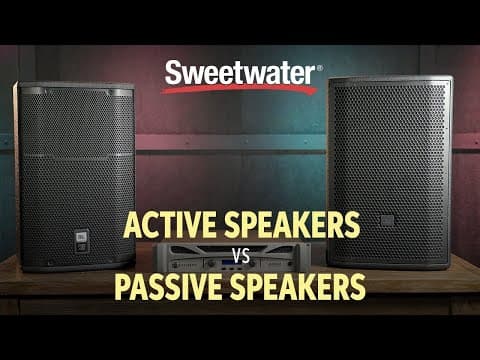
[0:00]Hey guys, Mickey here. I'm a sales engineer at Sweetwater Sound. Today we're going to be discussing the difference between non-powered or passive speakers and their powered counterparts, active speakers.
[0:10]The difference is is that an active speaker has a built-in active electronics system and are powered by battery or external AC for the built-in power amplifier.
[0:20]A passive speaker on the other hand uses only passive electronics and because of this, they need to be driven by an external power amplifier.
[0:29]This often means that this speaker would be lighter and would not need to be near an AC outlet.
[0:33]There are many places where one may be more beneficial than the other. Passive or non-powered speakers are the traditional loudspeaker.
[0:41]Think of your family's old Hi-Fi system. There, the speakers are wooden boxes with bare wire connectors on the back, and they can only start to make sound when they're connected to an amplifier, sometimes integrated into a receiver.
[0:52]PA systems work a lot in the same way, but when music got louder and crowds got larger, so did the speakers and the amplifier.
[1:01]To use passive speaker systems, you need three primary components and an audio source. These are the speaker, the cable, and the amplifier.
[1:10]When using the appropriate amplifier with a set of passive speakers and say a mixer, you're ready to start making sound.
[1:17]Amplifiers can have an output in the tens of thousands of watts, enough to cause hearing damage within seconds at about a meter.
[1:23]But in large arenas or stadiums or places where there's large crowds, these speakers are often much further away from the audience, so the perceived loudness is a lot less.
[1:32]Of course, there are also smaller systems that work great for small clubs, rehearsal spaces, houses of worship, and you could utilize these as well.
[1:40]This has been the traditional live sound rig for over 50 years. Some people still swear by these systems, and they're not wrong, but there is an alternative that may save some time on studying up on Ohm's law or just save some trunk space.
[1:53]Here comes in the powered or active speaker. Nowadays, these can come in a variety of different forms.
[1:59]Some like this JBL look exactly like a traditional loudspeaker. Some may look more like a guitar amplifier or a line array system.
[2:08]Some even have a woofer at the bottom and a long skinny column of speakers for high frequencies.
[2:14]Uh these are all self-powered from a wall adapter, or sometimes even a battery. Let's look at these JBLs.
[2:20]The speaker from the front is nearly identical. But when you start to look at the back, you start to see a few subtle differences.
[2:28]First, there's an XLR combo jack instead of a SpeakOn connector. This is because it's designed to take line level signal.
[2:34]This input is actually a small power amplifier built into the speaker. Things like digital signal processing, which can include EQ, limiting, crossover settings, and in some cases, even mixer channels, can be found in them as well.
[2:48]For the musician playing an acoustic gig, this may be all you need besides your mic, a guitar, and a preamp pedal.
[2:54]For the medium-sized DJ or band or wedding DJ, you can integrate powered subwoofers or zone speakers for other areas of the venue, just by connecting one XLR cable and connecting to the nearest AC outlet.
[3:06]This is not the only place where we see these speakers either. Houses of worship, mobile venues, side stages, and even some arenas can benefit from this type of speaker as well.
[3:15]Some people consider it to have a cleaner look, and its smaller luggage size can be great when traveling.
[3:21]All the while, it can also feature new integrated technologies like Dante, Ultranet, or AVB, allowing you to connect speakers using a cost-effective category ethernet cable on a computer network with local control.
[3:34]This can be great for installments that are semi-permanent or permanent but have a revolving set of needs.
[3:40]At the end of the day, both speaker types can work for you in a variety of ways.
[3:43]One may be more convenient than the other or even more expandable in the future, but I recommend going over some use cases with your Sweetwater sales engineer to see what might be best for you.
[3:54]Thanks for watching. Be sure to like, comment, and subscribe. Click here for more videos like these, or start at Sweetwater for all your music instrument and pro audio needs.


