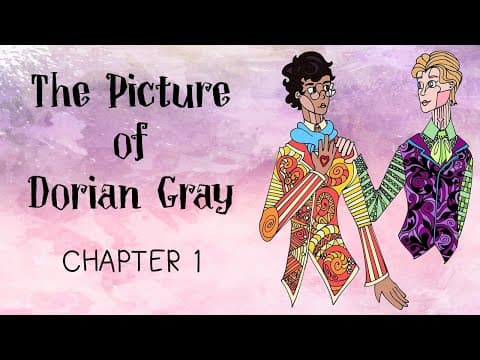
[0:00]Hello everyone. The following presentation is a brief summary and analysis of chapter 1 of Oscar Wilde's novel The Picture of Dorian Gray.
[0:15]In the opening chapter of the novel, we are introduced to two characters. The first character is named Basil Hallward. Basil Hallward is a painter who becomes captivated with Dorian Gray's beauty and innocence. Basil sees Dorian as the perfect inspiration to create his art. The second character to whom we are introduced is Lord Henry Wotton. Lord Henry is a sophisticated and intelligent man. He only associates with the most fashionable, upper-class people. He enjoys spreading his intelligent, paradoxical, and controversial views about art and life. The novel opens in the gorgeous flower-filled art studio of Basil Hallward's house. Lord Henry and Basil are together in the studio discussing the portrait that Basil has been painting. The portrait is of a slender, very handsome young man. Lord Henry praises the painting, but Basil says he will not exhibit it anywhere, as he has put too much of himself into it. The first chapter is set in Basil Hallward's flower-filled studio looking out onto his lush garden. These upper-class men are surrounded by luxury and beauty. They are secluded from the poverty experienced by the masses in the city. The central focus is on the painting of Dorian Gray. The reader is introduced to the beautiful portrait of Dorian Gray before meeting Dorian himself. This can be interpreted as an indication that Dorian's reputation for his physical beauty is more important than any other part of who he is. In this first chapter, the ideas of aesthetics is also introduced. Remember that aesthetics is a branch of philosophy that deals with questions regarding what is considered beautiful, and the idea that anything beautiful is considered art.
[2:35]In chapter 1, Lord Henry refers to Dorian as an Adonis and a narcissus. In Greek mythology, Adonis was a young man who possessed remarkable beauty. In modern times, Adonis refers to a very handsome young man. Narcissus also comes from Greek mythology. Narcissus was a hunter known for his beauty. He saw his own reflection in the water and fell in love with it. He stared at his reflection until he died. We will soon learn that Lord Henry's comparisons of Dorian Gray to Adonis and Narcissus are apt. Dorian Gray is certainly young and very handsome, and his obsession with his own beauty will lead to his demise.
[3:30]Basil realizes he has mentioned Dorian's name, and confesses that he didn't want to reveal Dorian to Lord Henry. He would have preferred to keep Dorian a secret. Lord Henry makes a humorous comment about how being deceptive and keeping secrets is necessary in a marriage. The two men walk out into Basil's garden. Lord Henry brings up the topic of Basil's reluctance to exhibit his painting of Dorian Gray in an art gallery. Lord Henry demands that Basil give him a suitable answer to his question. Basil maintains that if the public were to view the painting, they would see the innermost parts of himself as the artist, rather than of the person in the painting.
[4:26]Basil explains that he met Dorian Gray at a party. He explains that the moment their eyes met, Basil was filled with a strange sensation and was immediately fascinated by Dorian. Basil explains that Dorian has taken his artistry to a new level. Dorian has become Basil's complete muse and inspiration. He says because of Dorian, he has produced some of his best artworks. Adhering this, Lord Henry is very eager to meet Dorian, this young man of whom Basil speaks so highly. It is important to note that the accepted interpretation for your final Grade 12 paper 2 exam is that Basil's feelings about Dorian is in no way a sexual attraction, but rather pure admiration and inspiration for the art that Basil would be able to produce from painting someone as beautiful as Dorian.
[5:35]Lord Henry asks if Dorian Gray has any liking for Basil in return. Basil feels that Dorian reciprocates the feelings of friendship, but also that Dorian might just enjoy being flattered and complimented about his beauty. Lord Henry comments that Dorian's fondness might last longer than Basil's. He explains that Dorian's youthful beauty is likely to change as he ages, and because he will no longer be as beautiful as he is now, Basil's feelings of inspiration and admiration for Dorian might not stay the same.
[6:19]The wonderful things that happen in life and the tragedies about life are what Lord Henry finds the most entertaining. We will soon learn that Lord Henry's philosophy about life is seeking out the things and activities that bring one the most pleasure. In light of this, he says he is very glad to have skipped a boring lunch he had planned with someone and to instead spend the afternoon with Basil. It occurs to Lord Henry that he actually heard about Dorian Gray's charming personality from Lord Henry's aunt. Basil is certain that he does not want Lord Henry to meet Dorian. Just at that moment, Basil's butler announces that Dorian has arrived. Lord Henry becomes very excited to meet Dorian, but Basil becomes very serious when he wants Lord Henry to swear not to take Dorian away from him or to expose Dorian to his bad influences and ideas.
[7:25]The quickness of Basil's attachment to Dorian shows how much his attachment is based on appearance and not actually on who Dorian is as a person. The importance of appearance is a characteristic of the upper class. Remember that both Basil and Lord Henry belong to the upper class of society. The upper class in this society comprise of gentlemen, ladies, and artists. These members of the upper class base their judgments about other people almost entirely on appearance and reputations.
[8:06]Note that at this point in the novel, before we have even met Dorian Gray as an actual character, he is presented as a pure and innocent young man with a sincere and beautiful nature. We will soon learn that Basil is reasonable in his fear that Lord Henry's influence would not be a good thing. The themes that are present in this chapter include the themes of art, beauty, class, and appearance versus reality. Thank you for watching this presentation on chapter 1 of the novel The Picture of Dorian Gray by Oscar Wilde. Please keep an eye out for presentations on further chapters in the novel.


