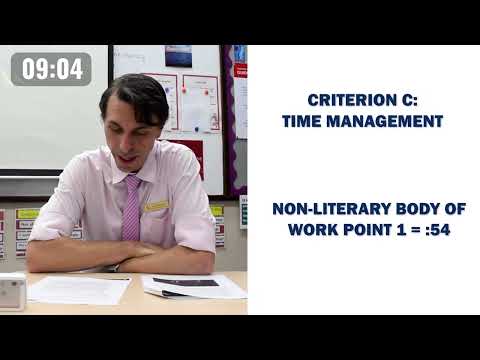
[0:02]Hi, I'm Adam Crossley and I'm Shireen Naidu. We're here today to model for you an entire individual oral, the analysis of the literary work, the analysis of the non-literary work and the question and answer section.
[0:14]This video will take you through the whole 15 minutes uninterrupted and show you the flow of the oral from start to finish. As different parts of the assessment criteria are hit, thought bubbles will pop up.
[0:25]Criterion A is knowledge of the works and connecting them to the global issue, it'll light up. Criterion B is your author's choices.
[0:32]Make these very, very relevant to your global issue and tightly aligned to that extract and the body of work.
[0:41]And also the effect on audience and criteria is pretty important too. Time management will be displayed throughout the oral and also look at how moving between the different key parts.
[0:54]This is the biggest part that students struggle with is moving between the literary extract and a literary body of work and the non-literary extract and the non-literary body of work.
[1:04]So that'll be labeled really clearly on the screen, watch that and manage your time carefully in your own oral with those areas.
[1:12]For the criterion D, which is your academic language, think very carefully about your word choices. Keep everything very simple, very clear, but varied.
[1:21]Avoid repetition and long pauses as well as the 'uhms and uhs', verbal fillers.
[1:28]Yeah, criteria D is not as highlighted in the video, but you'll just see it throughout. Should we get to the model?
[1:34]Yes, we should. All right.
[1:37]Hello, welcome. We're here today to film an individual oral. I'm an individual oral examiner, my name is Adam Crossley. I'm here with Ms. Shireen Naidu, and we are going to model for you an individual oral. Are we ready?
[1:50]I am. All right, I will start the timer and we shall begin.
[1:57]Today, for my individual oral, I'm going to be discussing the issue of racism and identity. In it, I'm going to be exploring two influential works. First is Langston Hughes's poetry.
[2:10]And Langston Hughes's poetry conveys that racism stunts the development and dreams and aspirations that are crucial for individual identity. For my non-literary work, I will be focusing on Richard Attenborough's film "Gandhi", which shows how racism can shape an individual's identity and motivate them to fight injustice.
[2:33]Both works show that racism limits the identity of individuals and that racist societies should be challenged.
[2:48]My extract is "Dream Deferred" by Langston Hughes for literary, and the first quote I would like to focus upon in my extract is on line 4 when it says "what happens to a dream deferred/does it fester like a sore?" And then again on line 6 it says "does it stink like rotten meat."
[3:07]We have two kinds of imagery being used there. The first, "fester like a sore" is tactile imagery you can feel the pain of the person who is suffering under this sore that is festering, and also it's visual imagery.
[3:24]You can picture it and it's not a pretty picture. It is unpleasant and then "stink like rotten meat" is olfactory imagery.
[3:31]So there's actually three types of imagery in there, and both are similes and all of the similes and convey together the identity of a person whose dreams are deferred or denied, delayed, over and over again.
[3:48]This conveys the widespread denial of dreams to the Black American population that Langston Hughes was representing with his poetry.
[3:59]And it prompts the white audience at the time who was reading this poem to feel guilty about ways in which identity and dreams have been denied to that population.
[4:17]Another question from Langston Hughes' poem is "does it explode?" Which is the final line, line 11. It's a rhetorical question. The explosion is a metaphor for violence.
[4:27]The violence, the type of violence, is not clearly enunciated or explained, it's just hinted at. It could be crime, it could be rebellion, but what happens within a when you take away their identity and their dreams?
[4:43]And by ending with violence being implied as a possible reaction, it's a subtle threat to those who would keep the black Americans from their dreams and from their identity.
[5:09]As we move on to the body of work, we can look at Hughes's poem, "Mother to Son". In that poem, uh, the Black American mother is talking to her son and she says, "life for me ain't been no crystal stair.
[5:22]It's had tacks in it and splinters." The crystal stair is a metaphor for a life of ease, a life of comfort. She's saying that her life has been difficult, challenging and used metaphors within that with the tactile imagery of "tacks and splinters."
[5:28]You can imagine the suffering that she's been climbing and working through, and the colloquial voice allows the Black American audience to really connect with the speaker, to identify with her experience and the way that her dreams and identity have been denied.
[6:03]And in another poem from the body of work, "As I Grow Older", the speaker talks about a "wall rose, rose slowly, slowly between me and my dream". So, we see repetition.
[6:18]There's several line breaks in there. So, there's enjambment to show the long process of the wall rising, the wall being a metaphor for racism that keeps them away from their dreams.
[6:31]It shows that it has been a long process, with the repetition of slowly and as the poem continues, the speaker says, "My hands! My dark hands! Breakthrough, the wall!" and another exclamation mark. So, we have repetition.
[6:47]The exclamation mark showing a hope for the audience. So, despite all of these dreams being denied or deferred, Langston Hughes wants to end with the audience feeling hopeful, inspired to challenge, to break through the walls that racist societies might put upon their populations.
[7:21]As I move into my non-literary work, which is the movie Gandhi, Richard Attenborough's movie, I'm going to focus on the scene where Gandhi has returned to South Africa after completing his training to be a lawyer.
[7:38]And in that scene, he is thrown out of a train even though he has a ticket because he is an Indian. And one of the first things that's immediately evident in that scene is that Gandhi's identity has not been formed within a racist society.
[7:58]He believes that he belongs in that car because he's bought the ticket, and when he comes face to face with open racism, he is shocked, confused, and he begins explaining to the train operator and the white man on the train that that he has a ticket, and he begins speaking to them as if he is a teacher.
[8:25]He has a pedantic tone. And he says on line 30, "I am therefore an attorney and, in your eyes, colored. I think we can deduce there is at least one colored attorney in South Africa."
[8:43]And the way he is speaking is completely out of context in this racist society. And you can see the shock on the black Porter who is dealing with the luggage, who has never heard someone challenge racism openly in this way in his life, in his society.
[9:02]So, Gandhi's tone really conveys to the audience the lack of logic of racism. The audience, the modern audience, really identifies with Gandhi and is outraged by the racism shown in this scene, and wants him to be able to sit in the place where he bought his ticket for.
[9:26]I think that's a great sign of progress, and I think if anybody who was openly racist were to watch this movie, they would be subtly challenged to rethink their own beliefs.
[9:44]But the racism continues and in line 35, we have the conductor turns to Gandhi and says "just move your black ass back to 3rd class or I'll have you thrown off at the next station."
[9:58]And you can see there there's a pejorative and open threat, a commanding tone, despite the fact that in most societies you would put a train conductor probably at a lower social rank than a lawyer.
[10:11]But race trumps all other concerns in this particular incident, and the result is that Gandhi is thrown off the train. Again, the audience is completely in sympathy with Gandhi and it highlights the injustice of the situation and the way that a racist society can take somebody who is brave and courageous, and punish them for that bravery.
[11:31]But Gandhi is brave and challenges that. And in that way he inspires the audience to question themselves and what parts of their own society do they accept.
[11:40]That perhaps they should have more moral outrage about and stand up and speak out against. And with the scene following, Gandhi begins burning ID cards that were required to be carried by Indians.
[11:59]He's burning them in public. And he holds it up and he says, "this is a symbol of our status. It's embodied this pass". And then he drops it in the fire and burns it.
[12:08]And a policeman begins beating him. And as he's being beaten, he continues to put the cards into the fire. He stands up and the policeman keeps beating him.
[12:16]It shows the courage of Gandhi, of course, symbolically, it shows him burning the power that the racist society controls because he's burning the passes that they issue and encourages all in the audience to be courageous and to challenge injustice in the world around them.
[12:51]Both works explore how racism limits identity and imply that the outrage should motivate action in the audience to challenge these societies.
[13:11]Thank you, Adam. Let's go to the literary work which is your poem "Dream Deferred". Please tell me what does the poet mean in Line 7 when he says crust and sugar over?
[13:22]Okay. That is a continuation of the similes throughout the poem and the similes that I highlighted were focused upon unpleasant sensations, uh, feelings with negative connotations.
[13:41]Crust and sugar over could be possibly alluding to rewards, maybe of acceptance, such as in Gandhi, the successful businessman who has the rewards.
[13:54]But it could also be kind of the leftovers of a a sweet that is kind of crusted and it's not the best part, but it's something. It's some sort of tangible something you could latch onto, but it's not as great as having your full dream.
[14:12]In Hughes's body of work, his poems tend to grow darker. Um, how do you think he uses narrative voices to show your global issue?
[14:22]My global issue, one narrative voice that really comes to mind is "Let America be America Again". In that poem, uh, there is a speaker who is speaking as if he is patriotic.
[14:34]But it becomes clear that there is a division, and there's two speakers within the poem saying "America never was America to me". So that's a really strong point about identity and what do we think of it?
[14:45]To be an American, to have freedom, is is that everyone's experience as American? And Hughes answers no in that poem, and that for him, being American has not been a moment of freedom or a a lifetime of freedom.
[15:02]But he encourages all to continue seeking for freedom, striving for freedom. And that's why at the end of the poem, he says the America she can become and will be.
[15:11]Thank you, Adam. And finally, is there anything else you would like to add on to this global issue of racism and identity?
[15:18]I think there's one other part in the body of work with Gandhi that really inspired me, which is the Amritsar massacre. This is Gandhi's influence throughout the country. During that scene, Indians were peacefully protesting the British control of India.
[15:25]And the British decided to make an example and brought in several armed soldiers and ended up killing the peaceful protesters. Many, many, many of them.
[15:42]And that was a real tipping point in the Indian freedom movement. But the way it is graphically shown in the movie, with babies crying in their mother's arms as they're dying and people running around chaotically jumping into wells to try to escape the bullets.
[15:49]As innocent protesters simply speaking up for their right to independence and dreams. It really brings the audience to feeling keenly the injustice in the world and to wanting to stand up and speak for and make the world a better and more just place. Thank you.
[19:52]Thank you, Mr. Crossley, and good luck to all of you in your oral.


