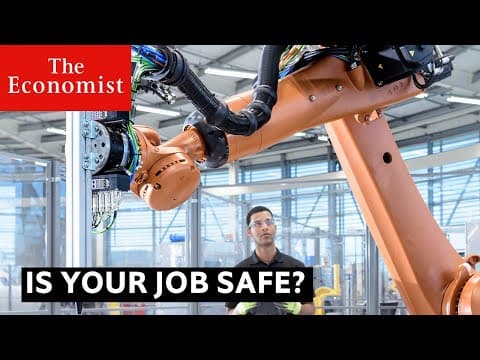
[0:05]This is the workforce of the future. Technology is transforming the world of work beyond all recognition. creating groundbreaking opportunities. It's an amazing thing to be living in this digital age. But it's also eroding the rights of workers. It creates a kind of dog eat dog world. Some even fear a dystopian jobless future. technology today could lead to 45% of current jobs disappearing. But are these anxieties overblown? The future is about the collaboration between humans and these technologies. How we react to this brave new world of work today will shape societies for generations to come.
[1:09]For some people, work is where the Wi-Fi is. In the past two years, Samantha and Justin have lived and worked in more than 20 countries. We started this year in South America. We lived in Peru, in Santiago, Chile, Bariloche, Argentina, Croatia, Innsbruck, Austria, Portugal, Italy, Norway, which was really pretty. And then we were on Reunion Island for two months, off of Madagascar. Yes, and when we were there everyone was like, how in the world did you find this place?
[1:43]But throughout their travels, Justin and Samantha have each been holding down a job. He runs a digital creative agency, and she works for a California-based startup. They're a very modern incarnation of a very old idea. They're digital nomads.Thank you. Today, people working remotely around the globe like this, number in the millions. A lot of people that define themselves as digital nomads move around very, very frequently. But we typically move around at least once a month. The couple say the extraordinary recent advances in digital technology allow them to keep exploring the world without compromising their careers. We rent an apartment, we set up an office. We're not on vacation.We live pretty normal lives and so it gives us the opportunity to kind of integrate and become locals and try on different flavors of life. There are downsides to this liberating grand tour of new cultures and horizons. Digital nomads sometimes have to be more nomadic than they might like. Just out of curiosity, I wonder what the visa policy is. Location-independent workers, as they're also known, often travel on tourist visas and are usually restricted to a maximum of a few months in each country. So Fiji, we need to go to so that we can get out of New Zealand before we violate their visa policy. Yeah.
[3:13]But some countries are going out of their way to attract this new breed of global worker. Estonia is about to launch a special visa, allowing them to stay for a year. With other countries set to follow suit, some predict there could be a billion location-independent workers by 2035. For those with no ties, it all points to an increasingly borderless brave new world of work, centered around the digital revolution. And it sounds extravagant, but we don't need much to be able to work and be productive. If you're smart about it, I think that travel can be a long-term sustainable lifestyle, and it's not that crazy. Of the more than 60 million Americans who work, over 50 million are employees. They work for somebody else.
[4:09]In the middle of the 20th century, many workers in the rich world expected a job for life in one place.
[4:20]But today, frequent job changes are not unusual, and 70% of professionals around the globe do some work remotely. These seismic changes are leading to continual reinventions of that most traditional workplace, the office. In San Francisco, entrepreneur Frank Boulet is starting his daily journey to work. You have to move from my room, go down the stairs, to my office space. I would say it's a dream commute, yeah. Frank's part of an emerging trend, living and working with other people in the same place. When I move from one space to the other space, I switch from living to working. The space run by a company called Rome, includes meeting rooms, relaxation areas, and even a cocktail bar. It caters to the more exclusive end of the global co-working market. You get to meet amazing people from all across the world and I find that exciting. The vibe is less office, more professional commune. And the residents are glad of the chance for some digital detox. We're all tethered to our cell phones, we're all tethered to technology, and I think that what's unique about Rome is that it builds community and it builds a communal living style that allows us sort of to unplug at times. This kind of communal living might have niche appeal right now, but 2.3 million people worldwide already share co-working spaces, and there are signs these make for more productive workers. The Harvard Business Review found that nearly nine out of 10 co-workers felt happier than in their previous place of work, and over 80% felt more engaged and motivated. I've never been more productive, like even though I do less hours. Would I ever go back to traditional corporate nine-to-five? No. Technology is also changing how people work and live in poorer countries. Kibera, Kenya, Africa's largest slum. Work here is scarce. The average wage is less than $2 a day. Joseph Kamau grew up here. This is my first computer.
[6:55]Two years ago he was scraping by as a street hawker selling food. But today, Joseph is making a new living as a paid-up member of the global gig economy. The labor market where self-employed workers are paid to do short-term freelance tasks. For me, a person living here in Kibera, how would I have gotten a job for a person in America? He gets up to 10 part-time jobs a week, entering data for clients based all around the world. It's an amazing thing to be living in this digital age.
[7:31]Joseph works in arguably the fastest growing segment of the gig economy, known as the human cloud. Some of the jobs that used to be done by white-collar workers in wealthier countries are now broken down into individual tasks. These are advertised online and carried out by remote workers scattered across the globe. This human cloud industry is worth an estimated $50 billion a year. Now the Kenyan government is training one million young people for this new digital workforce. And helping them is the outsourcing firm Samasource. Clients have included Google, eBay and Microsoft. Freelancers here work on a range of digital services, including image tagging for artificial intelligence. We're training cars to drive themselves. I know right? It's so funny. I don't even have a car, but we are working on projects for the self-driving cars, you know.
[8:31]Some fear that the flow of digital service jobs from rich countries to poorer ones could push down wages globally. But for many people here, the new opportunities offer a way out of poverty. I mean someone sitting in the US might say, you know, a job like this is not paying a living wage, but for us it really gives us an opportunity to be able to bring some of these young people into digital age and the digital economy. Since working in the human cloud, Joseph has been able to move his family out of the slum. I'm going to join university next semester, I'm going to do computer science, my dream course. And yeah.
[9:19]In wealthier countries, some workers see the gig economy as less of an opportunity and more of a threat.
[9:36]How many jobs am I going to do today? Am I going to do 18 jobs or 30 jobs? On days when it's very slow, we're not going to make enough money to live. Many online platforms, those intermediaries between customers and gig workers, don't cap the number of freelancers that clock on each day. This can flood the market, ramping up competition and slashing earnings. It creates a kind of dog eat dog world and a very competitive world amongst the workforce. Some competition amongst workers is healthy for consumers, but Max has a more fundamental complaint. That basic employment rights, such as sick pay and job protection, are denied to most gig economy workers. They don't have any ability to set the price of their labor, they don't have any ability to negotiate with the client. They have zero protection. Of course people like flexibility, but that shouldn't come at the expense of everything that's ever been fought for for the last 200 years. Some people have money. It has millions in their account.
[10:44]Max continues that fight as vice president of the Independent Workers' Union of Great Britain. And I said, well, it's only impossible until we win. The union is mounting legal challenges against large companies operating in the gig economy. We've taken a number of career companies to tribunal, from CitySprint, eCourier, Addison Lee, and XLL, and now we're taking on Deliveroo as well.
[11:16]To critics like Max, the lack of rights offered to workers in the gig economy by big contractors is rapacious capitalism that will increase inequality. There are loads and loads of people on these bike contracts. We see it more and more spreading into other sectors, cleaning, retail, banking, and that's very worrying.
[11:43]Amid heightened concerns about job security, some workers are facing new pressures to become more efficient and productive. But what lengths is it acceptable for companies to go to to achieve this? In Boston, Massachusetts, workers at this firm are being closely watched. Their every conversation is analyzed. Their every move monitored. This is our humanized sociometric badge. Their employer Humanize has designed surveillance technology to gather data about how they spend their time at work. So it knows if I'm speaking or not speaking, um it knows if I'm moving, whether I'm walking around or just sitting at my desk during the day. It knows generally where I am in the office and it also can tell my proximity to other people wearing badges. And it also can tell my proximity to other people wearing badges.
[13:01]The company says it uses this data to improve the productivity of its workers and their work environment. I see interactions within my team, how many of my teammates interact with in a week or a month, the same gender or the other gender, and I can see my dominance in conversation. The green is my speaking time versus the blue which is when I'm listening. I use this data as a way to optimize my work experience. Humanize sells its surveillance technology to companies around the globe. And with more than 10,000 people now wearing its badges worldwide, business is starting to boom. Because now we have all this quantitative data coming in, we're able to understand it at unprecedented level.
[13:57]This kind of surveillance technology is raising fears about workers' welfare and rights to privacy. A British report found that 70% of workers believe workplace monitoring will become more common in the future. Over 60% believe it will fuel distrust and discrimination.
[14:19]Humanize says it anonymizes and aggregates data and doesn't record the content of conversations. But other tech companies are developing ever more intrusive ways to monitor workforces, including micro-chipping staff and photographing them at their desks using webcams. I mean there's legitimate concerns around this kind of data when it comes to, you know, for example, could your boss look at what you're doing minute by minute in the organization? Can we look at what you're writing in emails and things like that? At some point someone will do the wrong thing with this kind of data.
[15:00]But in the minds of many people, there's an even greater threat to the workforce of the future. And it comes from a new breed of worker. One that is relentlessly efficient, works around the clock, and never complains. Robots and artificial intelligence are increasingly part of many industries. Machines will soon take the wheel from truck drivers, and companies are turning to new types of robots for mass production of food. New worries about robots taking jobs. Automation is set to cause mass disruption to working lives. As artificial intelligence and automation grow by leaps and bounds, it could lead to 45% of current jobs disappearing. But how justified is this wave of automation anxiety sweeping across the world? Are hundreds of millions of workers really heading for a jobless future?
[16:07]In a warehouse in Southern England, the dystopian vision of a fully automated future appears to have arrived. This swarm of robots is packing groceries for British firm Ocado, one of the world's most technologically advanced online retailers.
[16:29]Here, collaboration is key. These robots are being orchestrated by a sophisticated piece of machine learning, it's a bit like an air traffic control system. They collaborate with one another, so if a robot wants to pick a bin that's fourth down in a given stack of bins, it just gets three of its friends or colleagues to move the top three bins out of the way, and then it grabs the one it wants. But the robots here aren't working together to replace humans, they're working with them. The robots take containers of products to pick stations where people put the orders together. I think the job is a lot less taxing on us physically. The robots themselves are very efficient, so they take a lot of the grunt work out. They're our little helpers. What's more, Ocado say these robots have actually created more jobs at the company than existed before. None of the 13,000 people that work for Ocado would have a job, myself included, if it wasn't for what we do with technology and automation. As we've found new ways to automate processes, the number of people working for Ocado has only ever increased because of the ongoing growth of the business. A growing body of research suggests artificial intelligence and machines could create at least as many jobs as they displace. One report estimates that while 75 million jobs will be lost globally by 2022, there could be 133 million new ones. We are on a journey to to go on finding ways to add automation, but it's about teaching people to be more adaptable in terms of their jobs and their skill sets because the future is about the collaboration between humans and these technologies.
[18:16]Disruption to working lives is inevitable, and insecurities will persist.
[18:24]How bosses, workers, and governments respond to these challenges will determine whether this new working landscape lives up to its enormous promise.


