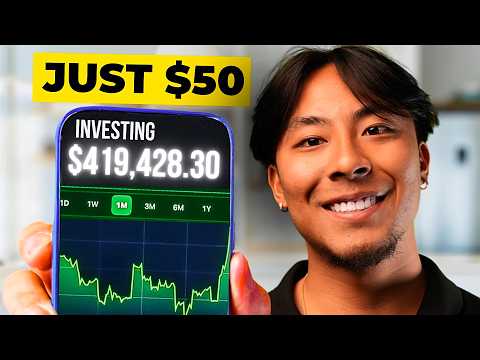
[0:00]This video is your ultimate beginner-friendly guide on how to start investing in 2025 or whenever you may be watching this. And I'm going to break it down into five simple parts so you can either follow along or just skip around to whatever you need. why you shouldn't even bother investing, what to invest in, when and how much to invest, a live walk through of my own personal portfolio, and my investing strategy, mindset, tips, and common mistakes that you should avoid. Just a little disclaimer, this is not financial advice. This is just what I'm personally doing to grow my net worth and invest in my 20s. And it's the same exact strategy that I use to help my 14-year-old little sister invest her first few thousand dollars in the stock market and countless others, so, not financial advice. Basically, investing is how you make your money work hard for you, even while you're asleep, even while you're sick, even while you're on vacation, even when you're not working. And there's two main reasons why you want your money to be working for you, and one of them is because of inflation. Inflation is basically when the prices of things go up because the value of the US dollar goes down. For example, the Chipotle bowl, it used to be $7 a couple years ago, now it's around 13 to 14 bucks. And this happens with literally everything: cars, education, housing. And so, the only way to beat inflation and to make sure that your money is not going down in value is to invest your money into assets that go up in value, like stocks, real estate, you know, businesses. To have your money make enough money for you so that you don't have to just keep working and trading your time for it. And the goal isn't just to, you know, get rich fast, put $100 on black and doubling your money in two days, it's to buy freedom over time. And this is done through compound interest. And compound interest, literally called the eighth wonder of the world by Albert Einstein, is what really builds true wealth and is the second and probably one of the most important reasons why people start investing, especially so early on. Let's say you're trying to save around $100,000. It will take you around seven years of saving $1,000 per month at an 8% return. You know, that's a long time, right? But the second 100K happens way faster, in way less time because your money's actually starting to earn money on top of itself and it's going to start to compound. So instead of a flat savings line or really a declining savings line because of inflation, your wealth line actually starts to curve up like a hockey stick. And here's another example of compound interest. Let's say you're 25 years old, looking to retire at 65, right? So you have 40 years to invest and you get an average around 8% return and you contribute $500 a month, right? You would have contributed around $240,000, but because you invested and gained an average return of 8%, which is really doable, you would have ended up with 1.7 million. Now, that's amazing, right? But let's take a little step further. Let's say you're 18 years old, and that's when you decided to start investing $500. I don't know how you got that money, but let's just say that you started investing that would give you 47 years to invest. And there's the difference. It's literally almost $1.3 million more than if you would have started, you know, seven years earlier. Now I know $500 starting at 18, I know it may seem like a little far-fetched. I personally don't think so, I think you can do it. Um, but let's just say $300. $1.8 million. So you see how the effect of compound interest and the cool thing about compound interest is it's not necessarily about how much you put in, it's about when you actually start investing. Bottom line, investing is not optional. It's the bare minimum for you not to fall behind and the prerequisite for you to finally reach financial freedom, you know, if you want to retire when you're a lot older. So now that you understand why investing actually matters, the next step is knowing what to actually invest in, you know, without you getting overwhelmed because there are a lot of options. You got stocks, crypto, real estates, Pokémon cards, but we're going to keep this super simple so you can start today. Number one, you got individual stocks, and this is basically when you can own a sliver, a small fraction of a share of a company. like Apple, Amazon, Google, Meta. And essentially, you're becoming a part owner in that company, so when that company goes up in value, your share also goes up in value. And so, there's a lot of pros and cons with just owning individual stocks. You have to kind of know the financials, you have to understand the company because it could go up and down. And you're also kind of putting your eggs all in one basket, because what if that stock goes bankrupt, or what if the CEO just goes off the rails? If that company goes down 100%, you know, your share, all that money that's in that company, goes down 100%. And this is where a lot of people go wrong investing. They try to time the market, pick individual stocks, which is shown to be really risky, especially if you're a beginner. And that's because you really don't know where the companies are going to go and what they're going to do over the long term. And that's why professional hedge funds and experts can't even really beat the market. And so, that's why if you're just beginning, I really recommend with starting with the next two. And number two, we have ETFs or exchange traded funds. I know it sounds confusing, but honestly, it's not. It's just a basket of stocks. So instead of, you know, putting your money into just one company, like an individual stock, you're actually putting your money into, you know, hundreds of different companies all at once. So, for example, QQQ, that is an ETF, and that is 100 of different types of companies. And this tracks the Nasdaq 100 Index, which is 100 of the largest non-financial companies listed on the Nasdaq stock exchange. And don't make it super complicated. An index is basically just a list of stocks. This one's a lot more tech heavy, like Apple, Nvidia, Google, Meta. Mainly in the growth and tech areas, but the reason why people like myself love ETFs is because it's low risk, plus you're diversifying, you know, all your money between hundreds of different companies. So, even if one company falls off, one stock goes down 100%, you still have your money in, you know, 99 other companies. And so, it's really good for passive investors who don't really want to stress about the market and not worry about anything and they just want to know that their money's working for them. And another thing about ETFs is that they could actually track a lot of other things other than market indexes, like crypto, bonds, gold, silver, specific sectors, and even different themes, like clean energy or AI or Metaverse. And third, we have mutual funds, which is very similar to ETFs, but they're structured and trade a little bit differently. For example, VFIAX, which is Vanguard's S&P 500 mutual fund, which tracks the S&P 500 Index, which is the top 500 largest companies in the US stock exchange. And what's really cool about the S&P 500 is that it's a self-correcting mechanism, to where it has 500 of the top largest companies, when one of them falls off, another one will take its place. And so, you're never going to have, you know, one company lagging and dragging the group down, it's just going to, you know, replace it when something falls off. And this is where people can get confused because ETFs and mutual funds can really look the same, especially if they're both tracking the same index. But again, the main difference is when they trade and how they're structured. And so, here are the main differences. ETFs trade like a stock, meaning you can buy and sell them whenever the market is open, and mutual funds, you can only trade them once per day after the market closes at market closing price, and sometimes they have a minimum buy-in. And as we mentioned earlier, ETFs can track other things other than market indexes, while mutual funds are mainly focused on just tracking certain market indexes. But again, they can look the same, track the same index, and get similar returns. For example, VOO is Vanguard's S&P 500 ETF. And VFIAX is just the mutual fund version. They both have similar performances, they're just a little bit different. So don't think about too much, if you're investing in either one of those, you're going to be okay. And you'll most likely be investing into an ETF rather than a mutual fund because, again, mutual funds have high buy-ins. The most important thing you want to be looking at is the expense ratio, which is basically just the service fee for owning the certain fund. ETFs usually have cheaper fees, while mutual funds, if they're actively managed, have higher expense ratios, so you kind of just want to pay attention to that. A good rule of thumb of expense ratios is lower is better because it could really eat away at your gains slowly without you even recognizing it. Number four, we have REITs, or real estate investment trust. Honestly, don't pay too much attention to this. This is just a way for you to get exposure to the real estate game without owning actual properties. If you're a beginner, just focus on, you know, the good stuff, just regular stocks. And then you'll have bonds, which is basically like loaning money to a certain company or government instead of buying a share of their business. And in return for you loaning them money, they'll actually pay you interest over time and then give you the principal back. But honestly, if you're young, you really don't have to pay attention to this too much. It's really meant for older people who are nearing retirement because they don't want their portfolios to swing super crazily with news or any geopolitical events. So, you really don't need to worry about this too much. There's really not any growth within the bonds. If you want something that's safe that'll give you, you know, 4 to 5% without any risk of things going down, you can really just buy like a CD or just keep it in a high-yield savings account. And with the high-yield savings account, you can actually withdraw it anytime, where with bonds, you can only withdraw it or get your money back within a certain amount of years. Now here's the thing that most people don't realize. You don't need to be a stock picking genius to grow your money or to make money investing. Warren Buffett, one of the stock picking geniuses, even said, the best thing for most people to invest in is a low-cost index fund. And John Bogle, the founder of Vanguard, once said, you don't need to look for the needle, just buy the haystack. And that's exactly what index funds and ETFs do. They give you an option to buy the entire haystack. The winners, the losers, and everyone in between. And over the past few decades, the S&P 500 has returned around 8 to 12% beating most professional hedge funds with PhDs, researchers and, you know, a whole team actively trading stocks. So you don't need to beat the market, you really just need to match the market. So rather than guessing who's going to be the next Apple, you can just buy everyone and then let the market set itself out. And from a psychology and just pure performance standpoint, this is one of the most underrated strategies. You're not constantly checking a portfolio, you're not stressing yourself out in the morning, obsessing over the financials, or obsessing over the news. All you're doing is choosing a low-cost index fund and just buying it every single month, every single week. And studies even show that passive investors actually outperform most active traders over time. And that's why being boring is secretly one of the smartest investing strategies that you can do. And so, here are a few example ETFs and Index funds that are worth checking out that I personally invest in. Number one, as I said, VOO, this follows the S&P 500, which is just the 500 top companies in the New York Stock Exchange, the self-correcting mechanism. Number two, you have QQQ or QQQM, and then you have VTI, which is Vanguard's Total Stock Market Index Fund, and it basically just covers, as it's in the name, the entire US stock market. So, if you buy that, you're diversified into everything. And so, here's my personal advice and here's what I did when I was beginning investing. And it's that your first 100K should be almost entirely of index funds or ETFs. Why? Because they're simple, diversified, low risk, and they work. This is going to be your financial foundation, something that you can just put money in, not having to worry about it, and know that your money is working for you, and it's not going to go up crazy or even down crazy, like if you'd invest into, I don't know, GameStop. But once you have that foundation built, you can then start to explore into more riskier alternatives, like cryptocurrencies or individual stocks. And that's what I did. Around 70 to 75% of my whole entire $400,000 portfolio is strictly index funds and ETFs, like invoo, or VTI, or VTSAX. And the remaining 20 to 25% are in individual stocks or cryptocurrencies. A little more high risk place, since I'm a little more young. But once again, older, and I don't want to be as risky, I'm probably going to, you know, level out and be more into index funds and ETFs and keep it like that, rather than just, you know, the individual stocks because again, it's risky. But one popular approach to investing that I'm going to show you is the three-fund portfolio. And it usually looks like this: one US stock index fund, one international stock index fund, and then one bond index fund, or ETF. Now, in this photo, it perfectly shows how the ratios need to change depending on your risk tolerance and age. And again, all these investments is up to you, it's all subjective, it really depends on where you're at in life and really what do you want to do with your money, so don't need to follow what I do. Just do what feels right to you and just stay consistent. I know there's a lot of information to digest, so let's just make it real and let me show you exactly what I'm investing in and why. Let's go look at my entire stock portfolio. So, this is my entire stock portfolio across all of my different brokerages. Here, you can see I have over $449,000, and I have an all-time game of around $108,000. Around 31%, which is, hey, it's not too shabby, I think it's pretty good. So here's exactly what I'm holding. The majority of my portfolio is in VTSAX. This is Vanguard's Total Stock Market Index Fund. This is just a mutual, passively managed mutual fund version of VTI. It just tracks the entire stock market. And so, when I first started investing, I pretty much only was investing into VOO, VTI, and VTSAX. I didn't understand that they overlapped and I didn't need to, you know, invest into all three, but I kind of just stuck with it. And so, I invested into VTSAX the most, and this is where I had automations going in. So every single week, I would put, you know, a couple hundred dollars into it, and that automation has been running for, you know, years. So, this is how much it's been. My second biggest position is VOO, third QQQM, and then I have Amazon. I loaded up a bunch um during the April tariff crash. It has not yet really returned exactly what I wanted, but, you know, long-term, I see the vision. Um, I also have Google, AMD, I think AMD is a sleeper stock. It is quietly outperformed Nvidia. And then I have Meta. They are a cash cow. I love it, I love how much they're investing into AI. I have a lot of that. I have Nvidia. I wish I got more during the April scare. But, you know, I'm happy with what I have. I have Apple, and this was actually one of my biggest investments for a long time, but they just have not been performing well. And so, I haven't really been putting too much into it, but it's Apple, they're still a cash cow, they're not going anywhere. I have Nova, which is another semiconductor, um pick, they actually make the mythology solutions to build the semiconductors. And it's kind of like the buy the shovel type of pick. And then I have Costco. Costco is one of my favorite stocks. I actually am going to start loading up a little more because it's been going down the past few weeks. I love Costco, their whole business model is insane. Then I have Tesla. I've actually taken profit on Tesla a couple times, but I just didn't really like how Elon was, you know, diving into politics and then also just doing like 5,000 different things. So, I took a lot of profits. I still have a good amount, but I still believe in Tesla, you know, and hopefully, their autonomous cars, you know, do well. I have Oscar Health. So, this is another health sector game. Their financials is insane, and their stock has been beating down. And so, I've quietly have like a little position into that. I have SCHD, this is a dividend ETF. Um, I'm kind of just slowly putting money into this. Then I have AXP, American Express. I have HOOD, which is Robin Hood, Netflix, United Healthcare, Eli Lilly, and then VTI, and then URI. My best performer, actually, is URI. I have over 140% uh, return. I wish I put more money into it, and I actually took out my principal, which is how much I invested, which is about $1,000.
[14:17]So, I'm up pretty penny. But, yeah, this is my entire stock portfolio. I started off with just a couple hundred dollars, and then as my income grew, I just invested more and more and more. So, when you're first starting, I don't want you to be focused on, oh, I don't have $100,000 or $1,000. Don't focus on the dollar amount, focus on the percentage of your income that you invest. 10%, you know, that's good. That should be a bare minimum. 20%, that's even better. 30%, if you can, 40%, 50%, 60%, you know? When I was really young, I lived really, really frugally in order to invest 50%, 60% of my income. And even to this day, I invest around 50%, sometimes 60% of my entire income automatically into the stock market because I know how powerful investing is, and I want to be able to retire as early as possible. So, when and how much should you invest? I look at investing as playing offense, right? You're actively trying to build your wealth. But before you need to play offense, you need to first be able to play defense. So, before you even start investing, you should be clearing out any high-interest debt, pay-day loans, credit cards, because if you have high-interest debt above, you know, 6 to 8%, you're not going to build any wealth, even if you're investing and choosing, you know, the best type of stocks because you have that kind of dragging you down. And then the next prerequisite that you want to do to make sure that you're playing defense first is to build an emergency fund. An emergency fund is 3 to 6 months of expenses saved up, usually in a high-yield savings account so you're getting around 3 to 4% interest. At least you're not going down in inflation. So, now that you paid off your debts and then you have an emergency fund, now we can decide how much you can actually afford to invest. As long as you're hitting your savings goal, that's literally all that matters. A good rule of thumb is to just hit your savings goal, increase it as much as you can, and then invest consistently, not perfectly, consistently. And the best way to do that is to just automate it. It's literally the most game-changer thing you could ever do because it takes all the guesswork, it takes all the manual labor, the mental stress, and just turns that into a forced habit. And it kind of makes you restructure your whole entire life to fit, prioritize investing and savings, kind of like what reverse budgeting did for me. And so, we can do it, and I'm going to help you set this up, is to set up recurring deposits. You can start small, $5 to $10 a week, whatever, just build the habit, just set it up and ramp it up again as you get comfortable. All right, so now that we went over why, what, when, and how much to invest, now we need to actually go over how to invest. Let's just keep it really simple. There's a lot of different accounts that you can have, and I'm going to go over all of them. So, one, you have the regular taxable brokerage account. This is stuff that I'm going to show you with, there's no special tax perks, just a regular account. If you can sign up on Instagram, you can sign up with this. It's super easy, takes 5 minutes, usually get you get like five stocks. Then you have a 401K. Usually, this is like an employer-sponsored plan, and this, you're able to invest pre-tax dollars. And that actually will lower your taxable income because you withdraw it from your employer, and oftentimes, you actually get a match, which is just basically free money to do this investing through your employer. One of the most important accounts that you need to have is the Roth IRA. Basically, it's a Roth individual retirement account. This is where you can put post-tax money in. All your investments in there, all of the growth that you have in there is tax-free. And that's a huge difference. Like, the difference between a taxable brokerage account and a Roth IRA account is millions of dollars over time because, you know, you're not getting taxed. But the cons is, you can only withdraw when you're 59 and a half, so your money is technically locked up. You can technically withdraw the contributions. Either way, you should be investing for the long-term, doesn't really matter. And for the sake of this video and to get you actually investing right today, right now, we're going to focus on regular taxable brokerage account because a 401K and Roth IRA, it does take a little more steps to like verify everything because it's more for retirement. So, I'm going to walk you through exactly how to buy a stock, how to do it using Webull, my favorite brokerage, and also how to set up that automation. So, step number one, open a brokerage account. It's really easy to open it. If you use the link down in the description below, you may get free stocks. I remember the first time I opened my Webull account, and I got $200 worth of Apple. I'm not saying you'll get that, you may get lucky, you may not, but it's cool, it's free money. Once you open your account, all you have to do is connect your bank and deposit money. Again, if you only have $10, you only have $50, it's okay, just do whatever you have. We just want to learn how to do it so when you have more money, more disposable income, you can do it, and you already know what you need to do. So, search for the stock, ETF, or Index fund or whatever you want to buy. For example, we're going to go with the ETF that I was talking about with VOO, VOO over here. You just want to click it, and here Webull's really cool because it gives you a lot of information, it shows you a lot of stuff. It is a little overwhelming at first, but honestly, I don't use all of this information. I just liked having the ability to, but you don't have to use all of it. It has like the news feed channel, which is pretty cool, I don't really look at it too much, but basically all you have to do is press trade. And here we can see the stock. We can either buy or sell it. And here's the order type. So, there's a lot of different things. I, you don't really need to pay attention to most of it. Limit order is basically when you can set a certain price amount, and once it hits that price, it will trigger the buy, or you can just set, you know, market order. This will pretty much just buy it at the price that it's at right now. Just focus on market order or limit order, it really doesn't matter. We're going to do a market order, and I'm going to buy, you know, the cool thing is, with Webull, we can actually buy fractional shares. So, I'm just going to buy $10 worth. And all you have to do is just press buy, confirm, and then that's it. And if you want to sell and lock in that profit, all you have to do is just press that sell. Do how much you want to sell? It may be like the full amount or whatever, and then you can do whatever price that you want, and then just sell. That's pretty much it. But again, you're investing for the long term. You were not really like focusing on selling maybe until like 30, 40 years in the in the future. But let's set up that recurring investment. So, if you see here, we can do order type. We can actually press recurring investment. And this, again, this is the most powerful thing that you can do because it makes it into a habit. And so, what we can do is we can set up $5, and we can schedule it to go into every single week. And so, every single Monday, $5 is going to go out of my bank account into the stock market. So, please, again, I recommend, please just set this recurring investment up. I don't care what you set it up with, just stay consistent because that's what's going to be the biggest difference between people who start investing, give up and don't make any money, between people who become stock market millionaires. If you can be consistent over the long term. So, please set that up, and future you will thank you. And so, now we're going to do a quick Q&A. I posted a story on my Instagram asking for some questions, and we're just going to go over it together. All right, Ronnie said, how often should you change portfolio concentration of stocks and ETF for long term? Again, this is really super subjective, it's really up to you and your risk tolerance, but me, personally, I like to have my index fund and ETFs, mutual funds, be around 70 to 75% of my entire portfolio. It really needs to be the big majority. So, if my individual stocks go more than, you know, 25%, then maybe I'll start to look to take profits, maybe trim some positions. I also don't really like to have any single individual position or investment be more than 3% of my entire portfolio. So, if it is going up a little higher, like, let's say if I make some some gains, then I am going to trim a little bit because I don't really want more than 3% into one position because, you know, that's a little risky. What if something happens? I don't want my entire portfolio to be, you know, dictated on whether Tesla or whether Elon makes a tweet or not. So, I just don't, I just don't like to have that. And so, again, this is really up to you, but that's kind of just my personal. I don't really like to have all my eggs into one basket, even if 25% of my entire portfolio is an individual stocks and the rest is well diversified. I still kind of look at that and say, okay, I, I want it to be kind of still spread out, and I don't want to have all my eggs into one company. Tayla asked, the easiest way to get started and to set up your child for financial freedom in the future is to. So, I actually helped my parents set my my 14-year-old sister up with this type of account so she can start investing before the legal age of 18. And it's called a custodial account. Your parents or guardians can actually do this for you. They can set up a custodial account. And so, basically, it's an account where the parents technically still have control over the account, but the kid can actually attach their bank account to it, start contributing money to it, and when they turn 18, then the ownership goes and transfers to over to that kid. So, you can actually do this with your kid right now. It's called a custodial account. Most brokerages do it. I think my parents did it with Fidelity with my sister. Unfortunately, they didn't do that with me, but they did it with my sister. So, do that with your kid. Um, if you're a kid, if you're under the age of 18, ask your parents to do that because, again, if you can invest early, you know, the more your money's going to grow. So, Adris said, I heard to invest into a high-yield savings account. With who do I put that money into? So, a high-yield savings account is not an investment, it's just somewhere to kind of safeguard that cash for emergencies. You do want to do a high-yield savings account rather than a regular savings account, because a regular savings account with like Chase, Wells Fargo, Bank of America, they'll only give you like 0.01% in interest. So, a high-yield savings account just gives you around 3 to 4% currently right now, and that just safeguards you from from inflation and will give you a nice little passive income on it. It's not investments, it's just for savings. Only Sabynation said, how to know when market bout to crash or go down so we can keep it safe? So, you're never going to know when the market is about to crash. They may be little signs, maybe you can tell if things are shaky, but like, you're never truly going to know. And no one's going to know. If anybody claims that they know when the market is going to do, you know, they're lying and they're trying to sell you something. Nobody has a crystal ball, nobody really knows because the stock market is literally just a snapshot of the human psychology of what the people are doing with their money mixed with, you know, the big institutions and government. But you're never going to know when the stock market's going to crash, and you don't have any control over it. So, for me, my long-term investing plan is to just keep investing into blue chip stocks, low-cost index funds and ETFs, where I don't have to care about if the stock market is crashing. If it crashes, great. I'm going to just put more money into it because it doesn't matter, because I'm investing for 10, 20, 30, 40, 50, 50 more years. And studies have shown, or just look at the graph, after every single war, after every single crash, the the market has, you know, been resilient and gone up. So, I'm not I don't really care about stock market crash. If anything, it's an opportunity for me to invest more. Literally, during the April tariff crash, I invested everything that I had. I invested like almost six figures right then and there because I was like, this is a good opportunity. So, is Acorns a good tool to start investing? I wouldn't use it as your main source of investing, like your main tool, but it's not bad, you know. I actually have it set up. I've been using it all like for a couple years. I don't have it connected to everything, so it's not as big as it used to be, but it's a real easy way to start investing. If you're unfamiliar, basically what it does is it rounds up all your purchases. Let's say you buy a quarter pounder for a buck 50, it'll round up that purchase to $2 and invest that 50 cents into, I think, rotating index funds and ETFs. Whatever they actively manage it, depending on what you set, it's not a bad thing, but it shouldn't just be your main source of investing, it should just be like, you know, a supplemental part of investment. Cam Barness asks, what do you do after you invest? Do I have to watch every stock constantly? So, this is exactly the reason why I suggested to do ETFs and Index funds. You don't have to watch the stock market at all. You can just set up that automation and you'll be chilling. That's what I did for literally years. I had that automation running into VTSAX for years, and I didn't even look at the stock portfolio for two years because I was so depressed that one time during the 2020 market crash when I lost a bunch of money. It really depends on what you look at. If you're investing into individual stocks, you're going to have to at a certain degree pay attention to the stock market price, or at least what the stock or company itself is actually doing because, you know, what if the fundamentals of the company changes? What if the CEO actually turns out to be a terrible person, really stupid, and runs the company to the ground? Or what if some geopolitical thing happened and now the company is obsolete and doesn't work anymore, right? So, that's why my thesis is the majority of your investment should be into index funds and ETFs that just track the S&P 500, or whatever other market index, so you don't have to do any of that. Let other people do the hard work and just shove your money in there, and let them do it. Do you need specific knowledge to begin investing? Not really. You kind of just need to understand why you need to invest, and you need to understand really simple terms on how to invest, kind of everything that we just put in. Because you don't really need to know so many of these financial jargons, like what people think you need to do, you really don't. You just need few easy concepts how to do it, and a few easy index funds that we covered already, and you'll be golden. Phobia future says, what's the difference between day trading and investing? So, day trading is meant for more active income, and what you're basically trying to do is you buy a stock, let's just say Apple at $100, and if it rises up to $102, you sell and you lock in that difference, that $2 profit. So, Alex says, how do you protect yourself during market crash, for example, invest less or something else? So, it really depends on what you're investing. For me, I'm investing things that even if things crash, I'm okay with kind of holding that loss and then adding more money into it. Unless it's some business where the market crashed, some event where it takes out all of the growth opportunities, where in most cases it's not, then maybe I'll like consider, oh, I need to switch. In most cases, even with wars like World War II, World War III, the market will rebound eventually. So, I really just look at it as an opportunity to buy more assets at a discount. Starting investing at 24, and the ETFs I'm in are VOO, QQQ, SCHD, DIA, and VGT. Good or bad? That's fine. Honestly, it's fine. It really just matters that you're starting to invest, and you're putting as much money as you can. These are all good ETFs. It really depends on like how much you're putting into what. So, I would say like, put like maybe 50% into VOO, 30% into QQQ, and then 20% into SCHD. Or you could do instead of QQQ, you can do VGT, because VGT is growth. It really depends on what you're doing. If since you're young, you could do a little more QQQ, a little more VGT. It's up to you, but if you're just investing into these, you're golden. Salad says, can your IRA and brokerage account be invested in the same stocks? Yes, you can. You can invest into the same stocks. They're different brokerages, so you can invest into whatever you want, whenever you want. It doesn't matter if you're doing individual stocks in a Roth IRA, if you have Google in your Roth IRA, you have Google in your brokerage account, if you have Google into whatever, it doesn't matter. They're all the kind of the same thing. It's just going to be hard to kind of track, so it's just up to you. Kaderi says, what should a college student with no job do? I just have a little my dad gave me to start. Simple, just index funds, ETFs, automated, just do as much as you can, um, and then just focus on kind of understanding what's going on. And once you do make more money, then just increase that contributions. But literally all you have to do. What apps do you use for the investments? So, I use a lot of different brokerages. Again, I said I like Webull for my daily account. I use Vanguard, Fidelity. I have Acorns as well. Um, I have accounts with everything else. I have accounts with like Moomoo, too. So, it really doesn't matter, but those are kind of the main accounts that I use for my investments. And then if you want to go cryptocurrencies, I use Coinbase, Kraken, and yeah, those are mainly the things that I, I mainly use. All right, so that's it. Now you know how to invest, what to invest, and how to actually buy your first stock. I hope this really helped. But if you want to see how I took these exact steps and built my $400,000 investment portfolio by 24, I break it all down in this video right here. It's packed with lessons, mistakes, and mindset shifts changes that actually move the needle. So, if you're interested, check it out. I'm sure it'll help you, and of course, till next time.


