[0:01]This UCSD TV program is presented by University of California Television for educational and non-commercial use only. Like what you learn, visit our website or follow us on Facebook and Twitter to keep up with the latest programs.
[0:20]The Sam and Rose Stein Institute for Research on Aging is committed to advancing lifelong health and well-being through research, professional training, patient care, and community service. As a non-profit organization at the University of California, San Diego School of Medicine, our research and educational outreach activities are made possible by the generosity of private donors. It is our vision that successful aging will be an achievable goal for everyone. To learn more, please visit our website at aging.ucsd.edu.
[1:11]Hi everybody, and welcome to the Stein Institute for Research on Agings Monthly Public Lecture. So my name is Luz Pinto, I am the Events and Marketing Manager at the Stein Institute for Research on Aging as well as a center for healthy aging. So our group strives to advance health and well-being and we do this through research, training and outreach. And and this here is an example of our outreach. We've been doing these public lectures for, I think it's almost 30 years. And we do this because we want to update you, our community on all the advances that are happening on research. So today it's my privilege to introduce our speaker, um Dr. Amy Jack. So let me tell you a little bit about her. Dr. Jack is a clinical neuropsychologist with extensive clinical and research related uh expertise with older adults, normal cognitive aging, mild cognitive impairment and dementia. She is an Associate Professor of Psychiatry at UC San Diego as well as a staff neuropsychologist and director of the TBI cognitive rehabilitation clinic at the VA San Diego healthcare system. She is a fellow of the Society for Clinical Neuropsychology of the American Psychological Association and serves on the editorial board of the Journal of Clinical and Experimental Neuropsychology. She has conducted numerous research studies and has published over 60 research articles and these are peer-reviewed articles. Um in fact, Dr. Jack is currently the principal investigator of a study investigating whether incorporating walking or a computer-based cognitive training can positively impact cognitive functioning in those with mild cognitive impairment. So please join me in welcoming Dr. Amy Jack.
[3:15]Thank you, thank you everyone for coming this evening. As Luz mentioned, I'm a clinical neuropsychologist, so really what that means is that my focus and really what what I emphasize and what I do in my day-to-day work is is look at people's cognitive functioning. So memory, attention, problem solving, those sorts of things and try to determine, um what's going on with it if it's not working so well, what if anything can we do about it? Um, and of particular interest and the salient topic for this evening is of course, things like behavioral interventions, so exercise. Can that be useful, um in in promoting good cognitive functioning and restoring cognitive functioning if you've had any declines, and that's really going to be the topic for this evening. So just to lay some of the foundation about why we might care about these sorts of things. Um, maybe you already know, which is why you're here, but um, but we have an aging population as a whole. So the percentage of Americans over 65 has tripled, more than tripled actually in the last century. And even in addition to just the general aging of the population, we have more, kind of the oldest old group than we've really ever had before. So about 70,000 folks 100 or older right now and by 2015, that's expected to increase somewhere to over 800,000. So this is the, you know, this is sort of the, the picture of of what's coming and, and the positive things have come out of how we're better able to treat um illnesses and again, keep um folks living longer. Along with that though, I think we'd also like to make sure that folks are also living well as they're living longer. Um, and one of the unfortunate then downsides of an aging population is that age is actually one of the largest risk factors for dementia. And for Alzheimer's in particular, and Alzheimer's disease is the most common dementia. So if you're in the folks in the age range of 65 say to 70, the prevalence of Alzheimer's disease is about 1 in 100. But again, if we think about that demographic, I showed before, as the population continues to get older and and have a higher proportion in that oldest old group, over 85 years, the prevalence of Alzheimer's disease is somewhere between 20 and 50% and the prevalence does unfortunately continue to rise as as folks age. So, so it's it's going to get more positive. I promise. This is the this is the the unfortunate statistics right now. Um, but truly, the concern that a lot of us doing this research have is that if these current trends continue with no other effective interventions or preventative treatments, that by about 2050, this is the anticipation that 14 million older adults, older Americans are expected to have Alzheimer's disease and this is what we're all interested in in trying to prevent and avoid. So here's the kind of a schematic of a very simplified schematic of of the cognitive aging process. So what where we're really trying to intervene at this point or think about what can we do is if you follow that yellow line, you can see that's really where we want everybody to stay. You see that there's a little drop-off at kind of the end of the, the that yellow line, so there are some normal cognitive changes as people age, but it's not terribly dramatic. What we're really trying to avoid is kind of that blue path and certainly down into that red path. And so one of the things that um has been a huge focus of research, certainly our um medication trials or pharmacologic trials to find drugs that work, um to prevent or stall or delay the onset of Alzheimer's disease. Um, unfortunately, they have not been as successful as we had hoped and so 99% of those really have not um proven to be effective in the way that we wanted them to be. So this is then the reason that that a lot of um a lot of folks are are particularly turning their attentions to other behavioral interventions. Um still certainly looking for medications that will work. That's not been abandoned, but also putting some additional emphasis on other things besides medication trials. And so um one of those things certainly has been to look at exercise. Um not to really, I guess give away the, the final ending of my talk, but there really is quite strong evidence to support um using exercise for lowering risk for cognitive decline and dementia.
[8:10]And that's really what I'm going to talk about is give you some of the details about what we know and the evidence that supports that and why and why we think there's that there is this really strong research base, um to suggest that you should um be exercising not only for your physical health, but for your cognitive health. So one of the places that really this all originated from was if we look at the animal literature and and people have quite widely. So at at a pretty basic level, the idea was was such that if you use um rodents and put uh put them in a sort of plain old cage with nothing much in there but their food and water, versus put them in an enriched environment, which is really giving them things to do. Something that would simulate maybe their natural everyday environment if they were still in the wild and behold, the animals that have these enriched environments do um much better on tasks of learning and memory.
[9:06]Um, their neuronal growth is more robust, um and so that enriched environment, that cognitively enriching environment was good for their cognition. So along those same lines then, uh different groups have looked at exercise, particularly in in rodent populations. And also found that if they're allowed to exercise, in case you're wondering, because I was wondering when I first started this research, I was like, really, how do you get the mice to, you know, you put the wheel in there and how do you get them to run?
[9:40]It's a natural behavior for them, so they do it um sort of spontaneously and I I was also then thinking to myself how how nice it would be if if that was the case for humans. If we had, you know, you have that treadmill that's sitting in your garage that you hang laundry on and if we were also so, so motivated like the the mice were to actually be on the treadmill and just sort of naturally, but Um so, so but what we found was that if you allow the the mouse or the rat to have this access to the running wheel, they will use it and that those then that are allowed to exercise have um way healthier hippocampus. And in fact, one of the more exciting things was not only that they have larger hippocampi, which is the structure in the brain really important for memory, but they actually have hippocampal neurogenesis once they start exercising. So some some generation of hipocamp new hippocampal cells um from the linked to the exercise. So that was particularly exciting. And so that inspired a lot of uh different research groups to say, wow, we have really solid evidence from the animal literature. Let's see what this looks like in humans. And so I have uh a summary multiple summaries to try to give you kind of the the gamut. So we have um as a starting point a lot of epidemiological research, so large population-based studies, which you get a lot of information about people's history and then try to um make some connections between the things they've endorsed that they did over their lifetime to how they're functioning now. Which is how we understand some of the information that I put up here. So, people that endorsed being particularly physically active when they were young or in their middle adulthood actually go on to have a lower risk of cognitive impairment as older adults and multiple studies have shown that.
[11:36]If you move into midlife, say you weren't much of a sporty person when you were young, but you were doing more physical activity at midlife. This also is associated with a decreased risk of dementia later in life. Um, so in general, this regular physical activity can reduce the risk or delay the onset of dementia. And why this is important. So again, um the the take home message won't really be that exercise will completely prevent dementia in every single person, but that it does reduce risk levels rather substantially. And in those that might go on to develop dementia, that onset for those that have exercised is often delayed and that delay can really be huge for quality of life, for financial reasons to the system of care, things like that. Exercise actually is also been shown to be particularly valuable for anybody that is at genetic risk for cognitive decline. So there are some some genetic factors that place people at higher risk for cognitive decline and if you have one of those factors and are an exerciser, it seems to help modulate that risk level a little bit. Um, moderate exercise done either in mid or late life reduced the likelihood of mild cognitive impairment (MCI). So if you think back to that schematic where we had the yellow, kind of normal cognitive aging line and then that blue line that was starting to have some cognitive decline, that's that's that area of mild cognitive impairment. So that's a space where we wouldn't yet consider somebody to have dementia or Alzheimer's disease, the impairment is not significant enough, but again, their cognition is not what we'd expect for normal aging, it's kind of in that border zone and it's a risk factor for future cognitive decline.
[13:33]And so again, moderate exercise either in mid or late life then seems to reduce the risk for kind of traveling down that blue path and staying more on the yellow path. Um, so for any of you out there thinking, okay, well, I didn't really exercise much as a youngster and I didn't do that great about exercising when I was in middle age, so, you know, is is there any, is there any hope for me? And I would say certainly there is much hope that a lot of the evidence also then supports that it's really never too late to begin uh uh some sort of physical activity program. Um, so starting later in life, there was some evidence that at least four hours of exercise per week can still protect against cognitive impairment, even in that oldest old group and particularly in females. Um, kind of if you take all of this put together that exercise seems to result in about a 20% reduction in risk for for future cognitive impairment or the equivalent taking three years off of your age. So again, there's, there's quite good evidence to support the benefits of exercise. Again, not just on your physical self, but but for your cognitive health as well. So, so I often um have questions as well about so this is nice as um a potential preventative strategy, but what about for anybody who has already progressed to a place with cognitive impairment or with Alzheimer's disease? What does exercise do at that point? Um, and I will say that it's probably that the evidence is not quite as optimistic once somebody's progressed to Alzheimer's disease as it is as a preventative strategy. But there are some benefits to continued physical activity even if somebody has has declined to the point of of dementia. Um, so it increases sort of physical health, it increases survival rates, um, but doesn't tend to change cognitive um functioning or rates of functional decline, um which is unfortunate because I know that's that's been sort of what what we've all been hoping that it would do. Um, physical activity with with folks with Alzheimer's disease can improve things though like their nutritional status. The MMSE is a mini mental status exam, so kind of a quick cognitive screen. They may get a little bit of a bump in that score. Um again, not maybe enough to to truly have a significant increase in their cognition, but some some kind of bumps in that in some of the basic questions that we might ask somebody, reduce things like fall risks, um and improves them behavioral problems or some psychiatric problems that can also emerge um in Alzheimer's disease. So those are some benefits. A much more recent study took kind of another look and really um engaged in a small trial. Um people in much more moderate to to significant kind of high intensity physical activity that also had Alzheimer's disease. Now, again, they didn't find that there were dramatic cognitive improvements as a whole, but what they did find was that there was again, some improvement in psychiatric and behavioral symptoms for the group that was exercising. But if they kind of drilled down and looked at the people who were particularly adherent to the program, were really coming three times a week, and this was all monitored and supervised, of course, but that they were really coming, they were really kind of working to the level of intensity that was being requested of them, that that subset actually did have a little bit better maintenance of cognitive functioning, meaning maybe not improved, but but not not quite the same level of decline. Now again, this was a smaller study and again, kind of structured and monitored with this moderate to high intensity activity, but again, kind of fits with this bigger picture that you get a lot of other benefits um from exercise in Alzheimer's disease, even if it's it's the evidence is a little bit equivocal about what it might do for your actual cognitive functioning. So these are the the the outward behavioral things that that we have found to happen with exercise related to your cognitive functioning. Um, but a lot of us are really interested, too, like, great, that's the behavioral, but but are we really making brain changes? Are we following what we saw in the animal literature and are there really kind of actual changes in the brain that might be linked to these outward behavioral changes? And certainly at a very global level, if you rate people's cognitive and cardiovascular fitness, they do have less age-related volume loss in most areas of the brain, so in the frontal, cortices, parietal, and temporal lobes.
[18:32]We're particularly interested in the frontal lobe because this is the area that impacts planning, kind of um volitional action, multitasking, kind of our higher-level thinking center. And the temporal lobe in particularly, because these are our memory centers. So, um having kind of a less age-related volume loss in those areas in particular, um is very encouraging. Uh those that are exercising regularly also have larger gray matter and white matter volumes, again in no specific brain region just look at the brain as a whole and we're particularly interested in in both of those components of the brain, but white matter because it helps us do things quickly and sort of process information in an efficient manner.
[19:16]Um and so then if you're looking at at at a kind of 50 to 80-year-old age range, those that had higher rates of exercise just over the last 10 years, right? So not looking so much epidemiologically, but just over the last 10 years, also had larger frontal lobes and reduced rate of medial temporal lobe atrophy, so maintaining better brain health for those that are exercising. In older adults, particularly focused on then the hippocampus, which is the structure in your temporal lobe that's essential for memory. It's one of the first structures that's that that um shows some sign of atrophy when there is cognitive decline or in dementia, so we're particularly interested in trying to maintain the health of the hippocampus. And those that have higher levels of aerobic fitness. So these are measured, kind of think about if anybody's done a a stress test, so it's a VO2 max, the amount of um kind of capabilities that that your body has for aerobic activity. Um, people that had higher levels of aerobic fitness had larger hippocampal volumes on both sides of their brain. So that was kind of looking back and saying, okay, we've measured your physical fitness and it seems to correspond to how big your hippocampus is. And then they followed that study up, um really kind of replicating what had been done in rodents. And prospectively assigned individuals to an aerobic exercise group or um or a control group. And found that those that began the exercise program uh experienced hippocampal volume increases by about 2%. So average hippocampal volume loss per year over the age of say 65 is about 1 to 2% a year. In normal, healthy people, it may be a little bit more in folks that are declining rapidly. So really then, this was the equivalent of reversing that age-related loss by 1 to 2 years by by um engaging in this aerobic activity. So that was particularly exciting news.
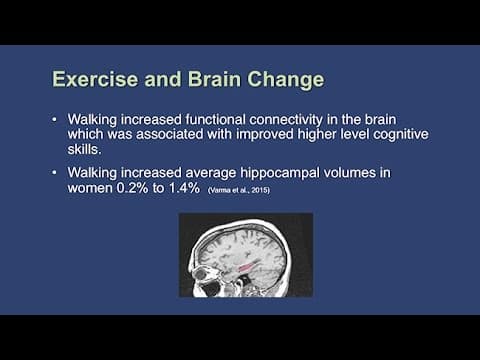
[21:31]So I'm going to talk a little bit more um about kind of everyday activity and walking in particular, but I also wanted to add that the the studies that I had just talked about. These were um exercise studies. So engaging in a guided program for the for the purpose of raising your heart rate, right? Aerobically driven activity. Um but the most popular activity that anybody does, older adults or not is walking for the most part and so there's been some interest in saying, well, what about that? What about sort of that level of activity. And lo and behold that walking also increases functional connectivity in the brain, which was associated with improved higher-level cognitive skills. As well as then the corresponding cognitive outward cognitive skills and even walking increased average hippocampal volumes in women, 0.2% to 1.4%.
[22:34]Which again, might not sound like a lot, except if you remember what I said about average annual decline in hippocampal volumes is about 1 to 2% and an increase from walking by 1% is pretty notable. It makes a big difference in in that particular trajectory. So, um in thinking about about exercise, there's also all sorts of other activities that folks might participate in that that we have begun to try to get a handle on and determine whether they're useful for um enhancing cognitive functioning. And yoga is one of those. I actually get a lot of questions about, hey, what about, what about yoga? So yoga is a little bit more equivocal, so it's pretty clear that that folks that participate in and do yoga have lots of quality of life benefits, have lots of kind of mental health benefits, but like I said, the cognitive benefits are a little bit more equivocal. One recent study found some cognitive benefits, but uh uh a study from a few years ago really just hands down didn't find any cognitive gains. So again, there's lots of other benefits from yoga, but uh probably doesn't rise quite to the level of aerobic activity in thinking about that for cognitive benefit. And then there's also been a lot of interest in uh resistance or strength training, which also clearly has lots of other health benefits, particularly for women in maintaining strength and bone health and things like that. Um, but whether doing strength or resistance training, again, would have any cognitive benefit, and the answer seems to be leaning towards yes. Again, some of the older information was a little bit more equivocal where it wasn't looking quite as favorable, but some of the more recent prospective studies that are actually randomized trials of strength and uh resistance training have begun to demonstrate some positive impact on things like working memory, so kind of holding information in your in your brain and doing something with it. And executive functioning. That's just our overarching term for that frontal lobe functioning, so the problem solving, the planning, the higher-level thinking. And then if you use a a meta-analytic approach, which is really just gathering all the studies that that that fit into your uh subject matter and kind of pulling the data to get to get bigger statistical power, that you do see that really then combining aerobic activity and something like strength or resistance training, may really actually give you the the most benefit of all that putting them together may be particularly beneficial for your cognitive functioning.
[25:09]I I felt like I would be remiss if I didn't talk about the kind of the opposite end of the spectrum and talk just for a minute about sedentary behavior. So, I, um, I have to say when, you know, when I started some of this work, I sort of envisioned sedentary behavior is sort of just the the inverse of of physical activity. And and the research isn't isn't exactly supportive of that, meaning that that, you know, kind of doing your your 30 minutes of physical activity a day is great. But if you're sedentary kind of the remainder of the time, that has its own detrimental effects that perhaps that that kind of exercise time that you did and should be applauded for isn't maybe going to really kind of balance out um the negatives of that much sedentary behavior. So, you know, as I said here, meeting those physical activity guidelines doesn't exactly eliminate the negative consequences of prolonged periods of sitting. It can, you know, kind of at a health level, compromise metabolic health, increases mortality risk. Um and so people have been begun to actually try to systematically study this and just a couple of the more interesting um results that I pulled that older adults that have primarily sedentary pastimes have poorer executive functioning, so again, that higher-level thinking.
[26:36]So, uh, and those then and this this last study was a um a very large study and those with a lifetime history of television viewing, so a lot of TV watching, had lower cognitive functioning, particularly in executive functioning than those who had kind of less history of overall of of watching TV. So again, I like TV, I don't want to say that you shouldn't, you know, watch your shows and, you know, the news and some things that we watch are quite cognitively stimulating. But it's sort of that balance about engaging sort of predominantly in sedentary pastimes and trying to balance that out with some um kind of movement and other physical activity. So I I kind of hinted at a lot of uh the research that has been done to date has been good, solid research that's done in a laboratory. So we bring people in and we monitor how long they're on a treadmill or they're in a group exercise class, so we know how long they were participating in whatever the physical activity, we we were hoping that they would engage in, right? We're being well monitored. And while that's very useful from a scientific perspective, again, to make sure that we kind of have a handle on that level of detail and we know what the input is. It's not really how we operate in the everyday world. I'm not saying people don't go to a gym, but sort of coming in to a laboratory to exercise three times a week is probably not a sustainable um approach for for most people. And so um a lot of us myself included have been particularly interested in trying to, kind of see, what does this look like, I guess, more in the real world? Um and doing it prospectively, so again, I mentioned that we have a lot of epidemiological data or retrospective data where we're kind of looking back and asking people to say, hey, how much, you know, did you exercise in the last year? How much did you exercise when you were a teenager to get that level of data? But um from a scientific rigor perspective, asking people to engage in sort of, here's your exercise program, let's see what happens moving forward, gives us a lot of really good information as well. And those studies have been less common. A lot of studies have also been done with healthy aging and so again, really valuable information to have to understand how people that are aging well are in fact aging well. Um but but we also have a lot of interest in seeing how and to what degree we can apply this to to mild cognitive impairment or some of the studies have been done in Alzheimer's disease. And most studies of exercise have been done in healthy aging, certainly not all, but many. Um, so, you know, as I said that that guided, but ultimately independently done physical activity, kind of in your own home on your own time has been less systematically studied. Again, how does this exercise happen in the real world? There's some benefits certainly to that. It's lower resources that are required that for for the people to participate in. Um, it can expand accessibility so individuals that may not really be able to come into the into your lab or to the specific place that they can do the exercise where they're at. Um and again, kind of just to get a better handle on, we know what it looks like in a very clean setting within a laboratory, but what does it kind of look like in everyday life? So we have a little bit of information about that. This was a particularly well done study that um that looked at actigraphy, so this is sort of a um usually it's a kind of like a wrist watch sort of apparatus that that people wear that track their activity. Often as well as some other things and basically just looked at people uh how they how much activity they had in their everyday life. Now certainly if they were doing purposeful aerobic activity, it would pick that up as well. Um, but what was really interesting is that particularly in women, those that had this highest just general daytime activity did have significantly better cognitive functioning in those tests that I listed are tests of executive functioning. Um then individuals who had lower levels of daily activity. And so, you know, one of the questions I had when I was reading this study, which then they also answered kind of through their statistical methods was, okay, but so maybe these people that are moving a lot throughout the day, right, always on their feet, always going, are also the people who happen to be doing a lot of aerobic exercise. So they really um statistically were able to control for that particular variable and kind of take that off the table and they still found then that there was a bump in cognitive functioning from people who were just moving more. So um increased daily basic daily activity. So this was a particular interest to me and a few years ago the the Stein Institute actually um has pilot grants and I was awarded one of those pilot grants and we did a study to look at just that. So now a walking intervention that people did in kind of in their own daily life, we gave them a structured program to follow to see if increasing that level of daily activity would help their cognitive functioning. So it was a 12-week study. We had 15 um healthy older adults who healthy sedentary but otherwise healthy, uh 65 to 80. They all wore a pedometer, which again, is pretty low-tech device. This was even kind of before like fitbits and all the wearable technology took off. So this is a really low-tech step count that they that they used um to track their daily steps activity. Now they did receive weekly calls from the study coordinator to say, here's your next step goal and to follow up and see if they had met their their goal um for the past week. Um and they were split, so seven increased their their daily steps over the course of the 12 weeks and eight just participated in their activity as usual. Still wore the pedometer. We still track their activity and we tested them um cognitive test before um and after their participation. So just to give you though a flavor of when I say kind of progressively increased their step counts, again, these were reasonably sedentary individuals. So baseline step counts were somewhere usually between say two or 3,000 steps a day. To give you a little bit of a framework of where that lies, the general kind of surgeon general's recommendation is usually for about 10,000 steps a day. So they were falling well short of that, um and so we very slowly upped their step count. So say in the first week, they were only asked to increase about 300 steps a day. But the next week, then it was 400 steps a day, and then 600 steps a day, right? So you can kind of see the progression, but it really was very slow and very gradual. But by the end of the intervention, if they were following the protocol, which they did for the most part, they they had upped their step counts close to sort of four to 5,000 steps. So they were ending in kind of the 7 to 8,000 step range, which again, is maybe below that 10,000 step mark, but if you think about where they started, that was a pretty dramatic increase in their daily activity. And then this is what happens to their cognitive functioning. So these are tests of executive functioning. Um and across the board, really, every executive functioning measure that we gave them showed um some significant increases in the walking group compared to the control group. So certainly the control group had some bump. Often that's from a practice effect, um that they both have by taking the test once and then taking the test again 12 weeks later. But you can see that then the walking group had had improvements kind of above and beyond what we would expect just from practice. More executive functioning tests. Um not all of them are significant changes, um but the vast majority of executive functioning measures showed a positive increase in response to this increase in daily walking. We did not see though the same um significant increases in memory or other health variables. So that uh the first couple of columns there, GDS is um the geriatric depression scale. So this was in there because one of the ideas about why does exercise really help is because maybe it improves your mood. Um and that's giving you some of that cognitive boost that you're kind of stripping off some mood changes. Um and so there was a little bit of of positive change in depressive symptoms, but not different between the groups and not enough to um kind of be a significant difference. The the walking group actually slept a little bit better, not significantly so, but that was another um kind of hypothesis or one thing about maybe exercise actually for most people does do positive things for your sleep. And so if you're getting a better night's rest, maybe your cognitive functioning is is improved because of that. So it didn't seem like sleep was um, you know, the the biggest component here. They lost a few pounds, the walking group, although not significantly more than the other group, but they did lose a few pounds. And that last column is a word list learning test, um and like I said, we didn't find significant differences in memory performance, but we did in executive functioning. So in this and again, it's a small pilot trial, but it really was fitting and in line with some of the data that was emerging that even after this three months, you know, kind of gradual daily step increase, um there was positive changes in their executive functioning, although not not the same level of changes in memory, attention, mood or health variables. Um we did follow up with these individuals and three months later they they still had maintained these these improvements in their executive functioning and not all of them had maintained that particular level of walking, but some of them had. So really what this led us to conclude was that even small increases in physical activity does lead to improvements in executive functioning in older adults. And where we're going with that information now, through some funding through the Alzheimer's Association, is really to take that walking program and apply it to individuals that have mild cognitive impairment. Again, so translating from normal, kind of healthy aging to mild cognitive impairment and can they follow the walking program at home? Can they do it semi-independently, again, with guidance, but but at at their leisure in their own environment? Um and we're also comparing it uh to some computer-based cognitive training and um combining them both together. Um but this study just started uh a little over a year ago, so I don't have any data to present. I just kind of wanted to give you some of the future directions that we're heading. So, hopefully I've I've given you a a reasonable body of evidence that that physical activity is beneficial to your cognitive functioning. But a lot of us are just very curious and say, that's great, but why? What is there what's really going on? Why is why is something that seems like, oh, it should help your heart. It should help your vascular system, it's helping your brain. So there's many hypothesis and I will say that this list is probably um not a pick one and that's the definitive. It's probably going to be a combination ultimately of of many of these things. So you get some general health gains from exercise. So if you lower your vascular burden, right? If you lower your blood pressure, if you, you know, kind of lower some of your metabolic risk factors from exercise, you get healthy brain benefits from those things as well. You do get some increased ability of the heart to deliver oxygen. The brain really likes oxygen and glucose. Uh you get increased cerebral blood flow, so kind of increasing the metabolic resources to the brain might be a piece of it. Um, there's certainly some evidence that it becomes a bit neuroprotective, so that if something else might happen to your brain, you're a little bit better buffered against some of those other things that might go wrong because you had some of this additional um protection. There there's some interesting information about it as a stress reducing technique. So, I don't want to go too far afield, but certainly with things like post-traumatic stress disorder, there's been some emerging information about long-term risk for cognitive decline for individuals that have PTSD. And one of the hypothesis is because it's sort of a chronic stress reaction that does negative things to your cognitive functioning over time, and exercise is an excellent way to reduce stress and to reduce that level of cortisol to the brain, so again, kind of um can reduce some of those physiological components of stress, as well as just truly improve your mood so that there's clearer thinking so that some of those um maybe mental health comorbidities aren't impacting cognitive functioning to the same degree.
[56:27]Yeah, sure. So the comment was if you notice cognitive changes in yourself or in a loved one or a friend have it checked out immediately and you're right, because sometimes there, there very, uh, reversible things. Um, yeah, so having it checked out is, is the healthy thing to do. Yes, sir. The question was about what do I mean when I say computer cognitive training? And so, you know, usually what I'm thinking of and referring to are these computer-based programs that have, you know, kind of cognitive games and things, but they're in a set it's a set program. However, there is definitely lots of evidence to suggest that participating in cognitively stimulating activities, learning a new language, I think was one of your examples, you know, learning something off the computer does have cognitive benefit as well. Without the computer, with or without the computer, absolutely. Just doing something that's new and novel for your brain.
[57:26]Thank you, if you do please come see me after, thank you.