[0:14]So in this next module, we're going to move up from sentences to paragraphs, talking about paragraphs and we'll continue the discussion of paragraphs and even get into whole compositions uh into next week.
[0:27]So when you think of the paragraph, I want you to think of the paragraph as the unit of composition of your manuscript.
[0:35]So each paragraph should contain one main idea and you should think in paragraphs when you're organizing your your manuscript.
[0:43]So, um, one idea per paragraph is often a lot less than scientists try to stuff into a single paragraph.
[0:51]You'll see in the scientific literature these just massive paragraphs that are too complex, there's too much going on in them.
[0:59]That's really hard on the reader. So use the paragraph to delineate to your reader where you're switching to new ideas.
[1:04]One idea per paragraph.
[1:07]Keep your paragraphs relatively short. if you pick up uh professional writing like a magazine, you'll notice that they might have three, four, five sentences in a paragraph.
[1:17]We don't need to be quite that short in in the scientific literature, but we probably shouldn't be much longer than that.
[1:21]And uh the advantages of having small paragraphs that aren't too long, one of the major advantages is that it provides a lot of white space on the page and that's really, really important to readers.
[1:36]So if you're faced as a reader with a page that's just kind of full of a huge block of text with no breaks, no uh breaks into paragraphs.
[1:46]It's really daunting because you kind of know it's going to be tedious and hard to get through and it's just this, you know, it's very intimidating.
[1:50]So try to break things up. This is one of the things that I often encourage students to do is to to break up uh they often have too many things in one paragraph, start to break it up into more paragraphs.
[2:02]Try to keep one idea to per paragraph. Another tip on paragraphs is that the way that scientists writes tends to be the following.
[2:11]So scientists like to put details, details, data, supporting data, conclusion.
[2:16]That's the way scientists think, of course, right? We start with the details and the data, we we uh go through and into the conclusion.
[2:24]However, when you go to write things up, I'm going to encourage you to invert that.
[2:30]I'm going to encourage you to give away the punch line early because it's really hard on the reader to weave through all of these details if they don't know where you're going, if they don't know what the take home message is.
[2:40]So, you're going to want to give away the punch line, give the conclusion, the take home message first and then fill it in with all of the details.
[2:51]That way your reader knows where you're going. The reader knows what to expect, otherwise it's just a massive amount of details that the reader has to weave through.
[2:55]So in journalism we call this the inverted pyramid style, you kind of start with the most important point, the take home message and kind of filter down from there with the supporting ideas.
[3:05]Give away the punch line early. Now, I should note, um, that you may have learned somewhere along the way uh to use topic sentences, or you may have been encouraged to use topic sentences.
[3:17]And I don't want to I don't want to say that you have to use topic sentences.
[3:22]Uh this idea of giving away the punch line early is kind of similar to topic sentences, but I on the other hand am not a huge fan of topic sentences.
[3:30]I think it's a little bit confining if you feel like you have to start every paragraph with an exact statement of the aim of the paragraph.
[3:36]Uh, you know, and it becomes a little bit monotonous too.
[3:40]So I'm not a big fan of topic sentences, but the general idea of trying to get your main take home message uh, you know, given away early in the in the paragraph, that's a good idea.
[3:50]It doesn't mean you have to go all the way quite as extreme as topic sentences. Another uh tip on paragraphs is that in terms of paragraph paragraph flow, making your paragraphs flow nicely within a paragraph, I'm talking about for the moment.
[4:02]Um, you really want to rely first, primarily on the logical flow of ideas.
[4:08]So that's the main thing that's going to make a paragraph flow well. It's not transition words, it's not uh the language, it's the logical organization of the ideas and I'll give you some more examples of that.
[4:20]So if you have good logic, you're building up your ideas in a logical way, your reader actually can fill in a lot of the gaps.
[4:27]You got to trust your reader a little bit that they don't need a lot of pointers if you've organized it in a way that's very um predictable.
[4:34]Uh paragraph flow can also help be helped by using uh parallel sentence structure, which we talked about in the last module, and sometimes I'm going to show you a couple examples where uh you have a compare contrast.
[4:46]And if you make multiple sentences across multiple sentences, you make those different sentences parallel in some way, that can help the flow of the paragraph within the paragraph as well.
[4:55]And then finally, at the very end, I've put a big, you know, if necessary, then you can also use transition words.
[5:05]So transition words definitely have their place. They can be very helpful in cluing your reader in on where you're going.
[5:10]However, transition words are highly, highly overused and so I have students where I've edited where almost every sentence starts with a transition words.
[5:20]So, uh, I really want to catch yourself if you find yourself reaching for too many transition words, that's probably indicating that you're overusing transition words.
[5:30]And the reason students tend to overuse them is that they use them kind of as a crutch to make up for the fact that their logic isn't actually that sound.
[5:38]And so they're throwing in those transition words to try to kind of, you know, help uh fix the fact that their logic underneath is poor.
[5:46]But that's not going to fix it. You need to go back and fix the logic. Don't rely on those transition words. They're they're not strong enough to fix a underlying logic that's not sound.
[5:55]So use those sparingly.
[5:58]And don't don't be too exotic with your transition words either.
[6:01]You'll notice in a lot of professional writing, the favorite transition word is the word but, B U T.
[6:07]It's a great way to indicate to the reader, hey, but I'm going to be changing gears here a little bit.
[6:11]So you don't need fancy, nevertheless, on the other hand, you can just use the word but, B U T.
[6:17]And then finally, the final tip on paragraphs is keep in mind that your reader will tend to remember the first sentence and the last sentence the best.
[6:25]So again, you're kind of giving away your take home message in that first sentence, and you want to make that last sentence kind of memorable, uh, have a little build up to the last sentence, a little emphasis at the end.
[6:33]That can make a really good paragraph.
[6:36]So in terms of the logical flow of ideas, what do I mean by that?
[6:40]So, when you're writing in your paragraph, you again, you just want your ideas to kind of flow from one another.
[6:46]And that's means a couple of possible things.
[6:49]So, so for example, um, if you go sequential in time, if you have some kind of history you're talking about, going sequentially in time starting from the first and going to the later, that's just a natural way that people, you know, people's brains work.
[7:02]So sticking to kind of a natural, easy timeline can be very helpful.
[7:05]So I like to say you should avoid the approach of uh that movie Memento that was out in 2000, which had this very bizarre timeline.
[7:16]Uh, you know, movie makers, uh movie uh directors may like to do it that way and it might be interesting for a movie but very hard on a reader of scientific literature if you mess around with the timeline.
[7:23]So just go with the natural timeline in general.
[7:26]Another way to make your ideas kind of flow logically is to start with something that's a general and then move to the specific.
[7:34]So they kind of give the take home message, the the general point and then give the specific examples.
[7:42]So that has a nice logical flow to it as well. Um, and then you can always think about when you're organizing your paragraphs, um, I was a philosophy major undergraduate, so I took a lot of logic where we did, you know, if A then B, A, therefore B.
[7:54]So I sometimes will think of my arguments in terms of kind of logical arguments, almost mathematically.
[8:00]And that can be really helpful in organizing your ideas is actually to think about the logical arguments that you're making and make sure that your logic underneath those arguments is sound.
[8:09]So I'm going to start here with an example paragraph of from something I was reading in The New Yorker a few years back.
[8:18]was about uh, uh bounty hunters and bondsmen and bondswomen as well.
[8:22]And uh, it has some good uh principles about uh organization uh of a paragraph.
[8:27]So, it says, usually, when a defendant absconds, a bondsman hires a bounty hunter to find and arrest him within the grace period (which, in California, is six months).
[8:37]If that fails, the bondman tries to seize any collateral that the defendant put down to secure the bond, or sues the defendant's "indemnitors," who signed the bail application as guarantors.
[8:46]But Zabala hadn't put down any collateral, and so far Green—one of the few bondsmen who always do their own bounty hunting—had found neither him nor his indemnitors.
[8:57]The grace period was nearly up. Soon, Green would have to pay the court thirty-one thousand dollars.
[9:02]So there's a lot of things in here that I can point out about the logic of this paragraph.
[9:07]An interesting topic obviously.
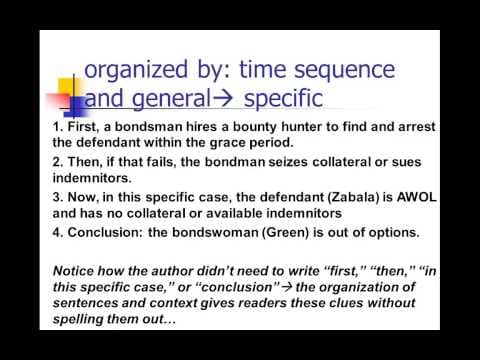
[9:10]Um, so notice that they they go kind of in logical time sequence order, first this happens then this happens and they also do a general to specific.
[9:16]So they have first, a bondsman hires a bounty hunter to find and arrest the defendant within the grace period. That happens first.
[9:21]And then, if that fails, the bondman seizes collateral or sues indemnitors.
[10:04]So you, uh, you take whatever the, um, the defendant left behind.
[11:10]And then if that fails, you got to pay the money yourself, the the bonds, uh, man or woman has to pay the money him or herself.
[11:20]So those are the three options. Something that the money is owed to the court. One of those things has to happen.
[11:25]So, uh, in this case, out of those three options, which one, what happened? Well, uh, the grace period is done and there's no arrest yet.
[11:34]There was no collateral, there was no indemnitors. So what's the conclusion? What's going to have to happen? Well, there's only one option left that Green, the bondswoman has to is, has to pay that $31,000 herself.
[11:43]So you can see there's actually a kind of a nice logical argument under that.
[11:48]Sometimes it's helpful to even map those out and kind of A B C terms.
[11:53]I want to point out to you uh the transition words used in this paragraph.
[12:00]There were a couple, but not too many, right?
[12:03]So there's an if, there's that but, B U T and that tells you we're switching modes and there was a soon.
[12:08]But notice we didn't have to start every sentence here with a transition word. We just needed a couple of key small transition words.
[12:14]Nothing fancy and not too many of them.
[12:17]And then one more thing I want to point out about this paragraph, it has a really nice ending, okay?
[12:21]So it ends, but Zabala hadn't put down any collateral, and so far Green, one of the few bondsmen who always do their own bounty hunting, had found neither him nor his indemnitors.
[12:31]So notice the use of dashes in that sentence. That's a kind of a long complex sentence with dashes and everything.
[12:37]And then we get a short sentence, The grace period was nearly up. Soon, Green would have to pay the court thirty-one thousand dollars.
[12:43]So we get this kind of long sentence, complex sentence, short sentence and then a little bit longer sentence.
[12:50]Notice the variety in the sentence structure. That provides a really nice build up for the conclusion there.
[12:55]And it ends with this memorable conclusion, well, this uh person Green is going to owe the court a lot of money.
[13:03]So those are some pointing pointers for how to organize your uh paragraph in a logical fashion and really make your paragraph work.
[13:10]So now I'm going to give you a paragraph that needs a little bit of editing.
[13:14]So, uh, this paragraph was from a scientific paper.
[13:20]And the goal of this paper was, the scientists took a bunch of perfume scents, you know, put them in test tubes.
[13:29]Had a bunch of participants come in and uh and smell the various sense and rate them for their preferences.
[13:35]So some people will like a certain scent and won't like other scents.
[13:40]So they have them rate these various sense. Then they took uh their blood and measured their DNA and measured uh genetic markers.
[13:49]And they're trying to see whether or not your preference for various sense might correlate to your genetic makeup. And there's some uh reason to believe, uh scientific reason to believe that that might be true.
[13:54]So that was the experiment. Um, and this paragraph, I pulled out of the conclusion section, specifically from the limitation section of this paper.
[14:03]So where they were trying to give the potential limitations and tell you kind of how they guarded against those limitations.
[14:08]So this paragraph was about a potential limitation of their experimental setup.
[14:16]So because they had to give these different uh perfumes for everybody to smell.
[14:19]They got to have some choice in terms of exactly the concentration that they were going to use for the different sense.
[14:26]And there's some issues with choosing the concentrations, actually really important for this experiment because if you put too high of a concentration, it turns out that when it's a really high concentration, it's so intense and overpowering that most people will just be turned off to that scent.
[14:38]So you don't want to put everything at too high of a concentration and similarly, if you put things at too low of a concentration, maybe um the smell turns out to be not that pleasant just because you're not getting enough of it.
[14:50]So you had to be very careful about the concentrations.
[14:54]And so they're telling you exactly how they chose those. So they uh chose the um concentration by standardizing against a reference substance.
[15:00]So then they give you some additional details here.
[15:04]So if you have time and you want to pause the video now and take a stab at editing this paragraph on your own.
[15:09]It's tricky because you don't have the background here, but hopefully I've given you enough background you might be able to figure this one out.
[15:13]Uh if not, I'm just going to kind of lead you through how I would approach this and I want to point out some interesting things about this paragraph to note.
[15:21]Um, by the way, the original paragraph had 212 words.
[15:25]I actually uh ran out of room in that last sentence, so I didn't quite put the whole paragraph here, but you get them you get most of it.
[15:32]It was 212 words, which is quite long. Not so many sentences, but some very long sentences in here.
[15:39]So I want to point out a few things about this paragraph. So notice that there is quite a few transition words here.
[15:44]We get a nevertheless, a hence, a however, and interestingly, so there's a lot of kind of back and forth.
[15:49]Um, telling the reader, I'm going here, I'm going there, a lot of pointing out to the reader where you're going.
[15:55]And that usually believes some problems with the underlying logic and if you, you know, have read this paragraph from start to finish, uh you will notice that it's pretty difficult to follow.
[16:05]Actually, I should read it through for you now, just to kind of give you a sense of how difficult it is to kind of make heads or tails of this paragraph.
[16:10]So it says, most scents remain constant in their quality over orders of magnitude of concentration (12).
[16:15]Nevertheless, at high concentrations, quality tends to be negatively correlated with intensity, as was the case, for example, for the cinnamon oil used in this study.
[16:21]Hence, reliability of absolute scorings was achieved by calibrating the amount of perfume ingredients with initial ratings for intensity against a reference substance of known concentration.
[16:32]The final concentrations were in principal chosen in a way such that individual ratings showed variance among participants within the sliding scale between 0 and 10 (meaning that people could decide whether they liked a scent or not).
[16:40]This procedure seemed successful for most scents; however, the concentrations for bergamot (highest average ratings) and vetiver (lowest average rating) could probably been reduced even more, as both scents did not show any discriminating power at the level of common alleles (people largely agreed on the quality of these two scents) (see Table 2).
[16:55]Interestingly, the pooled rare alleles showed discriminating power for...
[17:00]So there's a lot going on in this paragraph. It can probably be edited, as you can guess, quite a bit to make it a little bit more concise and uh bring out the logic of it a little bit more.
[17:07]So one thing to point out is the transition words, again, if you have a lot of transition words, that sometimes is a good clue that you need some work on the logic of the paragraph.
[17:17]Another quick thing I want to just point out is uh as I was reading this over to prepare these slides, I recognized that there's actually a spelling here in here.
[17:25]This is the kind of spelling error that uh, you know, word or your word processing program isn't going to pick up.
[17:33]because um, it's the final concentrations were in principal, well that's spelled correctly, but it's the wrong word choice here for principal, right? Principal is your pal.
[17:44]Uh, what you want here is the final concentrations were in principle, which is the P L E.
[17:50]So your spell checker is not going to catch that one, and in fact, the copy editors for this journal didn't catch that one, nobody caught that one.
[17:55]It's not a big deal, but it'll just point out there, you know, to be careful on usage.
[18:02]And one final thing I want to point out in this paragraph is that interestingly, the authors of this uh paper actually did use parentheses.
[18:10]We talked about using parentheses in an earlier module to stick in extra information.
[18:14]And the authors actually did that here, not all uh scientific papers will you see this.
[18:19]And interestingly enough, I really liked the stuff that was in the parentheses because that was the most clear to me.
[18:27]In fact, they they seem to want to like every time they write the kind of a long complicated thing, they want to tell you, clarify it for you in the in the parentheses.
[18:33]Oh, this is what I mean, meaning that people could decide whether they liked a scent or not.
[18:37]Oh, this is what I mean, people agreed largely on the quality of these two scents.
[18:40]And that's the easiest thing to understand in the in the whole paragraph are those two little things.
[18:44]So it's almost like they didn't want to put it in simple language, but they they kind of recognized that they needed a little simple language, so they stuck it in.
[18:51]Anyway, uh, it's a good use to the parentheses, although it kind of shows you that maybe what they should have taken what was in the parentheses and made that built that into the into the paragraph itself.
[19:01]So when I'm approaching editing a paragraph like this, what I really need to do is first of all, I got to understand what it is that the authors were trying to say.
[19:09]And sometimes that's a challenge. Sometimes I have to go back to the authors and kind of ask them what is it you were trying to get at? What was the main point of this paragraph?
[19:15]What were you trying to do in this paragraph?
[19:18]And so I actually didn't go back to these authors, but I was able to sort of piece it out from reading it over many times and from the context.
[19:25]So, um, then once I kind of figure out what the paragraph is about, the main point, then I can try to kind of weave through all the sentences and figure out exactly what is it that the authors were trying to get at.
[19:35]What were they trying to tell the readers? Is some of that unimportant? Can we delete that?
[19:38]A lot of times there's extra details that we don't even need and and, you know, they're not really contributing to the main idea of the paragraph.
[19:44]A lot of times we can read those out. So there's a way that in my head, I don't usually build a formal outline, but in my head as I'm editing things, I tend to kind of build a very simple outline.
[19:54]I don't necessarily write this down, but I think it's helpful for um for the purposes of teaching to write this kind of outline out very explicitly.
[20:01]So, first I got to ask myself, well, what was the main idea of that paragraph? What were they trying to get it?
[20:07]So I think what they were trying to get out here was just asking the questions because it's a possible limitation of the study, whether or not the perfume concentrations that they picked in their experiment were appropriate.
[20:17]If they didn't pick good concentrations, that could have greatly affected the results.
[20:23]So they're trying to tell you that they did an okay job at picking the concentrations in this paragraph. So that's the main idea of the paragraph. That's the goal of the paragraph.
[20:29]So we have to kind of keep everything focused on that main goal. And again, the main means stripping out some extra details that don't contribute to that main goal.
[20:36]Um, then there's some subpoints to that, right?
[20:39]So asking the question where the perfume concentrations in the experiment appropriate? Well, here's some things to think about, related directly to that question.
[20:50]So one thing that's a very important point to make is that if the concentration is too high, you might get a smell that's so overpowering that everybody rates it as a poor quality.
[20:58]Just it's too overpowering intense for everyone.
[21:02]So that will not allow you to get enough variation in your ratings to be able to correlate with any, um, genetic, uh, makeup.
[21:10]And they say, well, if that were the case, that's going to be a problem, but in fact, we standardized the intensity here, so we feel pretty comfortable that we didn't have any sense that we're simply just too overpowering or too intense.
[21:24]So they answer that particular question.
[21:27]Uh, another thing that they need to think about in terms of the perfume concentrations, another potential problem, is that remember, they were trying to correlate people's preferences for the perfumes with their genetic makeup.
[21:38]Well, if everybody rated the perfumes exactly the same, if there was no variation in the preferences, then you wouldn't be able to correlate that with genetic variation.
[21:50]So they are saying in their paragraph that, you know, the one way to kind of tell whether or not the concentrations are appropriate is simply if they have enough variability in their quality ratings, that's a good indication that that was the right concentration.
[22:01]It's at least good for the experiment because they can get enough variation to potentially correlate with genetic makeup.
[22:07]And they tell you that that was true for most of the sense in the experiment, they had good variability in the quality ratings, except there were two sense from which that wasn't the case.
[22:15]The one that got the very highest ratings and the one that got the very lowest ratings, both of those were a little bit uh, you know, didn't have very much variability.
[22:23]Maybe because everybody really liked them or everybody really hated them.
[22:26]Um, but potentially it could have something to do with the concentrations that they chose.
[22:30]So this is really everything that was going on in that paragraph.
[22:35]And then the goal of editing is going to be to kind of bring out all of those main ideas in simple language, get everything rid of everything that doesn't contribute to those main ideas.
[22:43]And then of course, when I'm editing the paragraph, I'm also going to be doing sentence level editing, not only fixing the organization of the paragraph, but also making the sentences read nicely.
[22:52]So here's the overall edit that I came up with.
[22:56]I got it down to 91, 93 words actually, so I cut it down by more than half.
[23:01]So I started with perfume quality and intensity may be negatively correlated (if a scent is too strong, most people will reject it independent of their preference).
[23:07]And I kind of stuck with this little uh stylistic thing that the authors have of of giving the little common sense message in the parentheses.
[23:13]So, uh, if a scent is too strong, most people will reject it independent of their preference.
[23:19]Hence, I kept one, or I kept two transition words here. Hence, we chose the final concentration of each perfume ingredient so that it had similar intensity to a reference scent (1-butanol).
[23:28]So they're saying, okay, we guarded against the fact that you might get um overpowered by making sure that there was a, every there were none of them were overpowering because they were all standardized against a reference.
[23:40]The resulting concentrations appeared appropriate for most sense.
[23:43]And we can verify that because the participants preferences varied along the sliding scale between 0 and 10.
[23:48]However, people largely agreed on the quality of uh bergamot and vetiver and so lower or higher concentrations may have been needed for these sense.
[23:55]So that with that exception, we did a pretty good job.
[23:59]So you can see, I've captured all of the things that I set out in this paragraph and got rid of everything that didn't contribute to getting those ideas across.
[24:07]The preceding program is copyrighted by the Board of Trustees of the Leland Stanford Junior University.
[24:13]Please visit us at med.stanford.edu.


