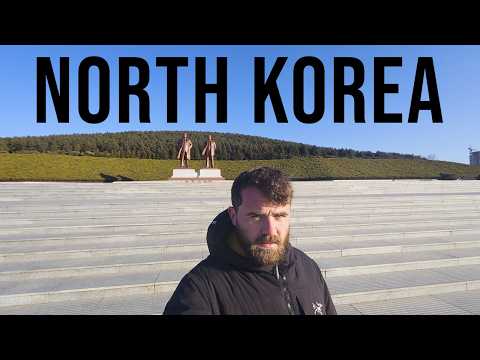
[0:00]On the 20th of February 2025, I became the first British tourist to gain access to North Korea in over 5 years. I am not a journalist. I have no political agenda, and I do not support the regime of The Democratic People's Republic of Korea. Welcome to the very, very cold Yanji, northeast China. 20 km in that direction lies a country so secretive that when I was flying in, we had to close the blinds on the windows of the plane because we weren't allowed to look outside. Tomorrow morning, I'll be among the first group of non-Russian tourists in over 5 years to step foot inside North Korea. Without any further ado, roll the cliche intro featuring a compilation of news reporters saying the words North Korea over and over and over and over again. North Korea. North Korea. North Korea. North Korea. North Korea. North Korea. British travel influencer Mike O'Kennedy, one of the first Western tourists to visit North Korea since before the pandemic.
[1:14]Looks like North Korea's back on the menu, boys. It's the most isolated country on Earth, and since January 2020, it's been completely closed to the outside world. Until now. While 13 of North Korea's administrative divisions remain closed, one has opened up. Rason. Not only is it the one place in the world where Russia, China and North Korea, the three bad boys of Eastern politics stand side by side, it also happens to be North Korea's controlled experiment with foreign trade. Come with me on this two-part series as we step into the most secretive and isolated country on Earth. North Korea. Hello, I'd like to speak to literally anyone outside of North Korea. No, he doesn't think so. Now, before we head into North Korea, let's clear up a few things. This is going to be unlike anything I've ever filmed, and that's because North Korea is unlike anywhere I've ever been. I like to do things solo, unaccompanied, whereas I'm going to be very accompanied. I'll be with a tour group and a tour guide, it's the only way that you can see North Korea is with a tour. I like to do things unplanned. This is going to be very planned. The next five days have been meticulously planned months in advance by the tour company. I also like to do things as uncensored as possible. Now, this is North Korea, the rules are different. I'd imagine there's going to be things that we can and can't do, things we can and can't see. But what we're going to do is what we always do, and go in with an open mind, with an unbiased perspective, and I promise you, I'll be showing you exactly what it is I see. Now, I've got to get out of this fucking forest.
[3:00]This is the Chinese border going into North Korea, and it's a border that quite literally hasn't been used in over five years by a tourist. It'll be interesting to see what the Koreans check, my phone, my camera, my passport, uh my 47 copies of the DVD Team America World Police. And I'll try and document the entire process. After crossing the bridge over the Tumen River, the body of water separating China and North Korea, our passports were checked, stamped, and then we were instructed to list every electronic device in our possession. That list had to match our items on the way out, not because they're worried about what we might take with us, but because they're concerned about what we might leave behind. You're not allowed to bring anything that could be considered politically sensitive, such as a book about North Korea or a USB containing external political content. And just like that, we're in North Korea. Let's see what planned adventures there are for us over the next five days, starting with a bus through the countryside. Let's see what we can see.
[4:25]The very first thing that struck me was the sheer amount of farmland. With 80% of North Korea covered in mountains, every available piece of usable land is dedicated to farming, and I mean every single piece. This isn't just due to necessity, but also stems from the country's core ideology of self-reliance, which prioritizes producing as much of its own food as possible, rather than depending on imports. We are also told that the country doesn't use any form of chemical fertilizer. The residents are asked to collect their own bodily waste, which is then taken to the fields and used as organic fertilizer. Being a socialist communist country, there are no advertisements in North Korea. Instead, almost everywhere you look, you'll see this government propaganda designed to inspire the people. This one says unwavering loyalty. We had five North Koreans with us, three guides, a driver and a photographer. They were very friendly, always polite, and they did their absolute best to make sure that we felt at ease. But no matter how welcoming they seemed, there was no shaking this feeling that we were being watched, always. So walking into the into the nature reserve now, as much as I love this is where this trip's going to be really tough for me because, um, as much as I love going around and seeing the things that they that they want you to see, the deer park, and we're going to visit a bank, which is going to be very interesting. What I'm interested in is what's going on above the beyond those mountains and beyond those mountains and in these villages. I've got a feeling there's not going to be a lot of human interaction on this trip, which makes me very sad. Give me a bag of your finest. a bag of your finest carrots, please, sir. I'll take I'll take whatever you've got. I'll take some corn. So they used these they raise them. One of the one of the reasons they raise them for me is one of them, and also they they cut off the antlers every year, every couple of years, and then they use the antlers to make uh some kind of medicine. Go away.
[6:33]Fucking, oh, go on, mate. Oh, for fuck's sake. You're scaring him off. You are scaring him off. Oh, fucking hell. I'm getting attacked by Korean North Korean deer. Don't worry, I'm not from America. I'm not from America, fucking hell. I said the word America and they've all gone nuts.
[6:55]The thing is, because we're feeding them, every time they see a white dude now, they're going to get hungry.
[7:05]Come with me to visit a mineral water factory. Yay! Yay! Mr. Moon, you said this is a factory. This is a factory. Where are the factory workers, the people working here? What's the day today? The day today is Saturday? Thursday. Thursday. Yeah. What I've just noticed, this is a this is a mineral water factory. The water runs the water runs straight from the mountain into this building, and there is kind of kind of like a grotto. I'll get some more videos of my camera. With my phone. Kind of like a grotto where there's just water pouring out and a cup where you can go and drink the water, and nothing else here, and no one else here. Let me show you what this thing looks like on a good camera.
[8:08]A little bit of the old What do you say? Don't drink too much of it, because it could get sick.
[8:19]It's good. Pretty much every individual house I saw in this region looked exactly the same, simple white walls with blue roofs. In North Korea, all property is owned by the state, and the people don't get to choose where they live. Housing and living arrangements are largely influenced by a family's political, social and economic background. However, many believe that this traditional system is becoming outdated, with financial wealth playing an increasingly dominant role over social status. One thing that really impressed me were these new rural housing developments. My guide told me the government is currently building 500 high-quality homes in every county per year. With 145 counties across the country, that's a huge number of houses being put up.
[9:07]Hi, how are you?
[9:14]Oh! Let's see what a North Korean hotel room looks like in 2025. What do we have? Coffee, tea, water. I think this is a heated bed scenario. That'll be that'll be nice. We've got a phone. Let's try and call someone.
[10:03]First impressions of North Korea. We spent two hours, um, traveling the bus from the border of China. I reckon I saw about 20 people in that time. Not a lot of people, no cars, maybe like one or two taxis in that whole journey. Um, people on bicycles, the people that I did see were on bicycles. They're out on the farm. I didn't see any farming equipment. I didn't see any Considering the amount of farming equipment there is here, no tractors, no harvesting crap, you know. Um, where I am now, Rason, it is an incredibly unique and a very, very unvisited part of North Korea even before COVID. And it's very, very interesting. A lot of foreign investment. Think of it as as a kind of experiment by the North Koreans to introduce some form of capitalism into the country. I'm going to learn about it. We're going to look around. We're here for five days, man. Forget about it. Chill out, man. Chill out. I'm going to bed. I'm going to bed.
[11:36]So those are 727s. Yeah. 727 stands for 727, 1953, the day of the uh uh end of the Korean War. The most expensive one and the most nationalistic one and the one smoked by Chairman Kim. Thank you, madam. So the cigarettes I bought back there in the souvenir shop, I used Chinese money for. Now, you might be thinking, Mike, you're in North Korea. What are you doing using Chinese money? Rason, the district I'm in at the moment, is a special economic zone, which means that its uh economic policies differ from the rest of the country. Now, let's speak to someone who actually knows what the fuck they're talking about because I don't. Justin, what makes Rason different and and why is it a special economic zone? So a special economic zone such as Rason invites foreign investment. So we have a lot of Russian and Chinese companies that are doing business here. It gives northeast China uh easy access to the Raging Port. Also, uh Vladivostok, the port there freezes over for about half the year, so it gives the Russians access to uh a port that isn't frozen in the region. And um it also gives um the DPRK the opportunity to earn hard foreign currency, which they can then put into social programs that, you know, are used to uh prop up the rest of the country, and the social programs uh uh on which the DPRK exists.
[13:19]This is the Golden Triangle bank in Ragin, and I've just gone and opened up my own North Korean bank account. I'm supposed to see cash card. Um, but it's a North Korean bank account. And North Korean DPRK money, which you can uh not spend, really. This is primarily used by locals to pay their monthly electricity and water bills, which comes to a whopping 5 US cents per month. And uh this is about a pound, and I've got about 13,000 DPRK money.
[14:32]It was quite nice that even having that very, very minute interaction with that man, shaking his hand and getting a smile from him, that is the absolute most interaction I've had in an entire day with any member of the public in North Korea. This is so weird. Okay, that's not what I fully expected. I mean, there's quite literally, other than the group that I'm with, no one here. It's strange. There's one lady there. Hi.
[15:15]I also find it incredibly strange to like not be able to to to just go and do my own thing. In the morning I won't be able to wake up and and go for a walk. I won't be able to wake up and go and have food. You just always, always with. We've got four guides with us. Four people watching us all the time. Did the for the past five years, there's been no traveling for you between here and Pyongyang? Just individually. Ah, okay. Is that because of COVID or anything? It serious. Was COVID uh here for the whole five years? How long did COVID situation last? Sir, I'll tell you later. Okay. Can I ask you later? Yeah, later. Thank you. Perfect. Perfect.
[16:16]Ah, no camera. No camera. Yeah. As you can see, my guide wasn't comfortable talking about COVID on camera. But off camera, he told me that the virus was sent over in a package attached to a balloon from South Korea. It spread fast, but thanks to Kim Jong-un's quick action, North Korea completely contained the outbreak in exactly 90 days. Honestly, that's not too hard to believe, considering how easily the country can lock things down and control its people.
[16:54]Apparently, the the soju. So there's a very uh popular alcohol in in Korea, South Korea and North Korea, called Soju. Uh, which is made from don't fucking know, and it's apparently the one that they have in North Korea, because, because of the the products are all um domestically produced. For example, the cigarettes and the alcohol, they're domestically produced and they're organic. So apparently, the alcohol doesn't really give you a hangover. What are we doing today? We're going to a bookshop, a North Korean bookshop. A government-approved authors, government-approved themes about the party basically. And then we're going to maybe buy some propaganda memorabilia. And then we're going to go and look at go to see some schools, a secondary school, and an orphan school, which is just like the secondary school, but the kids don't have parents. So that'll be fun for the orphans. Hey, kids, today, uh, we have a surprise for you. A fat hungover white dude is coming to look at you. This is a foreign language bookshop, and I'd say 99% of the material here is about the leaders, about the party. Thank you. So these are anti-American propaganda postcards. Knives, and these are American soldiers here.
[18:52]I'm actually running a giveaway where I'll be personally writing and sending these postcards to five people. All you have to do is follow me on Instagram and message me telling me one thing that you learned from this video. Warning, if you're from the US and you get one, it might come with a visit from the national security agency. Big North Korean soldier. Lots of American soldiers in a crash plane down here.
[19:19]This is a bottle of North Korean Rattlesnake Brandy, and it's supposedly a classic drink here in DPRK.
[19:38]One of the guys picked up this book on Juche, North Korea's core ideology. In simple terms, it promotes total self-reliance, politically, economically, and militarily, rejecting any dependence on foreign powers. The irony is, I'm in Rason, a region actively experimenting with foreign trade and investment. It seems like we're living in a world where even North Korea can't survive without outside support. Can you explain to me what these big circles on the floor are? Mass dancing point. special occasions are our the birthday of President Kim Il Sung and the birthday of General Kim Jong Il. Yeah. We had a grand mass dancing here. Young people, students. On on the birthdays of the of the leaders, uh, students will come around and they'll do some kind of, um, choreographed dancing. Very interesting. And what does this say over here, this big sign? Yeah. Long live the revolutionary ideal of the great comrade Kim Jong Un.
[22:21]Put your hands up if your favorite subject is English. You like English? Cool. What's your favorite thing about English? My favorite thing is conversation. Conversation. Me too. I love conversation. You're the English teacher. Nice to meet you. Michael. Nice to meet you. What do you like about the countryside? Beautiful? Now, under the wise leadership of our fatherly Marshal Kim Jong Un, the countryside has been changing. I I don't know. No, how is it being changing? Now new houses were built and also gymnasium, park and swimming pool and so we were all rebuilt. Do you like daughter or sons? Do I like to have a daughter? I have no children, but I think I would like to have a daughter. Because girls are much nicer than boys. Do you think so? Yes. I think girls are more polite. Boys are not polite. What do you think?
[23:29]I think so. But it's very different on every person. So for girls are more polite than boys. Okay, I agree. Thank you so much. Thank you so much. Thank you so much. Thank you.
[24:23]You're about to see possibly the most cringy performance anyone has ever given on a volleyball court in the history of forever.
[25:10]You don't see this on BBC.


