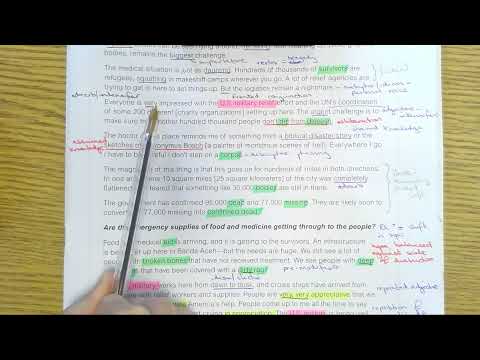
[0:02]So today we're having a look at text 7.1, which is a piece of reportage and it's from Chris Rainier after and it's a first-hand account of his experiences of a tsunami in Indonesia in 2005. So in terms of the gap then, obviously this is a piece of reportage. It was actually prepared and read out, and then is later published online as an article. The audience is going to be people who are particularly interested in world affairs, and any of those with an interest in natural disasters. Chris Rainier was also a famous documentary photographer, so there may be some people who are kind of fans and followers of him. National Geographic is kind of huge, um, and well-known publisher, so it's going to attract quite a wide audience. It was obviously, um, one of the biggest natural disasters that we've known, as well, so, um, that would have led to a wide audience. So primarily then the purpose is to inform and to share his experiences of a disaster and the aftermath of the disaster, as well. Now because of the serious nature of the, um, reportage, you can see I've kind of picked out some adjectives here to describe the voice. So it is somber and it is solemn. It mixes really between a, a more kind of personal voice and then a a factual voice, as well. So let's have a look at this opening paragraph. Um, so the, the sort of title is, is really quite a basic one, just explaining what this online article is about. And then we start with, "The best way to describe this because we grew up with the images and we all know what it looked like is that Banda Aceh looks like Hiroshima after the atomic bomb." So we start off really with quite a personal voice, um, and really this kind of parenthesis here helps to develop that personal voice, because it engages the us as the listeners with this direct address. There's also here these collective pronouns, "we", "because we grew up with this", and "we all know it". Okay, they, they gives a kind of sense of community. Now, this was a disaster that the kind of, um, globe responded to, because it was such a, it was on such an unbelievable scale, and, um, that's something that Rania talks about later on about how the Americans responded to it. So there's those kind of collective pronouns there, because there was that sense of a kind of global response to it and everybody, um, being together in that. Um, he then continues with this image, "It's the Banda Aceh looks like Hiroshima after the atomic bomb." There's assumed knowledge here that we're going to know what Hiroshima looks like, and it really there provides us with the imagery of the destruction.
[2:54]It gives us a sense of of what that's like in our imagination, and really what that does then is it really emphasizes the horror of it. You know, those images after the atomic bomb in Hiroshima are so kind of widely and well known as as horrific. So that really helps us to see just how awful the image of destruction was that he observed. After that we get a very simple declarative sentence, "It's totally destroyed." Now the effect of that is that it seems really brutally clear that everything has gone, okay? And we've got the adverb "totally" indicating, you know, the epic scale of destruction. That's continued in the next bit of description, "The buildings have been flattened for miles and entire communities, probably something like a hundred thousand people have been swept out to sea." So we get this descriptive phrasing in "flattened for miles" and "entire communities", and that descriptive phrasing is again really emphasizing the kind of feelings of horror and the scale of the tragedy. The premodifier here that you've got "entire" is also emphasizing that huge scale of tragedy. And then we get another parenthesis with this little bit, "probably something like a hundred thousand people." Now in this case the parenthesis is there to add detail, again it's emphasizing the scale, and also the fact, because of this adverb "probably", that actually we don't know quite how many people it is, that these numbers are still unclear. And that in itself emphasizes the scale of the destruction because they haven't even 15 days later managed to work out how many people have died. Um, we again get this sort of descriptive phrasing and alliteration here, "have been swept out to sea." Um, and you could sort of say that sibilant alliteration is really creating the expansive sense of like how many lives were lost. Um, and then from this more kind of personal tone and commentary here, we shift to a much more factual tone. So it's day 15, so that again indicates quite a long time since the disaster, and there are still vast areas where exposed bodies can be seen lying around, decaying. Now these premodifiers, vast and exposed, are again emphasizing the real kind of tragedy of this, the scale of destruction, and of the sort of horror of of what's left behind. The verbs here, and later on, are also giving us that sense of kind of tragedy and disaster, so this idea that there are just bodies left decaying is obviously really horrifying. Just cleaning up, picking up the bodies, remains the biggest challenge. Um, and I think this really helps us to kind of emphasize and understand the scale of the tragedy, doesn't it? By using that superlative "biggest", we realize that actually the main challenge that they're encountering is just, is getting rid of the dead bodies. That's how many people have died. Um, so again that's emphasizing the scale of the tragedy for us. So that sense of tragedy is also conveyed with the verbs that are chosen next. So the medical situation is just as daunting. Hundreds of thousands of survivors are refugees, squatting in makeshift camps wherever you go. A lot of relief agencies are trying to get in here to set things up, but the logistics remain a nightmare.
[6:21]Now another thing that typifies the voice of this piece of reportage is the balance between sort of hope in the response of the kind of global community. So in this case the relief agencies are there trying to make a difference, pitted against just the scale of the tragedy. And this fronted conjunction here, "but", is that constant reminder that, you know, despite everybody's best wishes and all the money that's sort of coming towards these relief agencies, and all the money that's coming in aid, actually making a difference on the ground is incredibly challenging. Um, it's interesting, this kind of choice of an idiom, "remain a nightmare", it fits with that kind of lexicon of horror. Um, but it also maybe indicates a shift from this more kind of factual voice to something a little bit more personal. The fact that it's an idiom is going to make it easier for the, um, audience to understand, and it helps us to, that sort of emotional aspect really helps us to understand the scale of the personal tragedies that have taken place, too. So let's look at the next paragraph, um, and there's a kind of shift in what he's conveying here, Rania. So, "Everyone is very impressed with the U.S. military relief effort and the UN's coordination of some 200 different [charity organizations] setting up here." The brackets here are just bits that have been added in to explain, as it's been published online. "The urgent challenge is to make sure that another hundred thousand people don't die from disease." The slight shift in voice here, I would say, and in this recurs a little bit later on as well, is there's this idea of a kind of appreciation. And it's clear that this is kind of written for, or spoken for an American audience, because there are three references to the U.S. effort, and there's a real sense of like wanting to appreciate that. Um, the adverb "very" also intensifies the appreciation that people feel like the U.S. are doing really well. That's going to make his audience feel better, you know, about the attempts that they've made if they've contributed towards that aid effort, in, in trying to make a difference to the people in Banda Aceh. We've got the adjective "urgent" before the challenge here, again really kind of intensifying the situation and letting us know as the audience just how incredibly difficult it is. And then we get this alliteration, "don't die from disease". Okay, the plosive alliteration is really helping to create a kind of more negative tone and, look, it's also focusing us in on this semantic field of disaster with death, decay and injury, which I've highlighted in, in green as we go through. That's what all these little bits are, okay? You've got this lexicon of death and decay and injury. And the alliteration is drawing attention to that as well, so it's really foregrounding that sense of disaster. This next paragraph is a little bit more descriptive. "The horror of this place reminds me of something from a biblical disaster story or the sketches of Hieronymus Bosch [a painter of monstrous scenes of hell]." Everywhere I go I have to be careful I don't step on a corpse. So the biblical disaster story, again, there's some kind of shared knowledge there that we, um, as the audience have, and that really helps us to kind of imagine the scale of destruction and the sort of, um, the danger and disaster that is there. The sketches of Hieronymus Bosch, you've also got some assumed knowledge there about what those images look like, and again, that's making us be able to kind of visualize just the the horror and the tragedy that's taken place. Um, we've also got the lexicon of death continuing, which is emphasizing the tragedy. And here, um, instead of a very factual tone, "Everywhere I go", it's got quite a descriptive phrasing to it. And again, that sort of descriptive phrasing is emphasizing the horror for us. Now we move then back into much more factual tone in these next two paragraphs. "So the magnitude of this thing is that this goes on for hundreds of miles in both directions. In one area some 10 square miles [25 square kilometers] of the city was completely flattened. It is feared that something like 30,000 bodies are still in there." And again, there we go on to get kind of more facts and statistics here. There's quite a lot of densely packed information here about numbers and timescales, that really gives credibility to Rania's report. It's not just about his personal experience of the tragedy as a photographer, it's also obviously something that he has researched and he's knowledgeable about. So as the audience, we're going to feel well informed by what he's telling us and that his voice is credible. We then get this rhetorical question, which kind of works as a discourse marker and shifts the topic. Um, food and medical aid is arriving and it's getting to the survivors. So now we're thinking about like the aftermath of the tragedy. An infrastructure is being set up here in Banda Aceh, but the needs are huge. So again, that emphasis on scale. We see a lot of people with broken bones that have not received treatment. We see people with deep lacerations that have been covered with a dirty rag. So look at these premodifiers again, deep and dirty, this is emphasizing the kind of horror and how difficult it is, the extent of the injuries, which is again reinforcing that sense of horror. But as I said before, what continues throughout is the hope that's coming through all of the aid agencies, is then balanced against the scale of destruction. So there is hope because there's infrastructure coming in, but again, look at that fronted conjunction in this clause, but the needs are huge. So, yes, there's hope, but it's going to be incredibly difficult to, um, to, to turn that into, uh, change through the aid agencies on the ground. So here's a return to a voice more of, um, appreciation again, when they talk, Rania talks about the U.S. military. So we get, "The U.S. military works here from dawn 'til dusk and cruise ships have arrived from Singapore with relief workers and supplies. People are very, very appreciative that we are here. They appreciate America's help. People come up to me all the time to say thanks, give me a hug, or start crying in appreciation. The U.S. military has been well received." So the U.S. military have been referred to three times now. That's important because that appeals to that American audience who might have provided aid, and who want to know that aid is kind of materializing on the ground. So that is reassuring for them. Um, we get this cliché from "dawn 'til dusk", this kind of idiom. And what that does is it makes it quite understandable to the audience, just how hard the U.S. military are having to work because it's such a huge tragedy. And it really emphasizes the effort of the U.S. military. We get the repetition of gratitude here, don't we, in, um, very, very appreciative, they appreciate, in appreciation. So nouns here, verb here, but really all from the same word stem, okay? And here, we get "very, very", we get this repeated adjective, which really intensifies how much appreciation there is, how much gratitude. Now that's obviously going to appeal to an American audience who want to feel like they can make a positive difference, and that their aid efforts are going well. Okay, last paragraph then. Uh, it's going to be interesting to see how the massive amount of money raised in the U.S. And other countries will translate into help on the ground. The bottleneck is a challenge. So there's again that sense of appreciation with that premodifier, "massive", emphasizing the scale of the aid. And as we come towards the end of the article, we get quite a lot of simple declaratives, which are kind of just honestly conveying to us the reality of the situation. So the bottleneck is a challenge. So we realize that actually it's getting that aid through to people that's really difficult. So many people are here and so much assistance is coming in. Okay, so again we're getting all of these intensifiers showing us how difficult the problem is. So last little bit then on the next page, again we get this simple declarative, picking up the bodies is a priority, which is drawing our attention to the key information. And, you know, we were told this at the beginning that, you know, the biggest challenge was picking up the bodies, and we're returning to that at the end. So really conveying the kind of main messages of the difficulties on the ground and drawing our attention to the key information. Then the medical assistance needs to move beyond the most urgent triage to treating broken limbs and deep wounds. People are dying because they are unable to get this basic medical attention. So you can see lots of the kind of lexicon of injury and death continuing here, helping us to see the scale of the tragedy. We also get the alliteration in triage to treating, drawing our attention to how difficult it is to get this treatment for people. Um, there's also some premodification in urgent and deep, which again is emphasizing the kind of scale of the tragedy and how and how difficult, um, it is. You know, these are, um, you know, the deep wounds, it's like the extent of injuries that people are experiencing. Another simple declarative in the end then, a huge number of people are displaced. So again, a kind of clear factual message, um, and then we're left with this last challenge, which is to stabilize their communities and set up new places for them to live.
[16:15]So very kind of factual, informed voice at the end, which really gives kind of credibility to, to Rania that he has not only kind of witnessed it as a photographer, but he's got an overall understanding of of what the issues are facing the aid agencies. So to sum up then, there's a balance throughout in terms of the voice between a human story and Rania's experience, particularly in that opening, in the more descriptive moments, and then the realities of the kind of wide-scale experience of the tragedy. At the same time in the voice, there's a kind of balance between the hopefulness at the attempted support, which is juxtaposed against the huge scale of the problem.