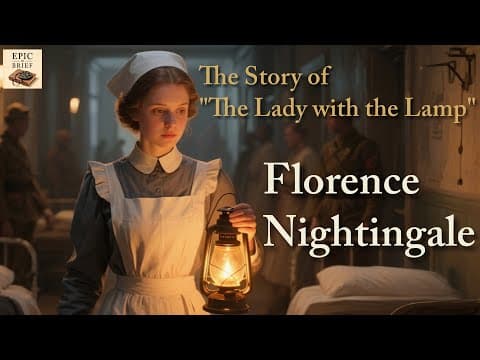
[0:01]Florence Nightingale. The lady with the lamp. The angel of the battlefield. A woman who transformed healthcare and redefined the role of nurses forever. This is the inspiring story of Florence Nightingale, the founder of modern nursing. Florence Nightingale was born on May 12, 1820 in Florence, Italy, a city that gave her its name. Her wealthy British parents were traveling through Europe on a cultural tour when she was born.
[0:44]Her older sister was also named after her birthplace, Parthenope, the ancient name for Naples. Soon after Florence's birth, the family returned to England, where she was raised in the peaceful countryside of Derbyshire and Hampshire. Her father, William Nightingale, believed that girls should be well educated. He personally taught Florence subjects like literature, philosophy, Latin, and especially mathematics. Her mother, Francis Nightingale, came from a family that cared a lot about status and fitting into high society. She hoped Florence would marry into wealth and take her place in elite social circles, but Florence had very different ideas about her future. As a teenager, Florence began to feel what she described as a calling from God. A strong inner voice urging her to help others. By her early 20s, she became certain: she wanted to become a nurse. But in Victorian England, nursing was not considered a respectable job for someone of her background. It was underpaid, poorly organized, and often associated with women of low status. Her parents were shocked and strongly opposed her decision. But Florence was determined. In 1850, at age 30, she began formal training at a nursing school in Kaiserswerth, Germany. She later worked at a women's hospital in London, where she quickly stood out for her skill, discipline, and tireless work ethic. But her true test would come in the fires of war. In 1854, Britain entered the Crimean War, fighting alongside France and the Ottoman Empire against Russia. Reports began flooding in of horrifying conditions in British army hospitals. Soldiers were dying in overcrowded, dirty facilities with little medical care. At the request of the government, Florence Nightingale traveled to the British Military Hospital in Scutari, Turkey, bringing with her a team of 38 nurses. What she found was shocking. Wounded men lay on filthy floors, surrounded by rats, insects, and rotting bandages. The air was thick with disease, medical supplies were scarce, and infections spread rapidly. More soldiers were dying from infections than from their wounds. Florence got to work immediately. She cleaned the hospital from top to bottom, demanded better ventilation, improved food preparation, and organized the way patients were cared for. She introduced basic hygiene practices that were revolutionary for the time. And each night she walked the halls holding a small lamp, checking on every soldier. Her quiet presence became a symbol of hope. That simple image, Florence Nightingale with her lamp, spread across Britain. Soldiers wrote home about her kindness, and newspapers dubbed her The Lady with the Lamp. But her impact went far beyond comfort. Thanks to her efforts, the death rate in the hospital dropped by two-thirds. Florence had proven that clean environments, proper nutrition, and organized care could save lives on a massive scale. When she returned to England in 1856, she didn't seek fame. Instead, she focused on data. She gathered detailed statistics about hospital conditions and patient deaths. and used a powerful new tool to present her findings, infographics. She invented a form of visual chart called the Coxcomb Diagram, which clearly showed how most soldiers in Crimea had died from preventable diseases. Her data changed minds and policies. In 1859, she published Notes on Nursing, a practical guide that emphasized the importance of sanitation, ventilation, observation, and kindness. It became the foundation of nursing education and is still in print today. That same year, she opened the Nightingale Training School for Nurses at St. Thomas's Hospital in London. Her students, known as Nightingale Nurses, brought her methods to hospitals across Britain and around the world, raising standards and transforming public health. Though her health declined after the war, she likely suffered from a long-term infection or condition like Brucellosis, Florence continued to work, often from her bed. She advised hospitals in India, helped design sanitation systems, and pushed for reforms in military and civilian healthcare. She believed deeply that preventing illness was just as important as treating it. In 1883, Queen Victoria awarded her the Royal Red Cross for her service. In 1907, Florence became the first woman to receive the Order of Merit, Britain's highest civilian honor. She had become a living legend, but she remained modest, preferring to focus on her work rather than public attention. Florence Nightingale died peacefully in her sleep on the 13th of August, 1910, at the age of 90. She had refused a grand state funeral and was buried quietly, just as she wished. During World War I, her methods were used in field hospitals. In World War II, her principles shaped military nursing again. In the 21st century, during health crises like COVID-19, her focus on hygiene, ventilation, and patient care remains more relevant than ever. Her birthday, May 12, is now celebrated around the world as International Nurses Day, in honor of her life and the millions of nurses who follow in her footsteps. Florence once wrote, Live life when you have it. Life is a splendid gift. There is nothing small about it. If you enjoyed this video, please like, comment and subscribe to help us grow. Thanks for watching.


