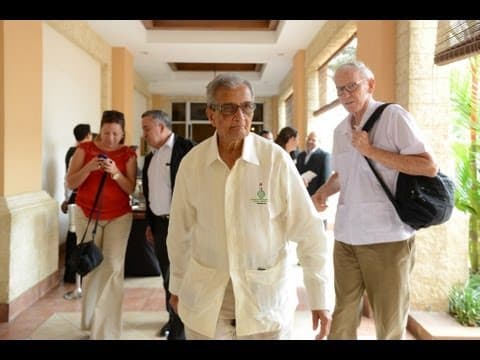
[0:06]El doctor Amartia Sen, es un economista y filósofo indio, Premio Nobel de Economía, considerado uno de los más influyentes pensadores contemporáneos en temas de desarrollo. Actualmente es profesor de la Universidad de Harvard y durante muchos años ha enseñado en Oxford, Cambridge, la London School of Economics y las principales universidades de la India. Amartya Sen es el autor de una veintena de libros, entre ellos, Sobre la desigualdad económica, pobreza y hambruna, ética y economía y Desarrollo y libertad. Su último libro se titula Incertidumbre en la gloria y trata de las contradicciones del crecimiento económico de la India, su país. En 1998, la Academia de Ciencias de Suecia le otorgó el Premio Nobel de Economía por sus aportes a la teoría de la elección social, en la que incorpora bienes como libertad e igualdad en la teoría del desarrollo. Su trabajo en el campo del desarrollo económico ha tenido una influencia determinante en la formulación del Índice de Desarrollo Humano del programa de Naciones Unidas para el Desarrollo. Precisamente la semana pasada el profesor Sen estuvo en Managua, en el campus de la UCA participando en un seminario sobre desarrollo humano sostenible auspiciado por el PNUD. Acerrmo defensor de la libertad de prensa, el profesor Amartya Sen nos brindó una entrevista exclusiva para la televisión nacional y esto fue lo que nos dijo. Profesor Sen, usted vino a Managua a atender una conferencia sobre desarrollo humano. ¿En qué se diferencia este concepto de lo que conocemos como crecimiento económico? Well, economic growth traditionally has been seen in terms of the expansion of the overall national income, gross national product or something, some other measure of total income of a nation. Now, human development differs from it in two different ways, two distinct ways. One is that it really concerns not so much with the products and commodities we have, but the nature of the human life people have, how long they live, how well they are, whether they're bothered by ill health, illiteracy, and that kind of thing. It takes into account income as well, but among many other factors. And also it's concerned with the not just the aggregate for the nation, but it's also seeing how the aggregate plays up in the lives of individuals. No se puede capturar todo eso en una cifra, pero el desarrollo humano es un esfuerzo en esa dirección, y han habido muchos otros esfuerzos de medición. Qué tipo de relación existe entre desarrollo humano y el tipo de gobierno o instituciones políticas. Por ejemplo, ¿se requiere tener instituciones democráticas o se puede lograr con un gobierno autoritario? Well, I think that's a very interesting question. Um, I think it really depends on how broadly you define human development. Because if by human development you include the ability of human beings to lead the kind of lives they want to lead, without being restrained either by poverty and forces of circumstances or by epidemics, famines and so on, or by an authoritarian government. Then having a democratic society is part of the requirement of human development. But it's not the only requirement. There are other things and I wouldn't say more important but different.
[3:47]Like how long you live, how free from illness you are. If you have been able to conquer under nourishment and indeed mal nourishment of of not having the right kind of nutrients. How well you are. How educated you are, what opportunities you have. Now, these latter things can sometimes flourish quite well in societies which are not democratic. I mean, in that respect, for example, uh, China actually has done very well. On the other hand, in the absence of a fully democratic multiparty system, one could say that there is something in the human development that's lacking. Now, the Human Development Index, the kind of thing that came around and was much used since the 1990s, they have tended to concentrate more on economic things like, uh, well, more immediately tangible or more immediately, uh, measurable things. And therefore they have been focused on life expectancy, focused on illiteracy, literacy and education. And in these perspective, democracy hasn't really figured. Not because it's not important, but because it's difficult to put it into an index in that kind. So I think one has to bear in mind that there are many things that can happen even in the absence of democracy, but ultimately to make them sustainable, you have to have a democratic system. In the absence of a democracy, a country could go towards like South Korea and have very good human development figures, or can go towards North Korea and have pretty foul human development figures. So it is, I think democracy is both important in itself and also in guaranteeing the ability of human beings to choose the kind of society they have reason to want to live in. Usted ha investigado de manera exhaustiva sobre la importancia de la libertad de prensa, la transparencia y el debate público para prevenir hambrunas. ¿Cómo funciona esa relación? Famines are very easy to prevent. It's absolutely amazing that they take place. Because it's not like regular hunger, of which there is a lot in the world, which is not like famine. With the hunger people just don't have enough food, or the right kind of food. But the famine is such an extreme state of starvation and illnesses connected with starvation, movement of people from one part to another, looking for food. Trying to eat anything, even from the dustbin, and and garbage cans. And in that kind of situation, uh, people die in very large numbers. Now, the um, India where I come from, um, uh, continued to have famine. And the British Empire began in 1770 with a gigantic famine, and it ended with a gigantic famine in 1943. It was a regular feature. Las hambrunas eran muy comunes, pero cesaron con la independencia. Fue fácil hacerlo, porque en una democracia independiente y multipartidaria, ningún gobierno se podría salir con la suya, permitiendo una hambruna. Y ahora volvemos a la idea inicial. La hambruna es fácil de prevenirse. Simplemente se acabaron. Por otro lado, hay otro tipo de problemas, muy serios, pero no tan dramático y catastrófico como la hambruna, como es la desnutrición regular.
[7:18]En la India hay mucho de esto. Recientemente escribí un libro con Jean Drèze discutiendo porque la privación esta tan extendida en la India, incluyendo altas cifras de desnutrición, un sistema de salud muy malo, y analfabetismo permanente. Proporcionalmente el alfabetismo ha incrementado pero nada de lo que el país deba enorgullecerse. Entonces, la pregunta es ¿por qué funciona para aliviar la hambruna pero no los otros problemas? La hambruna es fácil de demarcar. La gente entiende inmediatamente la responsabilidad del gobierno. Pero cuanto tienes a algunas personas más o menos hambrientas, por lo tanto, más susceptibles a enfermedad, con algo de educación, pero no la adecuada porque no hay suficientes escuelas... esa es una situación dramáticamente más difícil de enfatizar. Y creo que los indios son muy críticos de los partidos políticos y los medios. En libro habla mucho sobre eso. Tenemos que trabajar mucho más en eliminar la desnutrición, el analfabetismo y la mala salud prevenible. De la misma manera en que hemos lidiado con la hambruna. Usted ha dicho de forma categórica que el debate público es la fuente más importante de cambio social. ¿Por qué? El debate público hace que la gente entienda problemas catastróficos, difíciles o simplemente problemas grandes. Cuando pensar simplemente no basta, escuchar a otros discutir nos permite aprender unos de los otros. También, en decidir que hacer, cuáles son nuestras prioridades debemos recordar que el debate público enriquece mucho. Solo por dar un ejemplo, como la hambruna en India. Hace diez años se decía que India sería el foco más grande de la epidemia del SIDA. Y todas las predicciones de la ONU ponían el mayor número de pacientes de SIDA en la India que en cualquier otro lugar. A diferencia de la desnutrición normal, que vergonzosamente continua, esto se convirtió en una alerta dramática, parecida a la que surgió sobre la hambruna. Se tomaron muchas acciones. Y cuando las acciones son demandadas por el público, en un gobierno democrático donde hay presión de la oposición, presión de los medios, entonces algo ocurre. Ahora nadie cree que la India se convertirá en el centro de la epidemia del SIDA. El problema no se ha resuelto, pero las cifras han resultado minúsculas en comparación a las predicciones. Entonces, hay muchas maneras en las que la discusión pública es efectiva a la hora de traducir un problema en reconocimiento y remedio. En segundo lugar nos permite discutir que es lo que debemos enfatizar. Veamos ahora la otra cara de la moneda. ¿Cuáles serían las consecuencias en una sociedad donde hay una tendencia a controlar la prensa ya sea por el gobierno, por grupos privados y para imponer un monólogo oficial? Yeah, I think that's an interesting question. Let's take the case of China, because China is a very interesting case. They, I believe, is not just my politics, but I do believe that the Chinese government, even at the time of Mao Tse Tung was trying to do a lot of good for the country. But it failed. It had a gigantic famine at the period of Great Leap Forward when 30 million people died. In that time, es claro que las políticas no se revisaban, a pesar de que unos 10 millones de personas morían cada año. What happened? The newspapers were completely controlled. So no one criticized the government. And the government itself came to believe its own propaganda. Ultimately, when three years later the change came, one of the most interesting statement is that of Mao Tse Tung in 1962, in a lecture of 7,000 members of the Communist Party and he said, it's the only time I've seen him saying it, saying that in the absence of democracy, we can't plan very well. because the government was misled because we were not getting the information from the ground. This is Mao's rather hesitant tribute to democracy. But then, you know, when they and then there were a period of cultural revolution in which some good things happened, one shouldn't deny. But there were also quite a lot of bad things, then came the economic reforms. Very, many good things happened. They marketed industry and agriculture with great success and they needed to do it. They were too suspicious of the market. But suddenly compared with the period in the Maoist period, when everyone was covered in health care. The new government decided, you have to buy your medical insurance, as in the United States. The result was the percentage of population covered dropped from 100% to about 10%. And as a result, we've discussed it in our book, if you look at it, the life expectancy was dramatically going up, suddenly, uh, started faltering. Le tomó 25 años a los chinos avispase y cambiar eso. Al mismo tiempo, no hay duda que en la medida en haya diálogo en China, a pesar que no exista un multipartidario... Voy a China muy seguido, creo que hay mucho que aprender de ellos.
[12:53]El gobierno chino sabe que no apruebo todo lo que hacen, pero admiro las cosas que si puedo aprobar. También soy consejero de un instituto en la Universidad de Pekín.
[13:10]Entonces, he visto que los espacios de diálogo incrementan, y a medida que incrementan la economía china se vuelve mejor, y no peor. Creo que es muy importante no suprimir información. Permitir libertad a los medios es importante para que la gente sepa que está pasando. Es importante para que el gobierno entienda lo que está pasando, y lo que la gente demanda. Es muy importante que la gente hable entre sí para decidir cuáles son sus prioridades. Es una prioridad tener un criterio mecánico de crecimiento del PIB? O es una prioridad la calidad de vida humana, y cómo reducir la pobreza, en tantas dimensiones diferentes? ¿Cómo pensamos sobre ello? Entonces, todas estas preguntas dependen mucho de discusiones públicas abiertas. Usted ha escrito sobre la necesidad de una alianza entre el estado y el mercado, entre lo público y lo privado. ¿Bajo qué reglas? I don't think the public and the private sector get into an alliance on their own. I think people have to determine how they would fit in into an overall pattern. You know, when I have a if I ill and if I get medicine from a doctor, and if I decide on what nutrition to have on the basis of either traditional knowledge or because of advice for nutritionist. No estamos ante una alianza entre nutricionistas y doctores. Estamos en una alianza entre mi persona, con doctores y nutricionistas. Entonces, igualmente para el pueblo, el sector público tiene un papel, y el sector privado tiene otro papel. El sector privado, según la experiencia mundial, incluyendo la de China, con mucha frecuencia el sector privado puede hacer mucho bien en términos de industria y particularmente agricultura. Por otro lado, el sector privado en servicios de salud puede ser bastante desastroso, particularmente cuando hace que la salud sea demasiado cara para la gente. Pasa algo parecido con la educación. A veces, también incluso en la industria!


