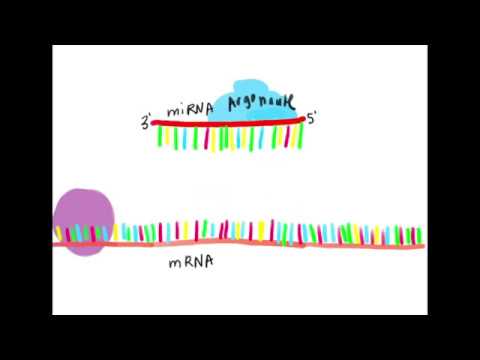
[0:00]Every cell in our bodies has all our DNA. But clearly, not all of our genes are needed to make each individual part of our body. How then do our cells prevent unnecessary genes from making unnecessary proteins? Let's find out by taking a closer look at microRNA, which is a key ingredient in switching genes on and off. Like DNA, microRNA is created in the nucleus. Each unique microRNA sequence is encoded for by DNA using the ACG base pairs. These segments are transcribed into an RNA sequence by RNA polymerase, which matches each base pair with its RNA complement. Unlike regular genes, however, the sequences that code for microRNA are found in introns, or non-coding regions of RNA. This means that they aren't translated into proteins. Instead, the resulting RNA sequence, also known as primary microRNA, gets processed by the dicer enzyme into its final single stranded form, which is a mere 22 nucleotides long. The mature microRNA is then bound to an argonaut protein, which is the secret sauce of genetic regulation. Now, microRNA is ready to get to work. MicroRNA regulates gene expression by RNA interference, also known as gene silencing. This happens after the transcription of DNA into RNA. In essence, microRNA prevents messenger RNA from translating or coding into proteins. Each microRNA sequence has a complementary messenger RNA sequence in that they have complementary base pairs that match up almost perfectly. This is how a microRNA molecule is able to find its target. In order to turn off a gene, a microRNA molecule will bind to the messenger RNA sequence of the gene that needs to be turned off by matching complementary base pairs. This process occurs with the help of the argonaut protein, which lines up the microRNA for interaction with its target. Together, the argonaut protein, dicer and microRNA form the RNA induced silencing complex, which acts like a multi tool of gene silencing. By binding onto the target messenger RNA sequence, microRNA acts as a road block to stop the ribosome from translating at the site of binding. The argonaut protein attached to the microRNA also has the power to cut the messenger RNA molecule into two pieces at that same site, effectively destroying the gene. As this destruction is occurring, the poly tail of the messenger RNA degrades, dealing the final death blow to the messenger RNA strand. The central dogma of biology has now been cut short just in time to stop a rogue gene from producing more proteins than a body needs.
MicroRNA and Gene Silencing
Biman Xie
2m 58s424 words~3 min read
YouTube auto captions
Transcript source
YouTube auto captions
This transcript was extracted from YouTube's auto-generated caption track. The transcript below is server-rendered so it can be read, searched, cited, and shared without opening the original YouTube player.
Pull quotes
[0:00]But clearly, not all of our genes are needed to make each individual part of our body.
[0:00]How then do our cells prevent unnecessary genes from making unnecessary proteins?
[0:00]Let's find out by taking a closer look at microRNA, which is a key ingredient in switching genes on and off.
[0:00]These segments are transcribed into an RNA sequence by RNA polymerase, which matches each base pair with its RNA complement.
Use this transcript
Related transcript hubs
Watch on YouTube
Share
MORE TRANSCRIPTS


