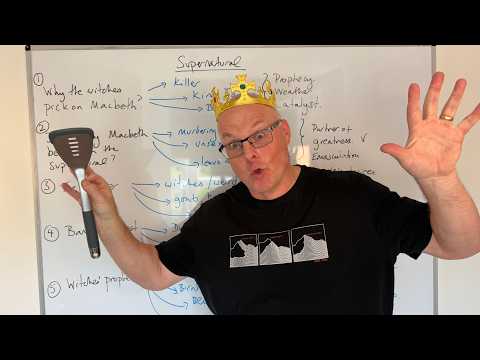
[0:00]Time for the Macbeth prediction, which is going to be the supernatural. I'm going to show you the five body paragraphs for your essay, and then if it's not the supernatural, how to apply what I've taught you to every other question. At number one, we're going to begin chronologically with the witches. Why does Shakespeare start with them? Obviously, that is to flatter King James because of his powerful interest in witchcraft. Demonology was the book that he wrote. He even took part in trials of witches because he was convinced they tried to sink his ship off the coast of Scotland. So, Shakespeare's giving King James what he wants, but he's also creating a thriller for the audience. Do these witches have real supernatural power or not? That is the central question. How much is this because Macbeth is a killer? Remember that they have chosen to meet him. They already know he is their perfect victim. Is this because Macbeth is inherently evil? Or is it simply that they have picked on the most powerful person in order to create maximum chaos? In a Greek tragedy, they maybe picking on Macbeth because they realize his fatal flaw is connected to his bloodlust, not just his ambition. The other interesting question is, why don't they pick on Banquo? This is going to be important because at the time everyone believed that King James was descended from Banquo. So Fleance who escapes in the play and is not murdered, he then becomes a father and through the generations, that then gives us King James. So Shakespeare has to present Banquo as a noble figure, one who is not corrupted by supernatural evil and one who is therefore a counterpoint, an alternative example to Macbeth. What about their supernatural power? Well, they definitely have the power to foresee the future. Even at the beginning, they know where Macbeth is going to be so that they meet him. They can see into the future. There is a suggestion, because they're saying, will it be in thunder, lightning or in rain, that they might be able to control the weather. King James certainly believed they could, or they might simply be a catalyst, bringing out the worst in Macbeth that wouldn't otherwise have come out. The next aspect of the supernatural to consider is Lady Macbeth. When she finds out what the weird sisters, the witches, have promised Macbeth, she immediately starts to plan murdering Duncan. But to do that, she calls upon murdering ministers, supernatural powers, who are going to give her direst cruelty, make her as cruel as possible, like a man. That is why she asked to be unsexed. She sees men as inherently cruel, and she needs to become like that in order for her plan to succeed. However, Shakespeare gives her no contact with the weird sisters, and no contact with any supernatural being. So, he is implying, isn't he, that the supernatural is not everywhere. He's also implying that the capacity for evil is inherent in everyone. That is original sin, it's the story of Adam and Eve in the Garden of Eden deliberately going against God's instruction. Eve, of course, is a much worse character than Adam because she tempts Adam into evil. And that is why Lady Macbeth is portrayed in this evil way. Shakespeare could be suggesting that the supernatural attracts those who have been denied power. Lady Macbeth does not have power at the minute because her baby has just died. She's still lactating, she has milk which she wants to be taken away because her baby has died. Lady Macbeth needs a feeling of status. And so, Macbeth writes to her and calls her, my dearest partner of greatness. He tells her how she's going to be queen, he knows that status is what drives her. Furthermore, she knows that Macbeth isn't going to kill Duncan left to his own devices, because he is too full of the milk of human kindness. And consequently, she tries to undermine his masculinity. She attacks it, accusing him of cowardness, which is clearly ridiculous. He's just survived this amazing battle and he's conquered the enemy. You couldn't get someone less cowardly. But Lady Macbeth knows that she can manipulate her husband with these insults. She knows that she can manipulate her husband by saying, leave all the rest to me. Put this night's great business in my dispatch. In other words, I will do it. I will come up with the plan. It will be perfect, foolproof, we can both do it together. We could even argue that Lady Macbeth tries to help Macbeth, to stop him being influenced by the supernatural, because she creeps up on Duncan's body once the grooms are drunk, and she tries to kill him herself. She tells us, he looked too much like my father or I had done it. So, you have another choice. Is that a supernatural presence, causing King Duncan to literally look like her own father so that she can't go through with it? Or is it a metaphor for the power of patriarchal society? Lady Macbeth cannot go against the rules of her society. It's why she cannot actually unsex herself. She asks for supernatural help to unsex her, but what happens at the end to Lady Macbeth? She is consumed by guilt and her own femininity, her own little hand, her own perfumes from Arabia that won't get rid of her guilt. She ultimately fails because she remains a woman. She doesn't have the stomach for it. She has not provided Macbeth with an heir. We find out Macbeth has no children. And so she's failed, in Jacobean terms, in her duties as a wife. Her way of gaining power and influence is therefore, if she can't provide children, to provide status. She wants to become queen. Macbeth also wants to achieve status. He is outraged that Duncan is decided that Malcolm's going to become King. Malcolm is just a boy. Whereas Macbeth has just defeated the Norwegians, he has saved Duncan's kingdom and his life, and his reward. Yeah, he's got some title. He's become the Thane of Cawdor, he's got some jewels. But really, he should be the successor. Because that was the tradition in Scotland, the king appointed the next successor. Duncan lets Macbeth down from his point of view. And what of the witches, they're described as ugly and having beards. These are women who cannot achieve status in Jacobean society because they can't marry, and therefore they are outside of society. It's no coincidence that they might turn towards evil as a way to gain status and influence over men. Not only that, we could see them as getting revenge on the society that has excluded them. So we've got a possibility here of having some sympathy for the witches predicament and Lady Macbeth's predicament or not. You decide. Now, we come to the mysterious floating dagger, the one that leads Macbeth to killing Duncan. Is that a supernatural presence? A theater director would have the choice of getting a witch to come on and hold the dagger. It's rarely staged that way, because there are no stage directions saying a witch is there. It's usually staged with an imaginary dagger that no one else can see, only Macbeth. So, it might be a supernatural presence. But it is more likely a product of his heat oppressive brain. It's in his mind. It has gouts of blood on it, because that is Macbeth's Hamartia. He is attracted to spilling blood, bloodlust. And then he sees the handle turned towards his hand, leading him towards killing Duncan. The dagger is an expression of his deep desires. You get to decide, is it a supernatural expression or is it his own hallucination? The main reason Banquo's ghost. Again, Shakespeare is really careful. There are no stage directions telling us that Banquo's ghost appears. That is entirely up to the director. So, if Banquo's ghost is not there, then he's not a supernatural presence, he is part of Macbeth's heat oppressive brain. He represents Macbeth's guilt. Macbeth doesn't see Duncan's ghost. He's killed the king. He doesn't feel guilty about that at this stage. That's done and dusted. He has got away with it. He's been crowned king. Lady Macbeth's plan has worked, until he sees Banquo's ghost. Because he says to Banquo's ghost, never shiek thy glory looks at me. Thou canst not say I did it. The nobles, they don't know that Banquo's been killed. But they do know who had the gory locks. It was Duncan, yes, this is me being Duncan, with gashes upon his head, blood everywhere where Macbeth killed him. They know that now Macbeth is confessing, not to killing Banquo, but to killing Duncan. This is the turning point. It is either divine justice or supernatural fate. Justice is a punishment, fate was always going to happen. You get to decide which way this goes. Is it Macbeth's free will and therefore divine punishment? Or was Macbeth always going to kill Duncan, even if the witches hadn't told him that he was going to become king? This is an interesting philosophical question because Shakespeare is asking, look, when we commit evil acts, are we individually responsible for bringing them about? Or is this evidence that the devil, Satan, is trying to influence us and steal our souls, taking them away from God, taking them away from heaven? Now, why this is important is, in real life, Banquo and Macbeth killed Duncan together. Macbeth became king and reigned very happily for years and Scotland did very well. So the true history is that murdering a king, that was no bother. The problem is Shakespeare has just seen this assassination plot, the great gunpowder plot. And so, his play has to say, no, you cannot kill a king. It will lead to catastrophe. And so the rest of the play shows Macbeth's mental and then physical destruction. But it is for killing Banquo, not for killing Duncan. Why? Banquo is King James's ancestor. Shakespeare's point is, imagine, do you nobles in the audience, how much worse it will be for you if you kill King James, because look what happened to Macbeth when he only killed King James's distant, distant, distant ancestor from 600 years ago.
[13:10]The next supernatural occurrence is when Macbeth decides to go back to the weird sisters, the witches, and to find out what the future holds. He's already become king. He's killed Banquo. So Banquo cannot kill him. Fleance is going to become king in the future, but that doesn't mean Macbeth has to be killed. There is no certain threat to Macbeth. When he goes back to see the weird sisters, he knows that from this moment he's going to face rebellions against him. And he wants to find out if he's going to survive it. And the witches as always, tell him the absolute truth. They never lied to him. They don't tell him the whole truth. And this is important because they don't change the future. They never once ask Macbeth to do things. They simply tell him what is going to happen, and they let his own evil make up his own mind. In fact, they can feel Macbeth coming. They can feel it in their thumbs, by the pricking of my thumbs, something wicked this way comes. They sense Macbeth's evil, his wickedness. Perhaps he is even more wicked than they are, because after all, he is the one committing these acts of murder, not the witches. Shakespeare is pointing out that the human capacity for evil is far greater than the supernatural capacity for evil. He is laying the blame squarely at people and the choices that they make. So they tell him, none of woman born shall kill Macbeth. And so he knows somehow there is a man who is going to kill Macbeth, but somehow he just won't be born of a woman. When his castle is invaded, he actually says, who was not born of woman, such a man am I to fear? He actually goes looking for the person. He's ready to be killed. He knows this is his end, but he just can't solve the riddle. Who on earth is going to do it? Like, who is this man? The witches do tell him though, beware Macduff. And that is a warning that he takes seriously. However, when Macbeth decides to act on this supernatural warning, Macduff has already gone to England to join with Malcolm. So what does Macbeth do? He kills Macbeth's wife, all his children, everyone related to him, all the servants in the castle.
[16:06]He kills absolutely everyone. And the irony of this or the trigger to fate is that Macduff uses this as his motive to kill Macbeth. So there is a very good chance that Macduff would not have killed Macbeth if Macbeth had not slaughtered the whole of Macduff's family. This is always the irony of fate in a tragedy. The protagonist, the hero, tries to do things to avoid their fate, and the very things they do lead to that fate anyway. And so now you have to decide, is Macbeth's fate divine judgment, because Macbeth has destroyed the natural order of the great chain of being, he's challenged God? Or is it a fate controlled by the weird sisters, these evil supernatural beings? The final image that the witches give him is Banquo reflected in the mirror is Fleance reflected in another mirror, Fleance's son reflected in another mirror, that son, each of them crowned king unto the crack of doom. In other words, the line of kings is going to last forever, not just King James, but on and on and on.
[17:28]This is Shakespeare's propaganda. But the witches here are not evil. They are simply prophesizing the future. They are accurately describing the future to Macbeth all the time. And so their supernatural power might not be evil. Their supernatural power is neutral. It is simply the ability to see into the seeds of time into the future. So, when Macbeth finds out that Macduff is the man who is going to defeat him, he fights him anyway rather than surrender. He chooses death. That is as noble as he can get. At the end, he is summarized as a dead butcher. His wife is summarized as a fiend-like queen. All his ambition and desire has come to nothing. And that feeling of nothingness, that belief that there is no meaning in life, that nihilism is not caused by the witches. The final heat oppressive moment in Macbeth's brain is not the witches at all. It is the death of his wife. That is the moment that he gives up on all hope. And he even gives up on any faith in God. He says life is a tale told by an idiot. And he compares the living person, himself, as a poor player, an actor, strutting away on the stage. In other words, the person who has written Macbeth's tale, who has written his fate, is an idiot. It is God. God has written his script, that is Macbeth's claim. The audience, of course, are horrified. They think he has written his own script through his own free will, through his own choices. Macbeth denies this at the end. He says, no, I have just been a dupe. I'm just an actor, following the lines and directions written by somebody else. And that somebody else was an idiot. This is where divine punishment steps in. Macduff finds him and executes him, puts his head on a spear. In your conclusion to the essay, you're going to decide how much of Macbeth's tragedy is caused by the supernatural influence of the witches, and how much is internal Macbeth's wickedness. If you would like a little extra bonus bit of grade nine info to help you decide, the witches speak in a different sort of verse. It is called Trochaic Tetrameter. Hubbub, toil and trouble, fire, burn and cauldron bubble. You can see it's very rhythmic, it's very childish, it's very innocent. Shakespeare's playing an interesting game. On the one hand, that makes it even more sinister that these adult characters are chanting like children. But another way of looking at it is that they are like children, it is like a childhood game. Their spell therefore may have no real supernatural power. It's just a child's incantation. What has the power is Macbeth's wickedness, his evil. They simply tell him the neutral truth. He turns it to his evil purposes. Now, what if by some miracle the examiners decide to ask you something else? Could happen, couldn't it? Well, I've prepared you here to write about Macbeth and Banquo. Here, I've prepared you to write about Lady Macbeth and the contrast between her and Macbeth. Here, you're writing about Macbeth again. Here, you're writing about Banquo and Macbeth. And you can jump into Lady Macbeth having to take charge at this stage and emasculate her husband further because he is in the grip of fear and this vision of the ghost. The witches prophecies, these bring us back to Macbeth and Shakespeare's purpose. I also discussed at this stage, Lady Macbeth's decision to commit suicide. You're in a position now to talk about her guilt, how unsexing herself was not possible because the supernatural could not do that for her. And how she is controlled by the rules of the patriarchal society, she can't escape. Even to the extent that she sees her own father's face on Duncan's and cannot kill him. I've also told you a hell of a lot about Banquo all the way through this, and if by some miracle that was the question, you could answer that too. If you would like the top 25 quotes that fit any single essay that could ever possibly come up, they are in the description on my website, Mr. Salas teaches English.com. Although I think I just teach English. But from now, I teach English.com. Whoever English.com is. Oh yeah, it's you, because you're clicking, aren't you? Clipped, clipped, clipped.