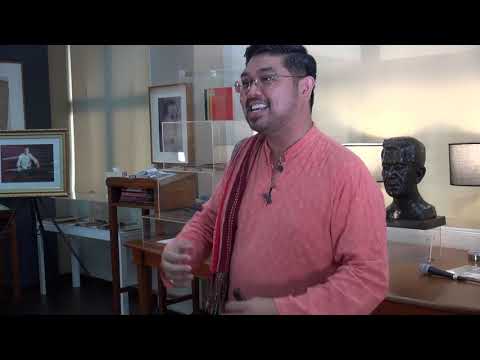
[0:19]Let me explain to you what we're going to do today. Um, I'm going to explain the Filipino children and youth in a kaleidoscope world. I am Clarence Batan. I am a sociologist. And so what I do in life is to study human beings, human behavior. And so, uh, whatever it is that includes persons fascinates me. And so it's a big privilege for me to be sharing with you what I think is happening with the Filipino youth and children in this very, very challenging world. And so today, I would like to um, encourage you to listen and be part of the conversation. You see, I think uh, there is so much problem with uh, understanding young people. I think young people are being misinterpreted in many other ways, and there are many reasons why. And I think one of the reasons why we think we are misunderstanding young people, is because we do not have a perspective of looking at them. And so my first question is, what do you see? What do you see? That's a wood, right? That's a wood, 'no, 'di ba? That's a representation of a wood, right? But all over us, around us, you could see a lot of trees, right? But the thing is, can you see the inside of the tree? Can you? We can't, right? Usually, we see plants, woods and everything, right? But we cannot see the inside. That is the reason why we're having this lecture, okay? I think you have all the conceptions of who you are, what you are, and what society is. But actually, we don't really understand it because we don't find time to listening, to researching about what is inside. Do you agree? Okay. So today, what we're going to do is to try to journey with me on how we could best understand the Filipino youth. Are you ready? And so, the objective of the lecture is really a practice, an exercise of seeing the world. That's why my first question is, what do you see? There is something about seeing as an activity that for me is very sociological. Why? It's because of this one. This presentation should talk about the very first wisdom of sociology. And what is that first wisdom in sociology? The first wisdom in sociology, and I would like to quote Peter Berger, is that things are not what they seem. So usually, when you see a person, you have all the prejudices and the judgments. Correct? 'Di ba? Wala namang ginagawa 'yung isang tao sa'yo, pero naiinis ka. Where is that coming from? 'Di ba? Example, 'Pag ikaw ay nasa bahay, hindi ko naintindihan why you have all the prejudices about your sibling? Or about your mother or about your father. Worst, when you get into the malls, if you are with your friends, you see people, you laugh at them. But they have nothing to do with you. Why? Because there are some judgments that we have. We get it somewhere. 'Di ba? You pick it up somewhere. But if you're doing some kind of sociology, the first wisdom is things are not what they seem. So when you look at me, you think that I am young, but I am not really young. When you look at the teacher, wala pang sinasabi 'yung teacher, right? There's already a judgment on what kind of teacher that teacher is, right? Even if you do not know the person, you already have some prejudices and judgments. And so, the wisdom in sociology is clearly suggesting that we have to suspend our prejudices in order for us to be able to see a particular phenomenon clearly. So when we talk about young people, the first thing that we have to do is to suspend things that you know, things that you think about young people so that you will have a listening ear and you will be able to see clearly. In Filipino, we have a very interesting adage, parang salawikain, 'no. This is from the Cultural Dictionary for Filipinos, and it says something like, "Ang maniwala sa sabi-sabi, walang bait sa sarili." So in English, it's he who listens to hearsay has no mind of his own. So what does it mean? It means that one should not form opinions and conclusions. One should form opinions and conclusions on the basis of fact and reason. You know why I love universities like the Far Eastern University? Because it reminds me of being mindful of the fact that I could not make prejudices, straightforward judgments, because what the educational process should be teaching us is that before you get to judge one person or a group of persons, you first shut up. Because your opinions may not be correct.
[6:38]Do you agree? Alam mo, this is so different when you are in school versus when you are in, uh, at home. When you are at home, it's okay, right? It's okay to just say things whatever it is, but in school, what is happening in school? In school, you have to study. You have to read, and then we discuss. Just imagine when you are in your respective families, in a family dinner, right? Du'n sa pagha-hapunan n'yo, for example. Before you get to to to talk about things, sasabihin mo sa father mo, "Pa, read this first, read this first." So that later when we talk, uh, uh, about uh, things over dinner, we're informed. 'Di ba? That will be crazy. That's why I love being in school. In being in school, and I thought, and I really think, a lot of students think that it is a waste to be reading, it is a waste to be attending classes, it is a waste to be thinking. You are missing the whole point. This is the whole point why we are in school. The university and the school system is offering us a perspective, whereby you could form your opinions and conclusions with basis, either it's based on facts or reason. Why? To rely on humor and unverified information is to show lack of sound judgment. Don't you think that that is the reason why the world is in conflict? Because we have all the prejudices and the judgments in the world. If we're going to think about it, the reason why you're having some fights and conflict with other people, it's not because there is really something to fight about, but because you're being misunderstood in many ways than one. So that's the wisdom in sociology, right? That we have to first understand the world as it is, but cannot form any opinion nor judgment if you do not have basis and facts. So today, that's what we're going to do in understanding Filipino youth.
[8:54]And how do we do that? We do that by unlocking some sense of sociological imagination. And what is sociological imagination? And this is an invitation to everyone, 'no, that when you start to think about young people, use some kind of sociological imagination. Meaning, if you know how to look at things, then you have to know how to look beyond things. Because things are not what they seem. So what is sociological imagination? Well, the thing is, it asks the questions about yourselves, psychological issues and psychological problems, 'no? It is interesting, 'no, from a sociological point of view, we start by thinking that this world, it's like what C. Wright Mills has explained in his book Sociological Imagination. The world seems to be made of a series of traps that we feel like we are trapped. And what does it feel when you are trapped? Well, it's like being in prison. 'Di ba? You thought that you are not in prison, but I think because of the problems that we are experiencing, you feel a sense of trap. But what is the whole point? The whole point is that the feeling of being trapped, of being alienated in in some sort or another, is something that is due because of you. It's something that is due because the private orbits of your life remain to be problematic. That's the whole problem of feeling trapped. You think that the problem that you are experiencing is just your own problem.
[11:39]Probably you don't like to get into the job or probably you don't like to be on the job market. But when you have about 60 out of 100 young people who are not working, it becomes a social issue. It's not an individual problem anymore. It's a shared issue. Often, we don't see it that way. I'll give you another example. If you are failing an exam, and there are only two out of 100 who failed the exam, probably there's something wrong with you.
[12:21]But if there are 70 out of 100 failing the exam, it might be that teacher that is the problem and not the student. Do you agree? But this world is telling you, you cannot do that because you are the one at fault. You have to study hard. We lack that kind of sociological imagination to see beyond ourselves. Why is it that you are having a problem with your academics? Well, it has nothing to do with academics. There's something to do with the fact that the world that you're into is enmeshed with responsibility because you want to help your family get out of poverty. That is the real issue. It's not the issue that that the academics is difficult. It's the issue of the expectation that you have to study hard to finish this college education for you to get a job in order for you to be part and helpful to your family in times of need. That is a sociological take. So what is it when you talk about sociological imagination? Well, sociological imagination is this quality of mind that enables one to grasp history and biography.
[13:48]So there is this history happening around us. Why is it that there are more, more and more young people having problems with finishing college? More and more young people having problems with having a job. Why? Well, the thing is, one should understand that when you look into your respective problems, there are historical forces shaping it. And that it is interacting with your individual biography. So, is your biography important? Yes, it is important. But it is not the only thing that is important. Is history important? Yes, it is important. It is not the only thing that is important. So you could look at history at one hand. You could be blaming the Philippines for for what kind of life you are experiencing now. But you could also blame yourself for not doing part, for not doing your part. What is sociological imagination? Sociological imagination is the capacity to look at the connection between your history and your biography. That is the quality of mind that some people has in order for them to fully understand what life is all about. So today, let us see if I could convince you with having some kind of sociological imagination when it comes to understanding young people. One of the ways by which to understand young people is to understand it from what you call as life course perspective. See? Who amongst you did not become a child? Mayroon ba? Basta sinilang na lang nang ganyan na, Were you? Would you want that? No. That one day I do not know. Oh, oh, teenager na ako. Right? Would you want that? No. Everybody is subjected to what you call as the life course, right? But why is it that I'm showing you the life course perspective? Well, it's important because you have to understand that you cannot understand being young if you do not have a reference of being a child and your expectations of the future. Those are the things that shape our understanding of young people. Are we good? So, when you talk about children and youth as a study focus, I have been researching for about 25 years and I tell you, there's so many ways to look at young people. It could be your research interest, it could be your respondents, they could be clients, they could be students, they could be friends, maybe family members or maybe looking at it as a life stage or probably one's life past. Can you actually study being young even if you are old? Of course. Because you could ask the respondent what happened to you when you were growing up. But what is the whole purpose of studying young people? The whole purpose of studying young people is to understand what you call growing up processes. Often, we think and we do not think about it anymore, how did you grow up? As sociologist of childhood and youth, that's my question. Specifically, my question is, how is it to be children and youth in contemporary Philippines? That fascinates me. Is it the same as with America? Is it the same as with Japan? Is it the same as with Korea? How is it to grow up in the Philippines? What do we know about it? Remember, I'm telling you that the things that you know about yourself are only within the private orbits of your life. And I am going to encourage you to journey with me, to go beyond that, okay? And so, children and youth may be seen like a kaleidoscope. A beautiful metaphor. And what is a kaleidoscope? This one is a kaleidoscope. What can you say about the kaleidoscope? What do you see in this kaleidoscope? What do you see? Diversity in color, right? Naku, ang ganda ng phrase, right? And do you think it's beautiful? Yes. So it's possible that we have different perspectives that you still see it beautiful. It's the kaleidoscope thing, right? However, when one is different, when one is abnormal, when one is beyond the expectation, there is a big problem. Always. We struggle on looking at things when they are different from us, okay? Do you agree? Now, I have here a kaleidoscope tool, okay? What it does is that it allows you to see me in a very different way, or to see the object in a very different way. Often, that's our problem. We see one thing, but we just have one way of looking at it. In sociology, like in understanding children and youth, what we're encouraging is to look at young people like a kaleidoscope and the growing up process like a kaleidoscope. What's my basis on this one? You see in 2002, The Kaleidoscope of Adolescence book was written, arguing this one. That as the world continues to get smaller, we have a feeling, 'no, that the world is getting smaller. As people come into contact through increased communication and emigration, so there are two things happening in the world. One is that you could actually communicate to each other, unlike before through the Internet and all, but also there are so many young people going emigrating, getting away from their respective country of origin. Just like the Philippines, right? The young people are the one getting out of the country. You're trained here and you get out of the country. So that's a world that we're having now. It is time to get closer at this kaleidoscopic variation. So there are variations happening. It is no longer sufficient to adopt the parochial view of adolescence in one culture and claim an understanding of this age period. So we are being asked to stop looking at young people from a parochial point of view, from one culture point of view, as a colonized society like the Philippines. Our problem is that we think we could be America. We think we could be in a developed world. But that's not the case. We have a different identity. We have a different culture. So to use their standard to us and to young people is really problematic. So scholars like us who study adolescence, or those people practicing youth work, or even business leaders concerned with new generation of employees, policy makers, and even parents, the parents are being asked to divest themselves from what we call as Eurocentric universalistic notions of adolescence.
[22:03]I'm talking about the fact that the thing that you know about young people being used by media, are actually Eurocentric perspectives. Okay? And when you say Eurocentric perspective, it has the tendency of universalizing what we know about young people, which I think is problematic. We must examine adolescence in what you call as historical and cultural context, and we have to be open to the variegated forms and recognize its tentative and evanescent nature. Parang mabigat siya 'no, 'pag titingnan mo. Pero how do you understand this? Well, let me share with you an example, the concept of millennial youth. 'Di ba you heard about the millennial youth? And I do not know how how many times you were blamed for being a millennial worker, a millennial problem, a millennial child. Am I correct? So let us look at this video for a while, ha? Tingnan natin. Amy, it says you are trained in technology, that's very good. Are you adept at Excel? No. PowerPoint? No. Publisher? Not really. Exactly in what area of technology are you proficient? Snapchat, Pinterest, Instagram, Vine, Twitter, you know, the big ones. I'm surprised you didn't say Facebook. That's for old people, like my parents. That's funny. Well, Amy, when you're working for me, you have to have those kind of research skills, because I'll send you things for you to comb through and get the answers and send them to me. So for that, you got to be really good at technology. For stuff like that, no problem. I'll just ask Siri. You'll just ask Siri? You know, Siri tell me this, Siri find me that. We're all good getting you the answers. Tell Siri, I want you ready to go at 8:00 sharp, each and every morning. I don't understand. What don't you understand? What you just said. You don't understand, be ready to go? No. You said eight, right? Yes. Eight, like in the morning, eight? Yes, in the morning. Yeah, that kind of doesn't work for me. Who gets up at eight? I do. I Skype with my French boyfriend in Paris until like 3:00 in the morning. I don't even get to Starbucks until like 10:00 where I order my Grande Chai Tea Latte, three pump, skim milk, light water, two percent foam, extra hot but not too hot. So if it's okay, I work best in the morning at 10:45.
[25:14]Wow. Amy, I don't think we're going to be a good fit. Why are you so negative? I can sense your hostilities and right now I am not feeling very safe. I've been here for over five minutes, and the only nice thing you have said to me was nice resume, which I typed all night for this meeting with you. You've given me no guidance, no validation, no encouragement, no supervision. Is there an HR director somewhere? HR director? Yes, I need to speak to someone. I may have to take off today as a mental health day. Take today off. You, Amy. Amy, look at me. You don't work here. Are you firing me? Okay, yes.
[26:01]End of part one. The FEU Public Intellectual Series is a blended learning project of the General Education program under the Far Eastern University Academic Affairs Office. Videographers: Babsie Morales, Jiane Nicole Mallari. Video Editor: Jiane Nicole Mallari. Musical Score: Jeulo D. Madriaga. Property Custodians: Anastacio Lopez, Norberto Mendoza.
[26:18]Representations of young people are actually abused in many other ways. The concept of millennial youth actually came from this. It's a document from from the United States of America talking about what millennial youth are, okay? There's nothing wrong with it, but it was a study not about Filipino youth, but about a particular type of youth growing up in a developed world. And so, the concept of millennial youth is actually a Western concept. And what makes it worse is that it is based on understanding developed privileged world. The concept of millennial is very Western that when you see some kind of a video like that you feel, "Oops, mukhang hindi ito nagrerepresent sa'min." 'Di ba?
[27:19]And so what do we do now? Well, what do we do now is to make you understand the context of Filipino youth and children. First is the historical context. I don't know if you know basic things, kasi sabi ko nga, if you really want to understand, you just have to understand the history natin, 'yung historical context natin. And you have to ask the question always, what is happening with our social world? If you don't study or listen to radio or listen to or or look at the headlines of newspapers, you will have a big problem. You will have a big problem. Why? Because studying, studying, knowing the headlines of that day, is very crucial for you to understand how you're going to negotiate the world, okay? So, see, there are world issues and concerns that I do not know if you fully understand. We live in a world, not an ideal world. There are so many things that we need to understand so that you would know why you are having that kind of problem, right? It's not your problem. It's the world problem. And it's interesting, 'no, that the Sustainable Development Goals actually reflected. Look at these problems. The number one problem is poverty. That is a problem. All over the world, to eradicate poverty all over the world. Zero hunger. Are there people feeling hungry every day? Of course. That's the second priority for the sustainable goals. Good health and wellbeing. Who is not sick? Who is that person that you think did not have a problem with the hospitals and all, right? Quality education. Now, tell me, do you think this country is having some kind of quality education? Oh my. I tell you, I have empirical proof that we are having a big problem with the quality of education that we're having. Gender equality. Issues of LGBT. Issues of those with different sexual orientation. Cleaner water and sanitation. You grew up thinking that getting a bottled water or drinking a bottled water is quite normal. Affordable, clean and energy. Aba, kailan hindi ano, kailan hindi hindi tumaas ang presyo ng bilihin ngayon, right? ng electricity, right?
[30:04]Decent work and economic growth. You could have a work, but it's not decent. 'Di ba?
[30:13]You want to have a job? Just have a job, but it's not decent, right? Industry, innovation and infrastructure. Oh my. You cannot get to your destination here now because of so many things happening, right? Because ginagawa 'yung ganito, you're going to be this one, and everything. Reduced inequalities. Oh my, in the Philippines, you know kung sino ang mayaman at you know kung sino ang mahirap. Ramdam mo 'yon, right? Have you ever been to Divisoria? You have to go to Divisoria in order to experience real Filipino life. If you just go to SM, or just go to malls, that's just one tiny bit of Philippine society, right? If you want to understand Filipino society, you go beyond FEU and go to the public schools. To see and feel how unequal this world is. Iba ang mayaman sa mahirap at nararamdaman mo 'yon. Sustainable cities and communities. Is this happening in this country? Do you think we are being our developing in sustainable ways? Madumi ang bansa natin. Compared to many other countries, responsible consumption and production. Wow. Do you buy things that will not be a problem? Okay? Or you buy things because it's cheap? That's the only thing that you could buy. Wala ka nang problema whether it's environmentally friendly or not. Climate action, right? Climate action. Well, If you are a Filipino at the truest one, you know that we have been impacted by climate change. 'Yung pagbaha sa Metro Manila, is part and part of my life course. Imagine mo 'yon? You grow up thinking that your university and the and and and your plans for school will just be all about the fact that you know what? One day you wake up, you don't have classes because it's all flooded. Right? Do you love it? Oh, I love it. 'Di ba? But there's something different happening, which means that we don't have enough time to discuss about things. Nagbayad pa naman tayo, right? Sa pag-aaral. Life below water. Oh, with the pollution, right? Life on land. Oh, with the pollution up, whether you you go to to the mountains or you go to to the sea, it's all polluted all over the country, right? Peace, justice, and strong institution. Oh, I tell you. You may not have seen war, but if you belong to the Philippines, I think we are on war always with our economic situation today. In our lifetime, you have a concept of Marawi crisis, right? That's fascinating for me. Okay? We don't have World War I or World War II, but we are having civil war. Partnership for goals. Who do we partner with in this globalization age? See? What's the whole point? And I thought you would be talking about young people. The whole point is this. The first thing that you have to understand is there are social world happening around you. And as you could see, all those things actually direct attention to your problem too, what you think as your personal problem. It's a world problem.