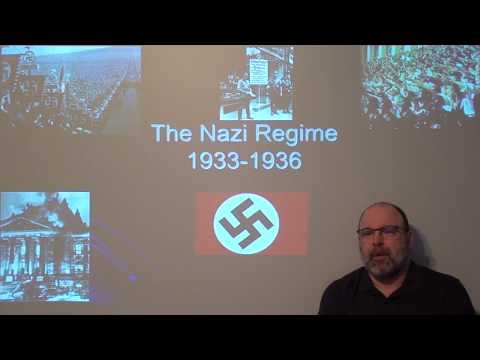
[0:15]All right. Greetings, everybody, and welcome to my continued series on themes of the 20th century. Uh, we are going to be looking at, uh, pre-war Nazi Germany in two lectures. I used to do 1933 to 39 in one lecture, but there's simply too much, um, to cover, and too much to talk about. So I'm going to break it up into two sections. Uh, this talk in particular will deal with 1933 to 1936. Now, before we begin, I wanted to mention that, um, my sort of sense of historical awakening sort of came out of this period of history. My mother was born and raised in Germany. As a young boy, I traveled to Germany, and of course, as a young boy, going to Germany in the late 60s, early 70s, it was a a magical fairy tale land with castles and cobbled roads and chocolate and schnitzel and everything else. And certainly from a child's point of view when I would travel there, I'd be spoiled rotten by my mother's family. My mother grew up in a small village in the Rhineland of about 2,000 people, so it was very quaint. Her village was established in 1343, just celebrated its 875th birthday. Um, so I kind of grew up, you know, thinking, that's what Germany was, and certainly that's what it is now. Um, then as I began to watch films on television as a boy, you know, I was always a bit perplexed why why the Germans were always the bad guys, you know? But I still enjoyed the World War II films that I just I was sort of trained to accept the fact that the Germans were the bad guys, but I never really was too young to really understand what was going on. And then in grade six, I had a family history project, and, um, we had to do, uh, pictures and, and write little narratives of our mom or dad or grandparents, and have a have a have an index, and it was, you know, quite a, quite a big project for a grade six. And on the front, we had to have a, a striking visual. So, um, long and short, uh, this was my striking visual. Now, keep in mind, I had no idea what Nazism was. I had no idea what fascism was. I had I knew nothing about the details of World War II. I just simply assumed because I'd seen it in the movies that that was the flag. And I'll never forget handing that assignment into my teacher when she when she looked at it, looked at it, she looked at me, she looked at it. And she said, she said, Eric, what what do you think this is? I said very proudly, oh, that's the flag of Germany. And she said, well, Eric, no, it isn't the flag of Germany anymore. I'm going to give you this project and I want you to go home and just give it to your mom and explain to her that your teacher asked you to bring it home and that was hoping that your mom could talk to you about it. Which in hindsight was really a good way to approach it, rather than she trying to explain it. Of course, when I brought the project home, I was quite upset, I didn't understand, why did she want me to do this? And that's where for the first time I ever had a conversation about Germany during the war. And, uh, from that point forward, of course, um, I was ceaselessly fascinated with this period of history. And then I just became enraptured with history in general. So, so I have a lot of sort of personal connection with with history, but with this period of history, because my mother was born in in 1933, so she was part of that mechanism, that that war machine and a victim of it, uh, when she would enter the Hitler Youth program, uh, when she was about six or seven years old. So, right up until the end of the war, um, she was part of that, and she was 12 years old when the war ended. But aside from my own family experience, there's something very, very compelling, ceaselessly compelling. Every student that comes into my class recognizes the image of Adolf Hitler. They recognize the image of what this dreadful symbol symbolizes. And I think there's just so much that we can learn from this period of history about intolerance and bigotry and hatred. And, and as as as horrific as it is, it is an incredibly valuable lesson of how things can go very, very wrong very, very quickly. Um, now, if you haven't had a chance, I would strongly recommend my lecture called The Weimar Republic. Um, 1919 to 1933, because it it'll it'll explain all the things that happened in that interwar period that allowed the Nazis to come into power. And it'll also finish with how Hitler came into power, which I'd like to avoid at this point, because I do go into great detail there. Um, you know, the Nazis were obsessed about image. They were they they they were more pictures and more film taken of the Nazis, which left so much great primary footage for historians to look at and analyze. Um, and, uh, you know, so there's there's there's the imagery of this period of history, I think, is what is, is really striking. Particularly when you look at something like the Nuremberg rallies, so, um, so much to cover. Here's a picture we're going to start off with this event, uh, called when the the Reichstag, which means Germany's parliament, uh, was set ablaze just weeks after Hitler came into power. Here's an image, just an incredibly daunting image of hundreds of thousands of people attending Nazi rallies, likely this one is from Nuremberg. Uh, some images of SA or Brown Shirt soldiers, uh, boycotting Jewish owned shops, and then more imagery of saluting. I think this might have been taken from the 1936 Berlin Olympics. So. A lot of stuff to to consider. Now, we will start by saying that in in January 30th, 1933, Adolf Hitler was appointed Chancellor by the president at the time, Paul von Hindenburg, through the legal means within the, uh, Weimar Constitution. There was nothing revolutionary about the way Hitler took power, it was all on the up and up, right? Um, and then we will see what happens from there. So, as I said, within the first two weeks, a very curious incident happens where the parliament is set ablaze. And out of that burning of the parliament, the Nazis would implement the enabling bill or the enabling law. Uh, of February 1933, it was enacted after the Reichstag Fire and allowed Hitler the power to make laws with about without parliament approval for four years. Now, how and why did other political parties consent to this? Was there dissent? Yes, there was, but not enough to stop it from happening. One thing you have to consider is that Germany had been on a horrific roller coaster ride of economic chaos. And of course, the great depression of 1929, um, really sunk Germany's economy, uh, deeply. And I think that by the time of the Reichstag Fire, I should note by the way, they captured the person that allegedly did it. It was apparently a Dutch communist, convenient that it was a communist.
[8:16]Uh, he was promptly tried and executed, but essentially what the enabling law does is the is the Reichstag Fire enables the Nazis to declare a form of martial law. Many believe that the Nazis themselves were responsible for setting ablaze the German, Germany's parliament because they knew that they would be able to implement this kind of enabling law, which they did. So, you know, I suppose the other political parties were just going to sit and wait and see what was happened, what was going to happen. But from this point, four years is a heck of a mandate to be able to make laws, um, without any interruption. After a series of arrests and political assassinations, the National Socialist Party was the only legal party in Germany by July 1933. All the democratic parties had basically been banned or made illegal. Now, you have to consider the the tremendous amount of fear and terror that was used to make this happen. Uh, the SA, the Brown shirts, which is essentially a Nazi private army or militia, had numbered over half a million men by early 1933. There was no lack of young men to go out and be doing the dirty work of the Nazis. And of course, a lot of young people were drawn to the SA because if you're out of a job and you can work for the Nazi party, you get a uniform, you get to hang out with your chums, you get to act tough, you get to be intimidating. Unfortunately, it brings out kind of the worst elements within society, but the SA became a formidable force, uh, of control within, um, the Nazi system. So, within six months, the Nazis were the only legal party in Germany. In April 1933, three months previous, all non-Aryans were dismissed from the civil service. And Joseph Goebbels, minister of propaganda, controlled and censored art, literature, film, radio, and the press, total control, totalitarianism. It's hard for us to even imagine in a democratic society, whether we're living in the United States or Canada or anywhere else, that this level of control could actually exist. I mean, every film that was shown to the German people had to meet censor standards. Any pictures published, any newspapers, um, any piece of art, literature, all quiet on the Western Front, by the way, gets thrown under the bus and becomes illegal. The author of that book, by the way, is chased out of Germany and he flees for his life. Um, so I mean, it's quite remarkable when you think of this. And, you know, there were only two other states that had done this before the Nazis on this level, that would be Benito Mussolini's Italy, which by 33 was 11 years, uh, in the running. And of course, Stalin's Russia, which by 1933 had become a pretty tightly controlled, uh, society itself. So, you know, there were models with which the Nazis could kind of look to it, and we now know that Hitler did look to Joseph Stalin and the Soviets with a great deal of respect like, wow, these guys know how to how to run a tight ship. There's something we can learn from these guys, even though, of course, his pronouncements were fiercely anti-Soviet and, uh, anti-communist, which I think he genuinely felt, but there was a begrudging admiration for that kind of dictatorship. So, um, you know, this is an interesting idea. Non-Aryans were dismissed from the civil service. So, already, the Nazis are moving to eliminate people who are in positions of influence that could potentially inhibit the ability of the Nazis to do exactly what they want to do. So, they are no holds barred doing precisely what they want, and nobody is stopping them, you know, as well. I think this is almost like a, like a a rolling thunder that is coming through government institutions throughout the 1930s. Here are some pictures of the Reichstag Fire, Germany's parliament. Uh, I was recently in in Berlin, and it's a beautiful building, uh, now, they've, of course, they've completely restored it. Uh, here's a picture of Joseph Goebbels, you know, he was one of the more sinister Nazis who was more than happy to do all the legwork of of taking complete control of, um, of German society. And that was his job, the Minister of Propaganda, right? So. All right. Well, legal infrastructure. Almost seems like a strange choice of words when we're talking about Nazi Germany. Um, one of the things you might recall if you watched my lecture on the Weimar Republic was the was the issue that one of the mistakes the Weimar Republic made was that when they when they were writing their constitution and forming their government, they didn't have all the people in positions of influence, whether it be law or or in supreme courts, uh, sign an allegiance to the Constitution.
[13:37]All those people who worked in those important positions were, um, hangovers from, uh, the Imperial period. So, um, in many ways, uh, you know, Hitler understood that if he was going to get away with what he wanted to do, he needed people in every position that was going to, uh, do what they were told or do what they were expected. So, as you can imagine, if you were a Nazi judge or you're signing an allegiance to the Nazi party, you're not going to be getting a real fair trial in a Nazi court. I mean, it's pretty well predetermined even before you step inside. So, um, you know, most of these judges, you know, these people that are trained in law, I mean, I just I think of this picture and all these judges signing a loyalty oath to the Nazi party. I mean, what a tremendous degree of hypocrisy there because they are the ones that we expect to be impartial, that we expect to be, um, objective and all those kind of things. But I suppose to save your own skin, you're going to do what you need to do, but, you know, there there is that sense of, you know, shame on you on one level as well. But, uh, nonetheless, you know, here they are, upon the top, pledging allegiance. So, um, Hitler quickly cleared public offices of undesirables and appointed those trusted to carry out Nazi policy. It was that simple. I mean, you know, not only now, by the way, does he have the S A or SA, the brown shirts to go out and filter into society to do his dirty work. He now also, of course, has the Gestapo and later the SS. So we're going to talk about the Gestapo shortly, but they're they they the SS starts out as Hitler's bodyguards, but then they become more and more than that. They become pervasive throughout German society. Uh, all judges and police chiefs had to be Nazis. So, once again, uh, maintaining that complete control. Uh, the Gestapo, here we go, or secret police, under the control of Reinhard Heydrich, was given the task of rooting out non-Nazis on all levels of German society.
[15:49]Okay, so the million dollar question is how is it that a whole nation, many of whom are decent, law abiding, liberal, open-minded citizens, fall into this and and and be part of this mechanism through their silence. And, you know, I wanted to use the same kind of, um, comparison I used, I used this, um, this, uh, comparison when I talk about, uh, Stalin's Russia, as well, because I think there's a lot of striking similarities between the way these two dictatorships operated. I wanted to share with you my thoughts and and give you something to think about when we try to identify what on Earth people thinking when all this stuff was going on, the political arrest, the assassinations, the intolerance out through the 30s. Let's pretend you're living in Berlin, and, uh, you know, you've got a wife and kids, you've got a, you got a civil servant job. You've learned how to navigate your conversations with people, you're careful what you say, you're you're careful what you do, and you basically just live life and make sure that you've providing a home and safety for your family. Your family is number one. So, therefore, you just have come to terms with the way things are, but you're very, very cautious. So you're looking out your window across the street where Mr. Smith lives, and you see one day that, uh, two Gestapo policemen come to his door. You're watching this outside your window. He's dragged from his home, dragged down the street, taken to the police station. There are three ways in which you're going to respond to what you have just seen. Number one, you're going to go down to the police station and say, I demand to know what on Earth happened to Mr. Smith. I saw two policemen rudely and roughly apprehend him and take him from his home, and I'm here to defend his honor. He's a good man, I've known him for years. Okay, that's number one, defend him. Number two, close your blinds and don't tell anybody what you saw and hope that it all goes away. Option number three is to go down to the police station and say that Mr. Smith guy you pulled out of his home, I always knew he was a bad guy. Uh, I wanted to come and thank you for doing your duty. Um, I've seen strange people hanging around there, too, and I I just want you to know that I appreciate your service, right? What do you think of those three is the most popular? Number one, defend, number two, turn a blind eye, number three, accuse. Number two, right? That's how the Nazis were able to get away with this because the majority of people were not willing to stick their necks out. And as a result, by not doing anything and not saying anything, you've allowed Nazism to flourish. So, you know, where the Gestapo is concerned, I mean, they are in every town and village, right? And their presence is is omnipresent. And people are behaving in strange, I mean, they're they're they're confronting a strange set of circumstances. People are afraid, is something going to be caught up to me? Am I going to be accused of something? Is somebody going to turn me in? And unfortunately, what this does is a percentage of Germans, now there's no way to quantify this, but some people found that the best way to defend themselves would be to accuse others, option number three, right? Um, and, and that is the real tragic consequence of of a dictatorship when it it puts people into a position out of desperation, they accuse other people. We saw this kind of thing in the United States in the 1950s with McCarthyism, although people were not executed, but people were turning people in to to ensure that their own career was saved. So, you know, it's this kind of climate of fear that brings out, can bring out the worst in human nature. Sometimes it can bring out the best as well, but, uh, in this case, you know, the secret police, uh, was everywhere. So it was very difficult for you to resist the government, right? Himmler controlled the regular police and later the SS. Now, the SS and the Gestapo, by wartime, they're kind of fusing into one big organization. They they more or less do the same kind of thing. The Gestapo are the regular police, and the SS are the secret police, but once it becomes an entrenched police state, which it certainly was on its way to becoming by mid-1933, those organizations and the SA, by the way, all kind of work in cahoots. So, uh, Herman Goering was appointed chief of the Luftwaffe and the Air Force. So, people like Herman Goering, Reinhard Heydrich, Heydrich, Himmler, Joseph Goebbels, these are malevolent human beings. I mean, I have there's no other way to put it. They are not just yes men to Adolf Hitler, but they think the same way as him. They feel the same way as him. They have no concern about rounding people up and executing people, and certainly later during the, uh, the the the Holocaust, you know, they have no bones about implementing policies that lead to mass genocide. So, you know, these are the worst of the worst of human nature, all bubble wrapped in one, uh, dictatorship. So, it's quite something. Quite remarkable. I mean, Herman Herman Goering is much to say, to talk, I mean, there's much we could say about all of these people individually, but Herman Goering, you know, um, was, uh, you know, during the war years, I mean, he collected looted art from all the museums that the Nazis occupied. At one point, he had the most the largest collection of of art in his own home, you know. I mean, how do you wrap your head around feeling good about that? Oh, there's my Van Gogh, here's my Renoir. Oh, yeah, it's it's in my home now because we we took it from the museums in Amsterdam and other places in Paris and so forth. So, you know, very, very unsavory characters to say the least. All right. So, the Nazi Party's full name was the National Socialist German Worker's Party. Hitler used socialist ideas and language to appeal to the working class, although he despised socialism. Okay, so the name of the party was very, very intentional. German Workers Party, National Socialist German Workers Party. The word workers and socialist is a curious choice of words coming from a fascist organization. The reason those names were put in would be to appeal to people that had traditionally been drawn towards left wing parties, whether it be the Social Democratic Party or the German Communist Party, to draw in those working classes, uh, within the Soviet or rather within the Nazi Party. Um, two of the 25 points of early National Socialism drawn up in 1920 demanded profit sharing in great industries and abolition of all income unearned by work. So there were those sort of socialistic ideas, but that was pretty much the end of it. They were militaristic, nationalistic, anti-Semitic, uh, in every other way, they were unsocialist other than sort of talking about this profit sharing idea. Many early Nazis liked these ideas and they liked the leader, here he is, Ernst Rohm, right? So, he was, um, he was the leader of the Brown shirts. Now, he goes back with Hitler, back to 1919, 1920, they'd known each other for years.
[23:40]And the SA starts just as kind of like bodyguards for Hitler during when he did speeches in Munich and in Bavaria in the early days of the party. And then of course, by 1933, it's blossomed into hundreds and hundreds of thousands. I can't remember the exact figure, but it's upwards of I think like half a million young men are in this SA organization. And if you are someone like Adolf Hitler, you have to wonder if having a organization with so many foot soldiers in it to be under the under the control of anybody but yourself could be a bit of a problem. So, you know, that comes to a head, of course, in 1934. Rohm made the suggestion to Hitler that the regular army, that is, the army of 100,000 that the Treaty of Versailles allowed, that 100,000 be scrapped and the SA, the Brown shirts, with his with his socialist ideas as head of the armed forces with him commander in chief.
[24:38]This was Rohm's great mistake when he suggested that he'd be completely in control of the SA, um, and others, too. I mean, see, the thing was, Ernst Rohm, um, he's a complicated guy. I mean, he was devoted to Hitler, but he was also a homosexual, and that was causing a lot of problems within the party, too. You know, Nazism is is incredibly arrogant and chauvinistic, and and, you know, they were certainly a tremendous intolerance to homosexuality. So that becomes a real liability for Ernst Rohm as well. The turning point is this, is that aristocrats and business owners told Hitler they would give him full support if the SA was tamed. The aspect of the SA they wanted to tame were those sort of profit sharing ideas. And Hitler went, wait a second here. This is my moment because if I can get those guys, aristocrats and business owners in my back pocket, by removing Rohm, not only do I get the support of business interests behind my party, but I eliminate a potential rival who controls the SA. So, as a result, Rohm and leading SA figures are rounded up and shot in The Night of the Long Knives. No knives, uh, were actually used. They were shot, there were no trials. These men were pulled out of their homes in the middle of the night, shot in the street and the bodies were dumped. I mean, this was, this was, and and it wasn't just, it wasn't just, um, the SA leadership that was executed. Many people that the Nazis found undesirable were also executed. In fact, one of the previous Chancellors, von Schleicher, was executed during the night of the long knives. So, Hitler saw, well, if we're going to kill a few, let's just kill a bunch of people that that we want gone anyway. So, um, it's a pretty crass moment in in Nazi history where they where they do this. And, and, and, you know, he could claim, which he did in the German controlled press, that he had eliminated a potential counter revolution, or a or a enemies from within. Hey, they stopped this revolution, and now the military and the SA are going to have to sign a loyalty oath to Adolf Hitler himself, which they did. So, you know, pretty unbelievable stuff going on here. All right, in that being said, that will be where we will stop. Uh, next lecture, part two, uh, will deal with Germany from 1936 to 39, and I believe if memory serves me correct, we will start with, uh, the 1936 Berlin Olympics. So, anyway, thank you very much and, uh, appreciate you having a look, and we'll see you again. Take care.