[0:00]We literally get our identities from our land. So we have more than a a a passing need for water. It's a spiritual, cultural relationship that has been interfered with. If the water is doing not well, human beings are going to reflect that. It's something we take for granted in Canada, access to fresh drinking water at the turn of a tap. But believe it or not, there are some communities in our country that are still without it. Trudeau promised to eliminate boil water advisories on First Nations reserves within five years. By now, you've probably heard of the story of how many First Nations communities across Canada do not have access to safe drinking water. But what you might not know is how this became a reality for so many people living on reserves and why after years of efforts and billions of dollars in government spending, people still do not have clean water running from their taps. Water is the liquid of life. Let's start with the basics. Water advisories are issued to warn people not to drink their water when it's thought to be unsafe. There are three types of water advisories, but boil water advisories are by far the most common. When Prime Minister Justin Trudeau took office, he promised to end long-term boil water advisories by 2021. So not all water advisories, just ones that have been in place for more than a year. Uh we are still very confident that we are going to be able to end the long-term boil water advisories across indigenous communities in this country, uh within the five years we set out. There were 105 long-term advisories when Trudeau came into office and right now, according to government data, 56 remain. This data excludes the territories and British Columbia. It also doesn't account for situations where a long-term advisory has been lifted, only to have a new short-term advisory issued within weeks or months. Of the 87 long-term advisories the government says it has lifted to date, 33 of those systems have experienced short-term advisories since. The causes of water advisories varies across the country. Everything from where the water comes from, to the pipes underground, to how remote the community is, can impact how vulnerable it is. For example, facilities relying on surface water, such as a river or a lake, have a higher chance of experiencing water advisories due to the fact that rivers and lakes are more prone to contamination. We pride ourselves on our high sanitary standards. Yet we deliberately make open sewers of our waterways. Each year, the government assesses public water systems on reserves. It looks at the system's design, how well it's being operated and maintained, its record keeping, the quality of the source water, and operator's qualifications. It then combines all those factors to give the system a score between one and ten, ten being extreme risk. See, I tend to regard a boil water advisory as the most extreme outcome that you can get. The risk scores can tell you about systems that have problems that are not on boil water advisories yet. So it's just it's just another element of information you can use to get a more complete picture. That's Matt McClearn. He recently analyzed more than a decade of government data on risk scores for the Globe and Mail. What Matt found is that despite the government's progress on eliminating long-term advisories, the national average of risk scores have not changed that much since 2015. The risk scores are changing a lot more slowly than the number of boil water advisories that are being eliminated. You know, there's a lot of systems across this country, uh on First Nations reserves that are in poor shape that aren't on a boil water advisory and the the risk scores reflect that. So just because a community doesn't have a boil water advisory, doesn't mean that they're happy with their level of water service. They may indeed have very serious problems. It's possible that new or recently repaired systems haven't been re-inspected yet. That means the ICMS data doesn't fully reflect recent improvements. So far, the government's strategy has been to build or repair infrastructure on reserves, like water treatment plants. But this doesn't always solve the problem, which is the case at Six Nations Reserve in Ontario. They got a new treatment plant in 2014, but it only serves a very small percentage of the population. That's because many households here don't even have functioning water pipes, forcing the people that live here to buy big drugs of water that they then have to transport to their houses. They get a pot of money and they'll say, okay, you can do this one-time deal. Do we go get a treatment plant because this may not come along again in another 20 years, right? But there is no money to run it. There was no many money to operate it. There is no there was just money to build a treatment plant. The budgets that they receive from the federal government to actually operate their systems are uh much lower than you would get at a at a municipality of similar size. First we add different kinds of chemicals and mix them up in the water to kill the germs. I've spoken to a few water operators who've told me that in in some cases they've actually had to pay out of their own pockets for uh chemicals to keep the plant running. To understand how the system became so unequal, we have to go back to the birth of Canada as a nation, also known as colonization. Long ago, when explorers sailed west from Europe in their wooden ships, what they found was a new world, a land that was vast, rugged, and empty. The reserve system, as we largely know it today, was established in 1876, when Parliament passed the Indian Act. The act, along with existing treaties, carved out specific tracks of land for First Nations people to allow European farmers access to their traditional lands. The Indian Act also gave the government control over most aspects of First Nations people's lives: their status, land, infrastructure, education, governance, and so on. Its aim was to force First Nations people to assimilate into settler society by stripping them of their autonomy, money, culture, and rights. So our social, political, economic, and spiritual life were basically attacked and destroyed, and part of colonialism is to then destroy the Indigenous population and recreate them in your image so they can be managed. John A. Macdonald himself said, the great aim of our legislation has been to do away with the tribal system and assimilate the Indian people in all respects. So the early settling, if you will, of Canada is what kind of dictated what we're we have today. Reserve land is owned and under the jurisdiction of the federal government, meaning that the federal government is responsible for services and infrastructure on reserves. Whereas typically water is governed by provincial and municipal governments. The Trudeau government has committed more than $2 billion towards water and wastewater infrastructure since 2016. And while there has been progress on lifting advisories, water is just one part of Canada's colonial legacy that has disenfranchised indigenous people in this country. There's so many injustices and racism and discrimination that is where do you begin with the land, with the sterilization of our women, with the abduction of our children, residential schools, like, it's like where do you begin? I mean, they never thought we would still be here and the fact that we are is is testament to our resilience and our strength as a people to to not follow their plan, if you will.
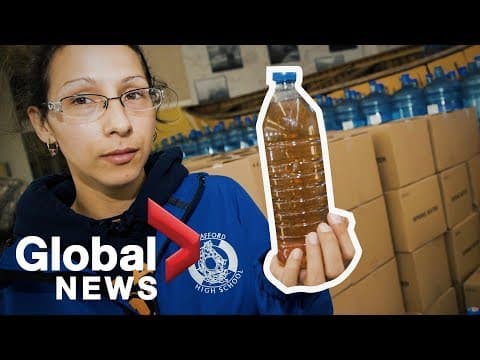
Why some First Nations reserves don't have clean drinking water
Global News
8m 5s1,303 words~7 min read
YouTube auto captions
Transcript source
YouTube auto captions
This transcript was extracted from YouTube's auto-generated caption track. The transcript below is server-rendered so it can be read, searched, cited, and shared without opening the original YouTube player.
Pull quotes
[0:00]It's something we take for granted in Canada, access to fresh drinking water at the turn of a tap.
[0:00]But believe it or not, there are some communities in our country that are still without it.
[0:00]Trudeau promised to eliminate boil water advisories on First Nations reserves within five years.
[0:00]By now, you've probably heard of the story of how many First Nations communities across Canada do not have access to safe drinking water.
Use this transcript
Related transcript hubs
Watch on YouTube
Share
MORE TRANSCRIPTS


