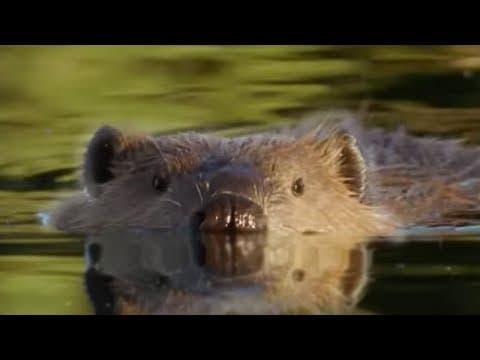
[0:01]A beaver, one of the family that lives here in this lake at the foot of the Teton Mountains in Wyoming.
[0:13]While beavers can get around perfectly well on land, they're most at home in the water, where their webbed hind feet and large paddle-like tail make them powerful swimmers above and below the surface.
[0:39]Like marmots, beavers feed on all kinds of vegetation, and eat wood as well as leaves.
[0:49]And they're accomplished engineers. This great pond is entirely their own creation. Only a few years ago, this shallow pebbly stream flowed straight down the valley. Then a family of beavers moved in and built a dam. The main body of it is built of boulders. On the downstream side, it's been lined with logs, some of them big and quite heavy, and on this side, it's been packed with mud and vegetation. It's been built so accurately that it is to within a few inches horizontal across its entire length of about 150 yards from one side to the other. And the lake it's created stretches upstream for almost a mile.
[1:53]So important is their dam to them that if they detect the slightest leak, usually by hearing the sound of trickling water, they start repair work immediately.
[2:35]The repair team will labor away until the leak is fully repaired. Maintaining the water at a high level brings the beavers several advantages. One of which is that it floods the surrounding woodland and so enables them to swim in safety to their main source of food.
[3:04]They increase the distance they can swim by digging channels that lead into the very heart of the woodland.
[3:20]Here they can use their sharp incisor teeth to strip off the bark from a fallen tree trunk and nibble at it, while still being close enough to water to slip away should a bear or a mountain lion turn up.
[4:05]Their network of channels also enables them to ferry whole branches back to their pond.
[4:28]And there, where the water is deepest, they dive down and push each branch firmly into the mud at the bottom. This is the beaver's fridge, where the vegetation will keep fresh through the long winter when the pond is covered with ice.
[4:56]Stocking the fridge takes a lot of work, and the beavers are at their busiest in autumn.
[5:53]At one side of the lake stands their lodge, a fortress built of branches and boulders that's so strong that not even a bear could break into it. The only entrance is through tunnels that open underwater, and the beavers take refuge here whenever they are alarmed.
[6:21]That was a warning signal, to say that danger was around, that's to say me. And now, I may not see the beavers for some time. They can stay underwater for five minutes at a time, up to 15 if they need to. They can actually get back to the safety of their lodge without putting their head above the surface for a single second.
[6:59]By October, winter is well underway, but whereas marmots would now be hibernating, the beavers are still active and will remain that way throughout the winter. Even when the pond is over completely, they're still able to swim under the ice to get back and forth to their lodge. No one knew exactly what went on inside the lodge during winter, so when the beavers were away, we installed a couple of infrared cameras in order to find out.
[7:37]A branch from the fridge is being brought back to the lodge for the whole family to feed on.
[7:48]And another.
[7:54]No wonder they don't need to hibernate with this ingenious setup. The lodge is warm and safe even in midwinter, and the only sign of activity in the snug home beneath the snow is hot air rising from the vent at the top.
[8:17]Inside, our cameras catch a glimpse of what at first sight looks like a very small beaver. It's a muskrat. There are a pair of them in here. This is a new observation. Do the beavers actually know in the pitch blackness that there are strangers among them?
[8:46]We noticed that the muskrats regularly left the lodge to forage under the ice. And on several occasions, they returned a few minutes later with a load of fresh reads. Perhaps the muskrats are paying rent by regularly providing fresh bedding for the lodge.
[9:35]Ah, infrared lights, however, are no longer welcome, it seems.