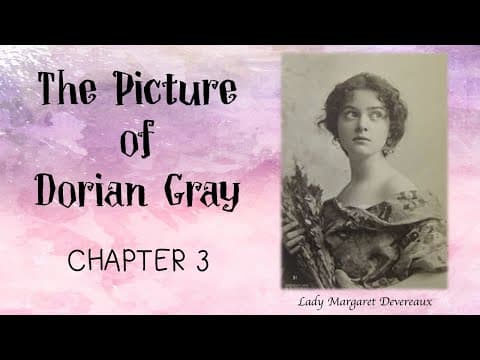
[0:00]Hello everyone. The following presentation is a brief summary and analysis of chapter 3 of Oscar Wilde's novel The Picture of Dorian Gray.
[0:15]Chapter 3 takes place the following afternoon after Lord Henry meets Dorian. Lord Henry goes to see his uncle to find out about Dorian Gray's heritage. Dorian is the son of a beautiful upper-class woman, Lady Margaret Devereaux. She offended her father by marrying a soldier beneath her social status. Remember that in this Victorian society, marrying within your class was an important social expectation. Perhaps due to embarrassment or shame, Lady Margaret's father paid someone to kill the soldier or Dorian's father. At this point in time, Lady Margaret was pregnant with Dorian, but one year later, she also died, leaving Dorian Gray an orphan. Lord Henry's uncle presumes that Dorian inherited much wealth from his grandfather and mother. Lord Henry's uncle explains that as a child, Dorian was raised by a guardian who is described as an old and loveless man. With this information, Lord Henry becomes even more fascinated with Dorian. He finds Dorian's childhood story to be romantic and wonderful. Lord Henry relishes or delights in the idea or the thought that he might have an influence on the young man. A quote from the novel states, he would seek to dominate him - had already, indeed, half done so. He would make that wonderful spirit his own. Dorian's tragic background with the loss of his parents and being raised by a callous guardian makes him that much more intriguing to Lord Henry. Lord Henry feels that his interaction with Dorian is like playing upon an exquisite violin. This suggests that he will manipulate and influence Dorian, like a musician would their musical instrument. We can definitely say that Lord Henry is very bold and quite egotistical to believe that he can project himself to such a large extent onto another person. Note that these ideas fall within the themes of influence, morality and art.
[2:48]Lord Henry goes for dinner at his aunt's home, along with Dorian and several of London's upper class. Lord Henry shocks the dinner party guests with his ideas of hedonism and selfishness. He also mocks his aunt's charitable efforts. Lord Henry insists that in life, a person should appreciate beauty and seek out pleasure, rather than trying to alleviate or lessen pain and tragedy. Many of the guests are appalled by his self-centeredness, particularly when he says things like, I can sympathize with everything except suffering. However, because he is so clever and witty, despite their shock, the dinner party guests still find him very likable and charming. Dorian Gray is so fascinated and enthralled by what Lord Henry has to say, that he leaves the dinner party with Lord Henry and abandons his plans to visit Basil, breaking his promise to Basil that they would spend time.
[4:02]Lord Henry loves shocking people with his controversial ideas, and he enjoys observing their reactions. He creates the impression that he is bad, but pay attention to how throughout the novel, he doesn't physically do anything immoral himself. Instead of practicing his own philosophies, he uses his cunning ways to corrupt Dorian to the point of Dorian's absolute downfall. Lord Henry corrupts Dorian's self-perception and changes the way he sees himself entirely, purely for his own entertainment. Throughout your study of the novel, keep asking yourself, who is to blame for Dorian's downfall? Is it Basil? Is it Lord Henry? Is it purely Dorian himself? Or could all three men be to blame in some way? Thank you for watching this presentation on chapter 3 of The Picture of Dorian Gray by Oscar Wilde. Keep an eye out for summaries and analyses of the rest of the novel.


