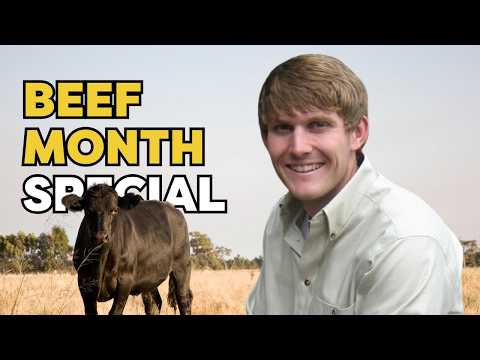
[0:00]We realized that heifers only had they can go two directions, they can either go into the feeding system or they can stay at home and in the breeding herd. The steers going the bull calf that's turned into a steer is definitely going to harvest. And so we we look at that value. And then to even back it up just a little bit more, just looking at the percentage of heifers on feed as as a percent of the total cattle on feed. And what we know is that number sitting around 40% of the cattle on feed right now are heifers. That's ridiculous. I mean, that there's no retention there. There's no retention there. And so what we're going to have to have is something closer to like 34% of essentially 1/3 of the cattle on feed will be heifers and then we'll know we're actually retaining heifers to put back in the breeding herd.
[0:51]Welcome back to The Beef Podcast Show brought to you by Wisenetix. I'm Dr. A.J. Tarpoff and we are dedicated to bringing you the latest insight and discussions from the cattle industry. So sit back, get ready to expand your knowledge with today's episode and today's going to be fun. We're going to dive into some cattle markets. Uh, we've got a lot of questions, a lot of ground to cover, but I want to introduce our guest today, Dr. Andrew Griffith. Uh, he's a professor and extension livestock economist with the University of Tennessee. Uh, a little bit of background about, uh, looks like started off in Tennessee and came back to Tennessee, right? Yes, sir, that's correct. You bet. So, he did his, uh, undergraduate degree at, uh, University of Tennessee, master's degree at Tennessee Tech, came out west for a PhD at Oklahoma State University, and then, uh, finally went back. So, it's now at University of Tennessee. He's originally, he's a Tennessee native, grew up on a corn and soybean, uh, stalker cattle and cow calf operation, so very diversified. Uh, his program focuses on risk management, working with cattle producers to, uh, to look at both inputs and outputs for, uh, for market, uh, market stalker and feeder cattle. Uh, so with that, I guess, uh, Dr. Griffith, welcome. Yeah, it's a pleasure to have you on the show. Uh, we'll get into kind of our key topic later, but tell us a little bit more about yourself, uh, what you do, who you work with, uh, kind of your role within the University of Tennessee system. Yeah, so I've been with the University of Tennessee since 2012, so we're right at 14 years now. And, uh, primary I mean, 100% extension appointment, uh, but I also do participate in research and research ideas and grant writing, you know, because I mean it that's what the research is what drives things. And and and the research that we focus on is based off of what I bring back from an extension standpoint. So what those producers need, that's what we focus on, that's what we try to go after and do research about. So, so I I literally for the most part, for those that are familiar with extension, you know, we have we have extension in Tennessee in every county, there's an agent in every county, and so I work directly with them. And to serve their producers based off the questions that they have, as it relates to livestock, uh, markets primarily, I was hired as a livestock markets person, but I also do a bunch of production, uh, work as well as forage production work. Um, just mainly because those are those are things that are very integral to to whether it be cattle, uh, small ruminants, equine, uh, dairy, what you know, whatever it is. All those things kind of filter in together and it's really imperative to also know the grain markets, uh, as they they're going to play into the markets of all these livestock at the same time. So, just working with producers individually or as groups and those county agents is who I primarily serve, but I also enjoy the opportunities of getting out of the state of Tennessee and working with producers in other states. No, that's great. And, uh, I hope everybody picked up on that key component of the land grant mission, getting the questions and the communication from producers of what matters most and taking that back to the university to find answers and then ultimately get it back out to everybody. I mean, that's that's what we all do in extension and I I really appreciate you bringing that up.
[4:49]So, I guess with that, let's, uh, let's dive in today. I mean, let's, uh, let's start looking at some of our cattle markets, our, uh, the economic outlooks. Uh, it's a, it's a interesting time to be in the cattle business. Is that the best way to describe it? You you bet it is. I mean, uh, these prices have have gone just wildly high. And it's amazing to think about a few years ago, maybe selling a 500, a freshly weaned calf, 550 pound calf for $750, and now we're talking about $2500.
[5:32]Uh, you know, somebody brought to my attention a group of a group of weaned and vaccinated 580 something pound calves that brought well over $5, uh, on Saturday at a sale in Tennessee. And and so, you know, uh, when you when you think about that, there there is just a lot of money involved in this business relative to what it was four or five years ago.
[6:08]Well, it is, it's supply and demand. Uh, yes, cost of production has gone up, you know, uh, throughout time, we're well aware of that, but these are really really extremes that we're we're working with right now. Uh, what are the main drivers shaping this cattle market right now? Uh, what is driven things to that that that extreme? Uh, what are what are we playing with right now? So I mean, it it really does go back to just basic supply and demand. And so if I if if the the a lot of the talk has to do with supply side. And I'm not saying that's the most important side of it. I really think the demand side is more of the driver than the supply side, but let's briefly touch on the supply side. You know, we're at the lowest beef cattle inventory since over in 75 years or so. Uh, so when we think about that, that is a that is a factor. Now, what a lot of people don't factor into that and I've written some some popular press articles on this. But they don't think about the fact that cows are a lot bigger today than they were 75 years ago. Uh, so, you know, 75 years ago put you back to 1951 or so and and we're we're producing a lot more beef with a lot fewer cattle today. I even think about just when I started in 2012, the the average weight of a finished steer was probably 12 to 1250 pounds. Well, now we finish them at 1500 to 1550 pounds. So we've added 300 pounds of live weight, and and some of that is due to genetics, some of that is due to feeding cattle longer. Uh, and what we do know is we're producing a lot more fat because of how long we feed these cattle, but the supply side from the supply side, that is an important factor of of what's going into or what's playing into higher prices. But in reality, demand is what has been the bigger driver of of prices. And so I'll take us all the way back to coronavirus, just briefly. I mean, I realize that was six years ago. Um, it's hard to think it was six years ago, but, you know, 2020, probably about this time, we we find out there's this virus from Wuhan, China, or something. And what it did was it shut down it kept people from traveling, it kept people out of restaurants, and, you know, you couldn't even go to church. Uh, you could go to the liquor store all you wanted, but you couldn't go to church. Um, you know, that's just that's the but but what happened there was the consumer had to start purchasing beef from the grocery store. Now, we remember there was also a short time when you couldn't get meat from the grocery store because people were just hammering those grocery stores and well if you know how a packer works, they've got lines set up for different outlets. Well, they've got a line set up for the grocery outlet. They've got a line set up for food service and restaurants and they don't they don't have the same cuts on them. So, anyway, once they got those things fixed and we started having plenty of meat in the, well people found out they could they could buy beef items. They could prepare them the way they liked them and they were actually good at it. And they have continued to do that. So their discretionary dollars despite the fact that now they can go back out to the restaurants, despite the fact they can go back, travel wherever they want to. What they found out is they still like to eat beef. And, you know, we have a culture that is experience based and so they want to have these experiences eating. I don't care what you have, just keep eating it, right? As a beef guy, just keep eating it. I don't care how you eat it, just keep eating it. But they, but but the general consumer despite a bunch of chatter on, uh, news media, uh, or whoever about how high beef prices are, even our president, you know, has made several statements about we need to lower beef prices. And and he's made some moves in recently, the move of, you know, opening up Argentina to a 100,000 metric tons. Not that big of a deal to me, doesn't matter to me, uh, because it's really not that much beef. Um, but, but despite people talking about how how high beef prices are, consumers continue to buy it. So, that is a clear indication and a clear sign that the consumer wants beef and they're willing to pay for it, and we hadn't found a price at which they say, we're going to stop paying for it. Now, people will say, well, there are going to knock some people out of the market. Well, that's what higher prices are supposed to do. They're higher prices ration products. So, we're trying to ration the consumption of this product. People keep buying it. So guess what happened to prices. Beef prices increased, cattle prices increased. And if you're in the industry, you think that's a great thing. And this is at the same time. I mean, fill, fill, fill me, fill me out here, but our other proteins, when we look at the the poultry, we look at, uh, you know, swine operations, their production is not, their their supply is not dropped off like the cattle industry. So, we are competing in the meat market place and still out competing it with a higher valued product at a low, at a moderate volume compared to what they're producing. Oh, yeah, by far. So, you know, uh, pork production and beef production generally run about the same on an annual basis. Now, pork production is higher than beef production right now. Uh, whereas poultry and that's probably, let's say 20, let's just round numbers, 24 to 26 billion pounds a year.
[31:22]Um, now the thing of it is, you take that out five years and we have a different administration in office, and if we have different leadership in this country, I mean, you you can see the stark contrast between a Biden administration and a Trump administration. And I don't mean to get political because that that's not the point of this. But you can see those stark contrast and how they they're different from the agricultural community. You know, five years is a hard thing to to to project, but all of these things. Well, I mean, it's just like here, we would think that that beef cow, you know, people would start retaining heifers. Well, I can't predict what the weather's going to be this summer or this fall. I can't, yeah, I mean, our weather people can't even predict tomorrow very well. But yet they still pay them. So, there you have it. Well, they did they did predict the ice storm pretty well that went through the south. Oh, yeah, yeah, they did. Yeah, they did. Uh, they knew it was going to hit. They just didn't know, uh, they kept changing every day where it was going to hit and how much you was going to get and. Uh, you know, for for most part, they actually know what the temperature is going to be, but, uh, you know, it's still like, uh, what do they call it? A veterinary practice, right? Yeah, it's not always fact. We just kind of we we figure it out as we go. Yeah. Yeah, you're practicing. Yeah. Uh, and I think that's what, you know, meteorology is the same way. And I'm not I don't mean that negative towards those people. I don't mean it I mean, I'm thankful we have them, but but but the cattle industry, you know, it's a bunch of individuals making individual decisions. We can't predict what outside factors will impact those those decisions. Now, that's fair. There's a lot more that we're going to figure out as we all wade through this together and, um, I I agree. I I completely agree. There's a lot of question marks there, but we'll figure it out together.
[33:58]Well, Dr. Griffith, we've had a great conversation. Uh, I know we could keep going and keep talking about this stuff for, you know, at nauseam for the next day or two. Um, but we don't have that kind of time, but so I'm I'm probably going to shut us off here, but I can't let you go without doing, uh, all of our on on the beef podcast show. We always, uh, have all of our guests, we ask them three specific questions, uh, to help everybody listening grow, develop as a, as an, as an educator, as a learner, as a lifelong learning. I guess, what do you go to find, I guess question one would be, where do you go to find information? What is your go-to that if you would recommend a a resource, a cattle, uh, cattle industry, uh, cattle related resource, what's your go-to? That's a really tough question because I I just read a lot. Uh, you know, I've got things that come directly to my email, you know, whether it be a beef daily or a drover's daily or a dairy herd daily, uh, pork daily, you know, you you think about all these things. And and, you know, you get the NCBA stuff and you get the your local cattleman's. And and so I I I go to other extension people. I I mean, I call I guess I guess the the thing that I would encourage people because I mean, there's information galore, right? Google, you can Google anything and find just about now, I'm not saying the information you're getting is correct. Uh, but but I guess when I'm when I'm really in need of information, the one thing that that I am not afraid to do is just get a hold of the right person and call them. Uh, and just ask the question. And and so I I read just I I'm I'm I don't like to read. Uh, you know, people, well, do you read this? Have you have you read this? No, I don't read that because I don't have to I read about cattle stuff. That's what I do. I mean, that's my job. And the last thing I want to do is read about something that's fake, you know, fiction. Um, and and so, you know, and oddly enough, I like veterinary stuff. It it's pretty interesting because I'm constantly, uh, trying to figure out, well, I I successfully amputated a leg last about a year ago. Uh, you know, on on a calf. I I successfully, I was trying to save the leg. Well, it successfully lived and the leg is gone now. So, you know, I I was like, I didn't get my job done, but I was still successful because the calf is still alive.
[36:54]Well, that's why we call it the practice of veterinary medicine. So, contacting your local veterinarian is important too. I told hey, hey, I I talk to three of them. I have three that I work with. I love it. So, question number two, um, you know, I know you're a cattle guy through and through, but outside of agriculture, outside the cattle business, when you're not working, what are you diving into? What are you are you, uh, you know, I know you kind of alluded to that. You're talking you're reading about cattle stuff, but what else are you, uh, diving into kind of outside of work? You're going to you're going to this is going to be There is only one other thing that I do other than work. And that's reading my Bible. I mean, that is, uh, faith is the only other thing. I mean, I have a wife and children, uh, but but to me that kind of goes hand in hand with my faith. Uh, so, I I work way too much because I I like to work. Uh, if I'm not working the day job, I'm I'm farming. Um, but, uh, a closer relationship with my Lord and Savior Jesus Christ, there's nothing more important than than that. No, and that's one way to keep us grounded is, uh, when we follow true, uh, it it keeps us on the right path. So, no, I I I'm in complete agreement with that, too. So, third and final question I'm going to I'm I'm going to needle you with is, you've been working in academia for quite some time now, as as I have. You've worked with a lot of individuals, you've seen a lot of people at different institutions. I guess what makes a good leader and a mentor in in our type of work? So, I guess to answer that question, I'll answer it based off of who has who people who have the characteristics of people that have mentored me, uh, and the people that have directed me in the right direction. Most important qualities is being able to listen, um, not a hearer, a listener. Um, people won't, everybody won't agree with this to go along with that, but experience, somebody that has experience makes I know this is it's kind of taboo to say that in a culture today where everybody wants everything right now. But it's hard to lead when you haven't done something or you hadn't been around something. And I've had I've I've seen that with politicians, local, state, federal.
[39:37]You know, trying to be a So, so just having the ability to listen, having experience, a willingness to to try to understand other people's points of view, whether you agree with them or not, trying to understand their points of view,
[40:01]because the whole key of leadership, the whole key is relationship. Nobody's going to follow somebody that they don't feel comfortable with.
[40:17]That they don't feel has their interest in mind. So I would say those are probably the three things that I think are most important. I mean, there's there's a plethora of other characteristics, but I don't think those are characteristics that people are always at the forefront of their mind. Well, I'm glad you brought those up. I think those those are all. I mean, when we start, it's difficult to quantify all the different characteristics that make those people that you look up to, that I look up to, that have helped us along our way. Uh, but I hope people listening in take that to heart and think about those things as they're living their daily lives as they're interacting with people, building those relationships. Uh, I think that's really important. So, uh, with that, you've been a this has been a fun. This has been a been a wonderful guest on the beef podcast show brought to you by Wisenetix. Again, this is Dr. Andrew Griffith, uh, University of Tennessee. Look him up, he's a wealth of knowledge and helps a lot of producers in that region. And with that, thank you and we'll see you again.