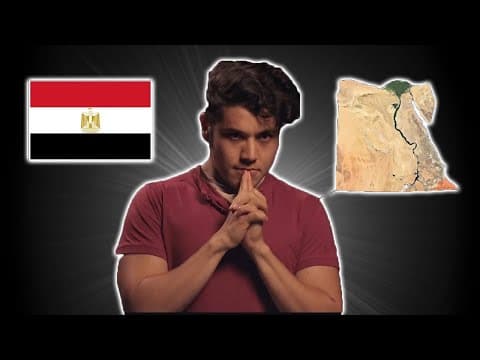
[0:00]Hey guys, meet my friend Mohab. Oh, hey everyone. He's a real Egyptian. Uh, tell us, Mohab. Egypt, there's a lot more than just pyramids and mummies and stuff. Are you kidding me? Come on, there's the Bibliotheca Alexandrina, Sharm el Sheikh, Luxor, Aswan, the Opera House. Intro first. Hey, everybody, I'm your host Barby. We have reached Egypt. From movies to toys, to fashion magazines, the world has been saturated with iconic images of what it perceives Egypt to be for years. But with the help of my friend Mohab, we're gonna jump in and see what's really going on, aren't we? Yeah, that's the plan. That's the plan.
[0:40]I don't really have to even say that much. Egypt has played such a powerfully historical role on the planet that it's almost difficult to say anything that hasn't been already covered trillions of times before. But, I'll try. First of all, Egypt is located in the northeast corner of Africa connecting to Asia by a land bridge formed by the Sinai Peninsula on both the Red Sea and the Aqaba Gulf, classifying Egypt as a transcontinental country. And technically the only Eurafasian country (yes, that's actually a word) in the world if you really want to get into geopolitical semantics. Also, keep in mind they operate the Suez Canal, which links the Mediterranean to the Indian Ocean via the Red Sea, which is like a big deal in terms of global economics. Egypt borders Libya to the west and Sudan to the south, sharing a tripoint border at the Hassanein Plateau. Egypt is divided into 27 governates, most of which are cradled around the Nile River Delta, with Cairo being the capital, the largest city in the entire Arab world. All the way in the South, Egypt has a little bit of a land dispute with Sudan over the Hala'ib Triangle, which covers the Elba National Park as well as the Egyptian Administer Town of Hala'ib. This place is de facto run by Egypt. This, of course, leaves the Bir Tawil Trapezoid, which neither side claims or really cares about, so this guy came in, planted a flag, and called it his own kingdom so that his daughter could be officially a princess. In addition to disputes, Saudi Arabia also lays claim to the Tiran and Sanafir Islands off the coast in the Red Sea. About 99% of the entire country lives on only 5.5% of the land, most heavily concentrated around the Nile River Delta. I mean, it's not that hard to understand why.
[2:04]Water is good! Now, of course, we all know about the over-exploited tourist traps, the pyramids, the Sphinx, the Necropolai, Luxor, Memphis. Even the sunken city of Heracleon is gaining a ton of diver tourists. However, head off the beaten trail and you'll find a vast realm of ridiculous treasure troves. Few roads will take you inland to the incredibly sparsely populated New Valley and Matrouh governorates that lie western in the desert of Egypt. The largest inland highway will take you all the way from the Siwa Oasis to the incredibly remote potato and wheat crop discs of Al-Wahat and Al-Ain. Now, if you can make it through, check out places like Muzawaka Tombs, one of the only places in the world where you can actually touch real ancient mummies. And if you really want to play a real life desert I Spy game, see if you can find the various Samir Lama Memorials, the Abu Bala's shattered water pots, and the abandoned World War II trucks and abandoned landing strip. And those are just the man-made sites. We haven't even covered the landscape yet, but now we will. If you get a good look at Northern Africa, you'll notice that it's so much more than just sand. Oh, yeah. There's an entire playground of eroded rocks, plateaus and mountains that give you clues as to what the place used to look like, primarily when it was covered in grasslands thousands of years ago before desertification came in. I mean, Wadi Al-Hitan Valley has fossilized whale bones for crying out loud. Whale bones. Yes. Cute. Just you wait till my country comes up. First of all, the country lies on the incredibly arid Western Saharan and Libyan deserts of Northern Africa. Primarily made up of sand dunes that can go over 30 meters high and rocky plateaus with the occasional oasis planted in conveniently remote areas. With the exception of Sinai Peninsula, where it actually sometimes snows on mountains, on average only, I don't know, about an inch of precipitation falls a year. Yeah, which is actually a lot better than some other places. Woohoo! Driest place on Earth. What up, Egypt? You ain't got nothing on me. But I do. These deserts contain rich geological gems. Head inland and you'll find the Al Farafrah white desert with strange eroded calcium rock formations caused by winds and dust storms. You'll also find extinct volcano calderas and dried up wadis. Which, by the way, terminology lesson. A wadi is a valley, ravine, or channel that is dry except in the rainy season when they typically amass bodies of water that eventually dry up. Egypt is currently the world's most heavily mined country with over 20 million active mines. That's like one mine for every 4.2 people in the whole country. Otherwise, the most distinguishable feature of Egypt would have to be the famous Nile River. Oh, the Nile River. It's the longest in the world at over 6,600 km that flows north, draining into the Mediterranean. Yeah, the Nile provides Egypt with a unique feature that not many North African countries have: fresh water irrigation. Which, in return, has made Egypt the world's largest date and artichoke producer. Really? Wow. Okay. In the South of the Nile, you reached Lake Nasser, a reservoir that was created by one of the largest dams in the world constructed in 1971 to control the flooding. Without the Nile, Egypt would look nothing like it does today. It's doubtful that they would have had the flourishing population and culture built up over millennia. They do have it and we'll talk about it now.
[5:07]Hey Mohab, what does it mean to be an Egyptian in the 21st century? What do you think? Jeez. That's a heavy question. Yeah. I don't even know where to begin. With a population of around 90 million, Egypt is the world's largest Arab country and the third largest in Africa, after Nigeria and Ethiopia. At around 91%, the country identifies as ethnically Egyptian, whereas the remaining 9% come from wide range of nationalities like Turks, Greeks, Bedouins, Berbers, and Nubians. In a sense, Egypt is kind of disputably considered the world's oldest nation. Yeah, speculated to have started somewhere around, uh, 5,000-ish BC. Egyptians have gone through a millennia and millennia and millennia of kings, Pharaohs, emperors, conquerors, Sultans, empires, revolutions, and presidencies, which brings us to today. Egypt is not only huge, but is also kind of seen as like the center of the Arab world, the crossroads between North Africa and the Middle East. Therefore, Egypt has a lot on its plate. Egypt alone contributes to over 15% of the entire African Union budget and is one of the largest economies in the Middle East and the largest and strongest military country in Africa with a mandatory draft for all males aged 18 to 30. Wait, Mohab, does that mean you were drafted into the military? Uh, nah. I, I don't know. I, I've I, I think I was too cute or something. I mean, I was drafted and then I was exempt. It's just a long story. We don't have the time for this. Anyway, long story. Long story. At somewhere around 80 to 90%, the majority of Egyptians are Sunni Muslims with a significant number adhering to the Sufi orders, which is why a lot of Turks feel perfectly comfortable living there. Otherwise, the second largest group are Christians, mostly Coptic Orthodox, with an incredibly small amount of Egyptian Jews left. Egypt is also the center of Arab media and cinema, pumping out about 75% of all Arabic films since the early 20th century. Many filmed at Medinet El Entag El Elamy Studio in Cairo, which is considered the biggest multimedia studio in Egypt. Oh, so it's like the Arab Hollywood? Oh, yeah. Oh, Arab Hollywood. Yeah. Famous Egyptian actors like Adel Imam, Ahmed Zaki, Academy Award nominated actor in the United States, Omar Sharif, have raised the silver screen, making an internationally recognized name for themselves throughout the Arab world. They're very famous, aren't they? Yep, everybody knows about them in the Arab world. Other notable icons would probably be Nobel Peace Prize winner, Egyptian writer and author Naguib Mahfouz, and chemist Ahmed Zewail, the first Arab scientist to win in a scientific field, and Peace Prize winner, former President Anwar Sadat. And generally, Egyptians are kind of known as being kind of like the most athletic in the Arab world, typically competing better than their cousins in the Olympics. Careful, buddy. I don't like where this is going. And have probably the most prominent soccer team as well. Oh, you did not just go there. Arabic or Al Arabia is the official language. However, as a former British Protectorate, English and to a lesser extent French are widely taught and spoken, especially in the younger generation as it is widely taught in schools and as a second language or third language and used in the tourism sector. Look at me. How do you think I learned English? Yeah, exactly. In remote areas, you can find languages like Berber, the Nubian languages, Domari, Beja, and the Bedouin speak a dialect of Arabic that's unlike any other. And although many claim that Egyptians speak standard Arabic, they have a whole set of distinct slang words that really aren't used anywhere else in the Arab world. Mohab, take it away. Engaz. Aash away. Ezzayak? Aywa, aywa, aywa. Enta gamid akher haga. Ya nahar eswed! W enta amil eh dilwaqt? Man, just wow. Egypt does have some of its vices though. Yes, wages are generally lower here than in other countries in the Middle East, and yes, pension systems have suffered greatly due to the cost of living. Government policy also has trouble administering social security, inflation rates have exploded, and unemployment has increased in the past few decades. Primary education is mandatory and free, but typically underfunded and poorly monitored, and sometimes classrooms are overcrowded. Nonetheless, Egypt is a front runner in smart women. Today, there are more girls than boys in secondary education, and women make up 31% of government employees. And there's the part where we have to talk about the revolution. Mohab, can you summarize this because I, yeah, you do it. You're the expert. On February 11th, 2011, Vice President Omar Suleiman announced that Mubarak would resign as President, turning power over to the Supreme Council of the Armed Forces. The Muslim Brotherhood took power in Egypt through a series of popular elections, with Egyptians electing Islamist Mohammad Morsi. However, Morsi's government encountered fierce opposition from secularists and member of the military, and mass protests broke out against his rule in June 2013. Morsi was deposed by a coup d'etat led by the Minister of Defense, General Abdel Fattah El-Sisi, who became a hero figure in the eyes of many Egyptians and was eventually elected President himself in 2014 election. According to the Egyptian government, Sisi was elected with 97% of the vote, and he is the current President of Egypt. Awesome. Couldn't have said it better myself. Literally I couldn't have. That's why Mohab is my friend. Sping of friends. When it comes to friends, you kind of have to factor in two things for Egypt. What does the government approve of, and was it before or after 2013? First of all, Egypt is part of the Arab League whose headquarters are in Cairo. So, naturally, they have ties pretty much with every Arab country in the world. Before 2013, they were really good friends with Turkey and Qatar, which were close politically in their views regarding development, but then after 2013, ties were dramatically strained and they favored Saudi Arabia more, especially after they gave them a lot of moral and financial support. Keep in mind, the general public has a lot of different opinions on this, and there is no universal consensus. Then we get to Israel and Palestine. After the peace treaty was signed in 1979 in Camp David, the whole world was watching, and Israel agreed to give back the Sinai Peninsula that they occupied after the war. In return, they asked to just stop the fighting. This was the first time any Arab country signed any kind of agreement with Israel. Nonetheless, today the agreement to them is just on paper, and most Egyptians don't even quite favor Israel that much. So for now, it's just kind of like saying, I'll hold my ground until you do something. Keep in mind, this is not an anti-Semitic thing, but rather an anti-Zionist thing. Egyptians have a long history of cooperating with Jews. In terms of Palestinians, Egyptians totally support the Palestinian cause, and they do share a border at the Gaza Strip. However, due to the potential drama, the border is closed indefinitely, rarely opening on special occasions. In terms of their best friends, Egyptians would probably say Sudan, the Emirates, and Kuwait. There have been no disputes with the Emirates, and Egyptians love visiting and working there. They supported Kuwait in the Gulf War, and Egyptians are treated nicely in Kuwait. Sudan is kind of like the cute little brother who is just starting to learn how to ride his bike without training wheels. They need a little help sometimes, but Egypt likes helping them and loves them. At one point, they were even part of the same country. In conclusion, you cannot understand the Arab world without understanding Egypt. Egypt is the central hub responsible for the development of an entire world of Eastern culture, and even after millennia, the story still goes on brightly as ever. Did I get that right, Mohab? It's It's like you're reading in my soul. Stay tuned. El Salvador is coming up next.


