[0:02]So my um task from her was to talk about the an update on dictic treatment. and of course, the good news is if you are at the opening session, you're nearly up to speed. Um, first off there is off label use of falling blocks, Dig Rush and movie viewing binocular treatments. Uh I did serve as a medical monitor for Luminopia in their pivotal trial. and salary support from the National Eye Institute of American Academy of Opthalmology, but nothing from Nova site. So my objective is to review recent digital treatment results for amblyopia, except for Cure site's pivotal trial, which will be reviewed by Tamara. So the interest is clear, look at this ring. Although I was told the rain outside may make this room more favorable. Um, we've been talking about binocular stimulation and the media talks about our parents talked about it and we talked about it in a number of meetings. And it has been modest treatments, more modest treatments seen in uncontrolled studies for merely 10 years. These treatments though are generally not available outside the research setting, but now we have two approved treatments in the United States. Because maybe that's the reason you're here. Now, binocular activities vary between all of the studies, all of the approaches, there are differences in them. So we can't think of one binocular treatment necessarily a synonymous with any other binocular treatment. But they all in some way reduce rebalance contrast to the fellow eye with an attempt to overcome suppression or they have moving masking of the fellow eye, which may or may not be considered true binocular therapy in the traditional sense. And then the content can be passively viewed or there can be active engagement of the viewer with that content. And we don't know which of those approaches will actually be better at the end of the day or we'll know in a few years. And of course, the content may be web, web based movies, dictic game, first-person action games. This is an evolving field. In terms of recent clinical trials, PDG did conducted ATS 18 with falling blocks, you can think of it is Tetris. We had two age cohorts, the younger children and the older children with a wide range of visual acuity resulting from strabismus an isometropia or both eligible. 16 weeks of treatment with a randomization to one hour a day of the game or patching two hours per day. High contrast images to amblia eye, reduced contrast to the fellow eye. And the findings were published in two different papers, in the first group, the adjusted difference favored patching, and in the older group, the adjusted difference also favored patching. But note the compliance in the older group, 13% completed up to more than 75% of the scheduled time. It was a pretty boring game at the end of the day. You can only do Tetris so much, but because it's good to have a repeat the Bravo trial, um, use also the Falling Blocks Talk design. Seven years of age or older, 115 patients, 36% compliance, ability to score with low contrast. And no difference compared with placebo. So this wasn't the solution. The next enter this array or this turning of binocular therapy might be Dig Rush, which is a first-person action game. The trial had to see the blue target and the miners in red and be able to interact with those to win in that game. Uh, we did two trials here, an older cohort a little bit younger, older cohort this time, seven to 13 and the younger cohort three to seven. Same wide range of amblyopia visual or legible, but the child had to be able to see both targets. So the results for the older group after four weeks the mean vision improved from baseline by 1.3 letters. But glasses alone did a little bit better, uh, so not the solution for the older age group and no difference with when we had continued the treatment for eight weeks of treatment. Stereo Acuity, which has come up in the open section on Thursday and was we'll get through in the movies, but we did not see any change in stereo in the Dig Rush study. The three to six years of group, which took longer to recruit and was published only last year, has a little bit different story, but there's a kernel of something good is going on. So after four weeks of therapy, the mean amblyopic vision improved 1.1 log Mar lines with binocular treatment, 0.6 log Mar lines with continued spectacles alone with an adjusted difference that was significant at 0.5 lines. So that sounds great. After eight weeks and this become became a fight, a discussion, more discussion and more discussion, what to do now. So you continued the treatment and we had 1.3 lines of improvement with binocular treatment and one line with spectacles alone. Now, the difference, although still there, favoring binocular treatment compared to spectacles was no longer statistically significant. But Dig Rush did get more children involved. Now 47% completed 75% of the prescribed Dig Rush treatment at four weeks and 43% at eight weeks. So compliance with the those that we thought might help was still not adequate. Ilinech and colleagues and others have talked about movies and this is certainly another exciting era. We don't have a large clinical trial here, but just as you saw in their presentation on Thursday, and again, with this study, we're just a short period of treatment. The mean amblyopic eye visual acuity and mean stereo acuity improved with movie viewing with the masking that you see going on there. So another kernel here that there is some benefit. And then of course, the Luminopia project really changed the story with their publication. So a lightweight virtual reality headset modifying streaming video in real time, contrast to the fellow is 15% of that in the amblyopic eye and they're some complimentary masking going on in the images that you see. The pivotal trial had a one to one randomization of treatment to control. The control treatment here, again, is full-time glasses. That's not compared to patching that study, um, may or may not ever be done in the future. The active treatment group one hour, six days per week with glasses with a 12-week treatment primary endpoint. So longer than the Dig Rush, shorter than the Falling Blocks game. And the data, the final data, if you will, the results for the primary endpoint in one slide, um, 88 of 117 participants had in window 12-week visit. At 12 weeks, the amblyopic eye best corrected vision improved 1.8 lines in the treatment group, 0.8 lines in the control group with a statistically significant difference. And interestingly, that difference was seen at four weeks, eight weeks and 12 weeks. So there is an early unexpected benefit and it continues throughout perhaps Linear perhaps, uh, I I don't see it becoming out of date yet in these data. We need the next peted trial by the way that's going to try and carry these devices out for a half a year. So going forward, um, we still have a pivotal trial to talk about, but we have a pivotal trial that led to an FDA approval, that led to the next problem in our space. There will be medical coverage hurdles. Don't believe what all was the companies tell you. In February, meaning a month ago, now two months ago, Elevate, which is the health office now for Blue Cross Blue Shield, uh, is currently evaluating the topic and their preliminary, uh, plan is a non-coverage decision. That may get changed, everybody has written to them. We'll see how that goes. Incidentally, that's what happens with every new technology going into commercial space. It always starts with non-coverage. Second, if you're getting paid after you want these things, that doesn't necessarily stop a company from recoupment. Now, the recoupment's not actually in from the doctor getting paid, of course, is from the patient. Um, and payers will keep citing, and they've already done that. They've taken the results that we PD did, and it's cited those as non-significant. So if you had the good fortune to medical director, make sure you cite them that those were earlier technologies, yet it's the same approach, but it's an earlier technology. And the results should not be viewed to offset the newer technologies, the newer approaches that seem to be working, and it will be an ongoing battle.
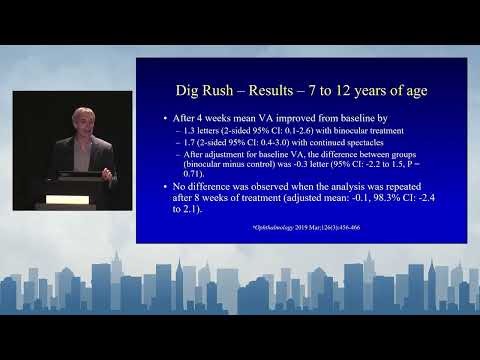
Update on Current Dichoptic Treatment of Amblyopia | Michael Repka, M.D. - NovaSight AAPOS 2023
NovaSight
10m 21s1,442 words~8 min read
YouTube auto captions
Transcript source
YouTube auto captions
This transcript was extracted from YouTube's auto-generated caption track. The transcript below is server-rendered so it can be read, searched, cited, and shared without opening the original YouTube player.
Pull quotes
[0:02]and of course, the good news is if you are at the opening session, you're nearly up to speed.
[0:02]Um, first off there is off label use of falling blocks, Dig Rush and movie viewing binocular treatments.
[0:02]and salary support from the National Eye Institute of American Academy of Opthalmology, but nothing from Nova site.
[0:02]So my objective is to review recent digital treatment results for amblyopia, except for Cure site's pivotal trial, which will be reviewed by Tamara.
Use this transcript
Related transcript hubs
Watch on YouTube
Share
MORE TRANSCRIPTS


