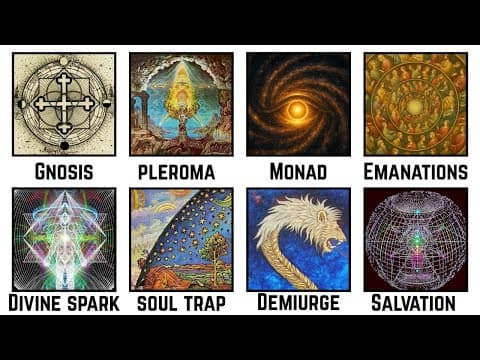
[0:00]Gnosis. Ever had a moment where you weren't just learning something, but remembering it, like the truth was already inside you? That's the heart of nosis and nosism. It's not about reading the right book or attending the right lecture. It's an inner awakening, a personal revelation that rewires how you see reality. Not belief in dogma, but a lived transformative experience where the soul recognizes its divine origin. They believed most of humanity lives in a kind of spiritual sleep, caught up in the distractions of the physical world, money, power, fear, pleasure. All the noise that keeps us from hearing the signal. Nosis cuts through that static. It's the moment you realize the material world isn't the ultimate truth, that you are not just a body with a soul, but a soul wearing a body. And in that instant, you see through the illusion built by the demiurge and his archons, the cosmic wardens of this realm. For gnostics, nosis was highly personal. No priest, ruler, or even scripture could give it to you. The myths, symbols, and sacred stories they preserved were more like treasure maps, not the treasure itself. Only by turning inward, questioning reality, and directly experiencing the divine spark within could a person truly awaken. And once that spark was lit, life was never the same because you didn't just believe in the higher realms, you knew them as surely as you know your own name. The Pleroma, imagine a realm so perfect, so overflowing with light and harmony that nothing is missing. No pain, no fear, no loneliness. This is the Pleroma, the fullness of divine reality in gnostic thought. It's not a place you could travel to with a spaceship or find on a map. It exists beyond time and space, beyond the rules of the physical world. It's where the true God dwells, surrounded by emanations of pure divinity called Aons, each a living expression of love, wisdom or truth. To gnostics, the pleroma was our true home. Every soul began there, a spark of that fullness before a cosmic mistake cast us into the shadows of the material world. Here, in this realm of matter, we forget who we are. But deep down, our spirit still ache for what we lost. That subtle homesickness you sometimes feel, the one you can't explain is in the gnostic view, your soul remembering the Pleroma. The myths say that to return is not about going somewhere. It's about becoming whole again. The pleroma is the fullness we've been searching for in every relationship, every dream, every achievement, but can't quite find here. The gnostic path is about stripping away the illusions until the pleroma isn't just out there, it's within you. And when you awaken to it, you realize you were never truly separate from it in the first place. Before anything existed, before stars, planets or even the idea of time, there was the Monad. The word means one, but this isn't a one you can count. It's not a God sitting on a throne, not a figure with a face. The Monad is beyond form, beyond thought, beyond even the concept of beyond. It is the source from which all reality flows, a still infinite ocean of being that has no beginning and no end. Gnostics described it as pure unKNOWABLE perfection, so vast that even the highest spiritual beings cannot grasp it completely. Yet everything that exists, both in the spiritual and material realms, ultimately comes from this single boundless origin. It's not a ruler handing down commands. It's more like an eternal fountain, overflowing with light, love and possibility. From that overflow came the Pleroma, the realm of divine fullness, and within it, the Aeons, each a facet of the Monad's infinite nature. You can't see the Monad with your eyes or picture it in your mind, but you can feel its echo in moments of deep stillness. When you sense that there's something vast and eternal holding everything together. Gnostics believed that to awaken spiritually is to follow the thread of your own divine spark all the way back to the Monad, to return not just to the place you came from, but to the very source of existence itself. Emanations, Aeons. If the Monad is the infinite ocean of divine being, the Aeons are like its waves, unique expressions of the same source, each carrying a different quality of the divine. In gnostic cosmology, the Monad doesn't create the universe the way a carpenter builds a table. Instead, it overflows naturally and from that overflow come the Aeons, streaming out into the Pleroma. They are not separate gods, but living aspects of the one, like love, truth, wisdom, and life itself, personified in radiant spiritual form. The Aeons often appear in Syzygies, male-female pairs, representing perfect balance. Their harmony keeps the spiritual realm whole. But the gnostic myths tell of one Aon, Sophia, wisdom, who acted outside her perfect pairing. Driven by an intense desire to know the unKNOWABLE Monad directly, she emanated on her own. This act, though born from longing, disrupted the balance and gave rise to something flawed, the demiurge, the architect of the material world. To the gnostic seeker, the Aeons are not just mythic beings in a cosmic drama. They are sign posts on the path home, each representing a stage of spiritual ascent. As the soul awakens, it moves through these emanations, shedding layers of ignorance until it finally returns to the fullness of the Pleroma and the unity of the Monad. The divine spark. Deep inside every human being, the gnostics said, there is a divine spark, a fragment of pure light from the Pleroma itself. It's not a metaphor for potential or goodness. It's literally a piece of the true God hidden beneath layers of flesh, thought, and illusion. This spark is eternal, untouched by the flaws of the material world, yet trapped here because of the demiurge's creation. Most people go through life unaware it's even there. They get caught up in work, pleasure, fear, and survival, never realizing that the quiet ache they sometimes feel, that sense of being out of place, is their soul's homesickness for the realm it came from. But for those who begin to wake up, the spark stirs. It sends little pulses of recognition, a moment of awe in nature, a dream that feels more real than waking, a sudden knowing that you are more than you've been told. In gnostic teaching, this spark is the compass guiding the journey home. It doesn't shout, it whispers, and the more you listen, the stronger it becomes. To awaken the divine spark is to remember who you truly are, not just a body, not just a mind, but a being made of the same essence as the infinite Monad. The material world as a prison. To the gnostics, the world we see and touch isn't our true home. It's a cleverly built prison, not a prison of stone and iron, but one made of flesh, time, desire, and distraction. Everything here, from the daily grind to the cycles of birth and death, is designed to keep the soul looking outward instead of inward. The architect of this prison is the demiurge, and his wardens are the archons, forces that maintain the illusion that this physical realm is all there is. This prison is tricky because it doesn't always feel like one. Sometimes it seduces with beauty, love and pleasure. Other times it traps with fear, pain and loss, but either way, it keeps the soul invested in the game. Gnostics believed that as long as we are enchanted by the material world, whether through its pleasures or its struggles, we remain bound to it. But cracks appear in the walls, a moment of deep stillness, a dream that feels like a memory from somewhere higher, a sudden unshakable sense that there's more than this. These flashes are glimpses through the bars. The gnostic path is about noticing those cracks, following the light that shines through them, and ultimately walking free from the prison altogether. The demiurge. In the gnostic story, the demiurge is the great plot twist. The being who shaped the world we live in, but who is not the highest God. Born from Sophia's lone act of creation, he came into existence, cut off from the Pleroma's fullness. Lacking the light of the Monad, he believed himself to be the only God and declared, I am God, and there is none beside me. To the gnostics, this was not divine truth. It was cosmic ignorance. The demiurge crafted the material universe, but because he worked with matter, seen as flawed and limiting, his creation mirrored his own imperfection. He set the physical laws, the cycles of birth and death, and the boundaries that keep the divine spark in humanity trapped. Some traditions describe him as arrogant and cruel. Others see him as simply blind, doing the best he can without realizing he is just one being in a much greater hierarchy. He doesn't rule alone. The myths say the demiurge is surrounded by archons, cosmic administrators or jailers, who maintain the illusions of the material realm. They distract, mislead, and keep the soul turned outward instead of inward. In gnostic thought, the spiritual journey is, in part, a jailbreak, not from life itself, but from the false reality the demiurge built, and the key to escape is nosis. The awakening that reveals there is a far greater, higher God beyond the walls of this world. Salvation through awakening. For the gnostics, salvation wasn't about being rescued by an outside savior, or earning a place in heaven through rules and rituals. It was about waking up, remembering who you truly are and where you truly come from. They believed the soul already carries the map home hidden inside the divine spark, but as long as you're asleep to it, you keep wandering in circles inside the prison of the material world. Awakening begins when something breaks through the noise, a dream that feels like a message, a sudden moment of clarity, a teaching that resonates so deeply, it feels like déjà vu. In that instant, you see the world differently. You realize the walls are made of illusion, and the key to leaving has been in your hands the whole time. The gnostics saw this awakening as a kind of inner resurrection, the moment the true self rises from the tomb of forgetfulness. Once awake, the soul can navigate past the archons, slipping through the gates of the material realm at death and returning to the Pleroma, the fullness it came from. And here's the twist, in the gnostic view, salvation isn't something you get after you die. The moment you awaken, you are already free. The prison still exists, but it can't hold you anymore because you've remembered the truth. You were never just a prisoner, you were always a being of light, temporarily dreaming in the dark.
Every Major Concept in GNOSTICISM Explained in 9 Minutes
Toon Explainer
9m 25s1,846 words~10 min read
Auto-Generated
Watch on YouTube
Share
MORE TRANSCRIPTS