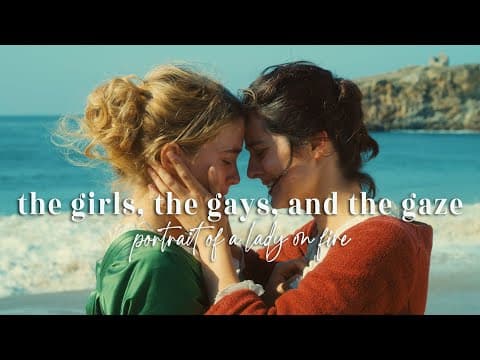
[0:31]Portrait of a Lady on Fire is a modern masterpiece about past love. Set in 18th century Brittany, the film charts the building desire and love of two women, painter Marianne and aristocrat Heloise. Marianne is hired to paint a portrait of Heloise that will essentially facilitate her marriage to a Milanese. Both portrait style and subject matter is distinctly feminine and feminist. It won best screenplay at Can and was the first movie directed by a woman to be awarded the queer palm. This award-winning director is Celine Ciama, an openly gay French director whose films deal heavily with themes of sexuality and gender and portrait is no exception. Ciama along with cinematographer Claire Maton, craft a unique lesbian gaze in which women are equal and have unique creative agency. Because of this, Portrait feels like a breath of fresh ocean air in a sea of male-dominated cinema.
[1:26]Unlike many period pieces that focus on power, hierarchy and the political aspects of marriage and the central relationship, Portrait of a Lady on Fire relegates these to the background and chooses to focus on the burning desire of two women. It's clear from the beginning of the film that the story is about women and female agency. Marianne's canvases fall in the water and she halts, waiting to see if any of the men will take action. They don't, simply observing the canvas floating away while Marianne dives into the water in her full dress and saves the canvas. Having spent time at a convent in the sole presence of women, Heloise says Et puis c'est un sentiment doux à vivre l'égalité. From the main characters to the community that surrounds them, women are equal. Unlike heterosexual couples where men are superior in a societal sense, this lesbian relationship is based on equality. Of course, there is a social hierarchy present among the women in that Heloise is an aristocrat, Marianne, a painter, and Sophie, a maid. But they do not act as such, taking part in activities communally. While all of them are constrained according to their sex, they experience freedom in varying degrees. Though Heloise is wealthy, she does not have some liberties the others are privy to. She is forced to be married off to live a family life while Marianne is free to lead a career in painting and Sophie is free to have sex outside of marriage. Once the countess leaves, Heloise and Sophie swap activities. Heloise cooks while Sophie embroiders. This highlights the cross-class sense of community that the women share, bound by the experiences of womanhood.
[3:04]Speaking of activities, the film privileges the artistry of women's activities in ways that were overlooked. Way before the Live Laugh Love cushions that appeared on every white suburban mom's couch, embroidery was an art primarily practiced by women. We see Sophie partake in embroidering a flower scene in our spare time. A line is drawn to distinguish male artistry from female artistry with the portrait painting. Unlike the man who came before her, Marianne is not confined to viewing Heloise through the male gaze. She struggles with this initially and both women recognize that the representation of Heloise is inaccurate due to conventions and rules put in place by men. Il y a des règles, les conventions, des idées.
[3:52]Vous voulez dire qu'il n'y a pas de vie? Pas de présence? However, together they are able to overcome these objectifying conventions in order to truly capture Heloise on canvas.
[4:07]Sciamma highlights the often untold or overlooked aspects of women's private lives with the scene of Sophie's abortion. It is rare that we see this depicted in film without it encompassing the narrative, but in portrait it is simply one facet of Sophie's character. The community of women come together to help a girl in need and not only do they do this successfully, but Heloise encourages Marianne to capture the scene on paper, immortalizing it in art. This emphasizes the necessity of female artists to capture, preserve, and share the intricacies of women's experiences. Marianne teaches painting to a group of young women, ensuring this tradition will be upheld.
[4:48]There are several other ways this film bestows agency on women. One is through the portrait painting which I will elaborate on later, and the other is through the myth of Orpheus and Eurydice. The film is concerned with the ending of the myth where Orpheus is trying to rescue Eurydice from the underworld. Hades allows her to follow him out, but he cannot look back to see her until they are out of the underworld. A few feet from the exit, Orpheus turns around and looks at Eurydice, and she is whisked back to the underworld. After the women read this story together, they discuss the ending. Marianne suggests that she took the poet's choice, not the lovers, in choosing the memory of her over her actual form. However, Heloise says maybe your Eurydice said, turn around. That she had more power over the story's outcome than is often suggested. This follows the trend of feminist retellings of classic Greek myths, such as Madeleine Miller's Cersei or Margaret Atwood's Penelopiad. These works take established classics and evaluate women's positions, bestowing the works with a much-needed female perspective and giving voice to the forgotten women who became footnotes in the history of great men. At the end of the film, Heloise embodies this new empowered version of Eurydice when she tells Marianne to turn around. We see her standing on the stairs in what we assume is a wedding dress, symbolizing how this dreaded moment that haunted Marianne has finally come to fruition. And she is left with the memory of Heloise. At the end of the film, both Heloise and Marianne attend a concert. The orchestra plays Vivaldi's summer, the same piece Marianne played for Heloise on piano. As the camera pushes in on Heloise and cuts between her and Marianne's emotional stare, we're left waiting for her to look back, to return the gaze. One could argue that because she's now married, she's been stripped of her agency and the ability to return the gaze. However, in the spirit of a film that emphasizes time and time again the power of women's agency, we can see that Heloise chooses not to look back. She chooses instead to preserve her memory of Marianne, or in other words, take the poet's choice, not the lovers. What's remarkable about Portrait of a Lady on Fire is that though it's a queer story, it's not a coming of age narrative. The queer cannon is saturated with films detailing the protagonist struggle to come to terms with their sexuality, and though I agree that these films are necessary, it's refreshing to see a film where querness is not the subject matter, but simply an aspect of a character's multilayered personality. Despite the fact that in reality, 18th century French people were probably not totally cool with homosexuality, the film isn't a tale of gay hardship, but rather a celebration of love. There's also been a trend in lesbian cinema that caters to the male gaze. But first, a brief crash course on the male gaze. The male gaze is a term coined by Laura Malvi in her 1975 article, Visual Pleasure and Narrative Cinema. Her ideas had and continue to have a profound impact on film and art in general. Mulvi argues that the camera functions as a hypothetical heterosexual male spectator and that women's bodies are objectified as a result. In this framework, women are valued for their appearance and sexual desirability, rather than their personality and skills. Women are to be desired, but do not desire themselves. Lesbian films challenge this idea, but not always successfully. Several lesbian films directed by men, like Blue is the Warmest Color and The Handmaiden, have been criticized for objectifying their female characters in exploitative and unrealistic sex scenes. The author of the Blue is the Warmest Color graphic novel, even said of the film, it seems to me what was missing on Sash was lesbians. Sciamma focuses on the sensual, rather than the sexual. Their eroticism of the film is rooted in emotional intimacy. She focuses on hands and eyes in her eroticism with close-ups of tender gestures and longing lesbian looks permeating the film. A sense of intimacy comes through the camera as we see the nape of Heloise's neck from the point of view of Marianne, and these tender touches build a sensuality without veering into an overt sexuality. In fact, Sciama omits sex scenes entirely from the film, substituting scenes that connote intercourse, like this shot of fingers going into an armpit. The nudity in the film is also de-sexualized, framed as a natural state for women to be in. This is a far cry from the ceaseless sexualization of women's body parts from their butts to their boobs and is a refreshing take on the female body. Seeing a lesbian film that doesn't partake in our culture's tradition of fetishizing lesbians from porn to period pieces is so refreshing and hopefully indicative of many more lesbian films that will be directed by lesbians.
[9:34]In a world ordered by sexual imbalance, pleasure in looking has been split between active/male and passive/female. These are the words of Laura Mulvey, the aforementioned critic who coined the male gaze. Portrait subverts this established binary through the myth of the muse. First, let's talk about the title of the film. The portrait of a Lady on Fire in English or Portrait de la jeune fille en feu in French, it invokes the titles of thousands of paintings that line the walls of galleries around the world. From Clem's portrait of a lady to Van der Vaan's portrait of a lady to Titian's portrait of a lady, you get the point. One assumes that these ladies posed passively for their male artists, but portrait of a lady on fire subverts these expectations and tells a very different story.
[10:22]The film has both a literal and figurative female gaze. The female gaze is literalized in the portraiture and artist-subject relationship of Heloise and Marianne. I really built my character as a journey between also being an object to being a subject. At the beginning of the film, Heloise is purely the subject of a male gaze. Her refusal to sit for the portrait is a refusal to subject herself to the gaze and be reduced to an object. She hides her face from Marianne behind hoods or scarves, and the camera remains firmly behind Heloise, shutting us out with Marianne. Sciama has said that with the film, she wanted to deconstruct the myth of the muse, that is, the idea that an active, typically male artist paints a passive female model. Marianne first operates under the assumption that the model is always passive. There is a turning point, however, when Marianne realizes that while she looks at Heloise, Heloise looks back. Pardonnez-moi, je n'aimerais pas être à votre place. mais nous sommes à la même place. Exactement la même place. This is not a one-sided gaze, but reciprocal and highlights the agency female models have. From this point on, Heloise and Marianne work together to craft the portrait. It's an act of collaboration, not domination. Ironically, we've known the power of the muse from the beginning of the film. It begins with close-up of hands sketching, then the scrutius gaze of young women sketching. Marianne poses for a portrait, but instructs the class on how to draw her, establishing the agency of the spectator and breaking the myth of the passive muse.
[12:00]From classical mythology to modern stereotypes, Portrait of a Lady on Fire deconstructs conventional cinema and films it through a gay feminist lens. The refreshing take on age-old stories makes this film feel so fresh and exciting. From its style to its substance, Portrait is steeped in the love of the feminine. Celine Sciama truly did it for the girls, the gays, and the gays.
[12:27]Thank you for watching. I've gotten a lot of new followers recently from TikTok and a shout-out from Shanbeer. So thank you to everyone who followed me and I'm looking forward to hearing your thoughts on the video.