[0:14]WORLDWIDE, A CHILD DIES EVERY 15 SECONDS FROM WATER RELATED DISEASES. If I would have the control of the money in the world, I would invest it in two things: education and irrigation. There is no greater issue confronting the world than the water scarcity and quality crisis.
[0:49]Contaminated water is a matter of life and death. 80% of infectious diseases are caused by using impure water, and these diseases kill people, especially children. The reality is, every day 14,000 people die because of a lack of water, or from disease caused by water pollution, and 9,500 of these are children. Worldwide, a child dies every 15 seconds from diarrhea. These quiet, preventable deaths hardly receive any attention. We are living on 1% of the world's water. And most of that is used for agriculture. The other 99% of the world's water is too salty to drink, or composed of icebergs and snow. Water is a very precious resource. And a quarter of the world's population urgently needs clean water. Citizens throughout the world need to comprehend the significance of the issue and how they can participate in solving the crisis.
[2:18]The world's population is growing fast and will grow by 50% in the next few generations. But humanity's use of water is growing even faster, in fact, twice as fast. In the future, there may not be enough water or food, for that matter, for everyone. By the year 2020, as many as 76 million people could die from polluted water. Most of them children. Diarrhea, shistosomiasis, guinea worm, cholera, dysentery. Uh, those are diseases that are fundamentally associated with our failure to provide clean drinking water and sanitation services. It should be a basic right that every human being is entitled to an adequate amount of good quality drinking water every day in order to survive. Countries face terrible challenges in feeding their people and providing clean water to their people, and providing decent habitat for their people. As resource scarcities occur in the countryside, they move to urban centers. How are they going to be able to support municipal facilities that give any kind of decent water treatment or schooling or infrastructure in urban areas. Unless we are in a position to provide the required infrastructure, both for water and the underground drainage facilities, I'm sure the problems are going to multiply manifold.
[4:02]40% of Africa's population is expected to suffer serious illnesses over the next decade. Frequently fatal because of water quality problems.
[4:18]An example of the crisis is in the country of South Africa. A minimum of 18 million of its citizens do not have access to adequate sanitation, and 5 million still do not have access to clean drinking water. Further, more than half of South Africans live below the poverty level. And the majority of those people are women whose men migrate to the urban areas seeking for for employment. Because they are at the coal face of poverty, they are vulnerable to diseases. But deaths, mortality rates amongst children is the highest. There couldn't be any greater obstacle to overcome within the spectrum of the global water crisis than what is confronting India. In both urban and rural areas of India, there is widespread water contamination and excessive bacterial pollution. A profound example is the conditions on the hallowed Ganga River. Currently, every day, 114 cities, each with a population of more than 50,000, dump untreated sewage into the river.
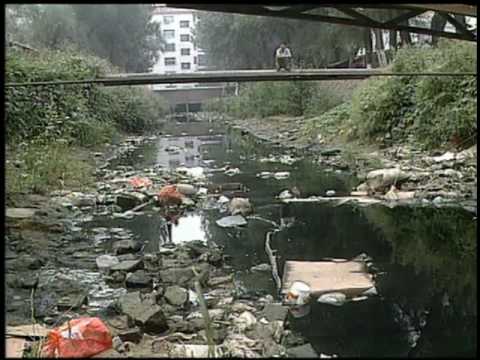
[5:39]Within the city of Bangalore, nearly 700,000 are slum dwellers. Within this urban squalor, there is a critical lack of clean water and sanitation. Consequently, there is a high mortality rate among children. We have a community over here which is deprived of basic amenities, both water supply and sanitary facilities. This toilet is probably discharging directly into this open drain. And we have a number of toilets along this route, which directly discharge into drains like this. And ground water has reached such a depth that even when you dig 850 ft, you're still not sure of getting water. And fecal matter may get into the ground water, and there is every likelihood that people may be drinking this contaminated water. China has 22% of the world's population, and only 7% of the world's fresh water. The water crisis in China is very serious, and it has already become a key constraint for economic and social development and sustainable development in China. 400 major cities face water shortages, and 70% of its cities have no sewage treatment plants. Around 700 million Chinese, half of the country's population, consume drinking water contaminated with animal and human waste. China's effort to become an economic and industrial power has been at the expense of the environment. 86% of China's rivers have exceeded local pollution standards. In recent years, the Yellow River itself is short of water, and the flow is seriously drying up. With the development of the population, economy and agriculture in the upstream, the water consumption increases greatly. Water use in the upstream is also careless. What's worse, the ecosystem along the Yellow River has been destroyed.
[8:02]The Middle East is a microcosm of the Earth's water crisis, and its centerpiece is the Jordan River basin region. This is our main problem today, how to get out of this crisis, out to stabilize the water sector. Because we are in a very shaky situation. The primary sources of water within the area are the mountain and coastal aquifers, and the most consequential river in the world, the Jordan. The region continuously suffers from drought conditions. There has been a significant increase in demand for water, caused by population growth, which has led to overutilization of water sources. And it is feared that shortly, it may be difficult to adequately supply municipal and household water requirements. Compounding the water supply issue is localized water pollution. Today, raw, untreated sewage from uncontrolled development is flowing into the Jordan. And the poor infrastructure and planning in the region causes sewage to pollute every source of water that's available to the area's 9 million population.
[9:20]The United States is not exempt from the global water crisis. In contrast to the developing world, however, it's not caused by a lack of access, but by overconsumption and misuse of this sacred resource. The American public in particular, but I think this is true of many developed nations, takes for granted the water that they get. The vast majority of Americans turns on their tap, beautiful crystal clear water comes out, and they drink it without a second thought. And that's a luxury that not everybody in this world has unfortunately. As everyone knows, US is a major guzzler of water. Uh, compared to any other country in the world, the per capita usage of water is the highest in the US. Today, the average American uses more than 15 times that used by most people in developing countries. Unless a dramatic change in behavior occurs, filling swimming pools, car washing, and watering lawns may soon be a luxury of the past. Um, Americans, this country as a whole, we use water more than any other country on the globe. Um, we're large consumers of energy, we're large consumers of water, and it's time to become more conscious and more frugal in how we use our water. You got to knock it off. Population growth has significantly outstripped the capability to store water. Water supplies are also being contaminated by both man-made and natural hazardous substances, including industrial waste, pesticides, urban runoff, and microscopic organisms.
[11:14]Water resources in the United States will become scarce. I think the the real message is we can't keep doing things the way we've always done it. We can't get water to everybody that needs it. We can't keep growing crops inefficiently. We can't keep building industry everywhere we want it, and we can't keep growing our lifestyles in a way that uses water in greater and greater volumes. That's the critical message. We used to think that our natural resources had no limit. No, we were wrong. Resources do have a limit, and we have to change our approach. Nations fight over oil, but as valuable as it is, there are substitutes for oil. However, there are no substitutes for water. We die quickly without it, and no national leader would hesitate to battle for an adequate water supply. But there are around 250 rivers in the world that, um, run through two or more countries. And interstate regional conflict potential is significant. The Middle East constant confrontation has had a devastating effect within this area. There is no place in the world where the solutions to providing pure, clean drinking water to all citizens are more complex and challenging. Historically speaking, land is war and water is peace. With water you can make policies, because you can transfer it, which you cannot do with land. There is enough water in the Middle East, but there is not enough peace to make a good use of the water. In today's new world, which includes the proliferation of weapons of mass destruction, rogue states, and terrorists, the evolving water crisis compounds and magnifies the challenges confronting the 21st century. The seeds of terrorism evolve from the global humanitarian crisis. There are conditions that produce terrorists and extremists. Those conditions are hunger, disease, poor education, and poverty. When these conditions exist, anyone who promises them a better life can easily recruit terrorists, because people are ready to do crimes to improve their lives. And you cannot overcome terror just by military means. You have to fight not only terror, but also the reasons for terror, the motives for it. You have to promise the people a better life. This will lead to the same point, it is a political point and the violence should stop and peace should come. Otherwise, every activity will collapse, water and sewage and economy and health and the water problem if we succeed in solving refugees will follow, borders will follow, security will follow. Transcending the current regional conflicts, it is widely believed by a diversity of entities that water can be a bridge to peace in the Middle East and other parts of the world. Most of the water crisis issues can be solved by a coordinated, global, environmentally sensitive, humanitarian effort. Any country, any city, as long as they are committed to make every drop count, every dollar count and every idea count, I believe that this water challenge all over the world can be overcome. The implementation process can be established by using affordable and practical solutions. Many organizations may have a role to play in scaling up the solutions. The public, non-governmental organizations or NGOs and other stakeholders, including the private sector, are all looking for innovative ways to work together effectively.
[15:49]And of course, the public sector would need a lot of support from the private sector, from NGOs, from communities themselves. And unless and until the communities are a part of their own development, I don't think we could achieve anything. No problem is insurmountable. In fact, every problem, there is a solution. And I believe that all over the world, every city, every country, as long as they're able to work together, we can truly overcome this water divide as a global community. So that all this projection, all this prediction about a growing number of people all over the world, facing water shortage in the future, hopefully, you will not come true. As citizens of the global community, we are the caretakers for maintaining the integrity of the Earth's ecological system. Our individual mission should be to pass along to future generations a healthy and sound environment. We must try all of us everywhere in the world, we need to save the children. They are the future. People are living in such inhuman conditions, and we must do whatever is needed in the least possible time. As quickly as possible. The bell calls for us, for each of us.
[17:21]The global humanitarian water crisis is not only a security and economic issue, it's a moral issue. We need a global revolution in our approach to education to empower ourselves and our children to think, to question, to act. Be a teacher and a student and inspire everyone around you through your example. It is within our power to transform ourselves. A few compassionate concerned citizens can make an immense difference for all of humanity. Take specific actions that will impact the institutions in your life. Speak out regarding the crisis whenever any forum presents itself. Write letters and emails, phone in questions and concerns, and support enlightened candidates for public office. There are amazing opportunities available to each of us for creating a healthy planet right now. It's possible to have enough clean drinking water for everyone throughout the world. Each of us have our own interests, abilities and skills. Ask yourself, what speaks to my heart? One thing we can and must do is to educate ourselves and those around us and inspire others. Enthusiasm is highly contagious. A small handful of people can change a nation and through it the world.