[0:00]Bismillah walhamdulillah, wasalatu wassalamu ala rasulillah, wa ala alihi wasahbihi ajmain amma ba'd. Today is maybe the last or almost the last session I'm doing on Surah Ali Imran, and it's time to kind of look at the entire Surah structurally.
[0:14]Uh, this is something I've been working on for some time, and this is to the best of my understanding how I can appreciate the organization of the Surah, so I'll share some of those findings with you.
[0:24]Uh, inshallah taala this is a benefit for me personally, this is very beneficial because there's a principle in the study of the Quran and Quran yufassiru ba'duhu ba'da, the Quran explains itself, parts of Quran explain other parts of the Quran.
[0:37]studying a Surah or trying to analyze the structure and how subjects are organized inside a Surah helps us understand what parts complement or are studied in in unison with other parts.
[0:49]So there's a kind of organization in the Quran where things are flowing from one subject to the other, and there's kind of a three-dimensional sort of view, which I which is what I'm going to try to show you today inshallah in the study of Surah Ali Imran.
[1:00]Uh, for the most part this work, uh or this breakdown is my own, um, and there are others that have done other kinds of breakdowns of the Surah.
[1:08]But, um, I found myself only agreeing partially with uh whatever was written so far, so inshallah here goes here goes nothing.
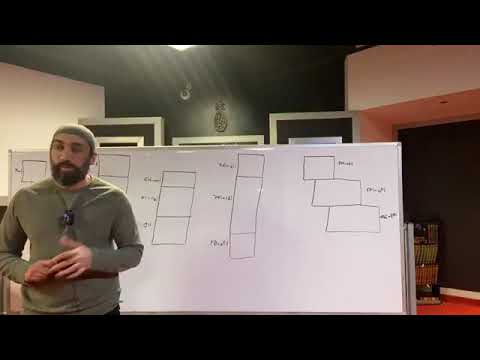
[1:16]Uh, the first thing I'm going to do is help you understand these amazing beautiful pictures that I've drawn because I'm an artist.
[1:23]And that is starting here, these three blocks represent the first three passages of the Surah. They're very small. So I know the text may be small for those of you watching the live video.
[1:33]This is Ayah 1 to 9, this is 10 to 14, and this is 15 to 20, right? So those are the first three passages of the Surah.
[1:41]This over here are the last three passages of the Surah, so that's 190 to 195, 196 and 197, just two Ayat, and then 198 to 200.
[1:57]So altogether 200 Ayat, this is the opening, 1 to 20, and this is the closing, 190 to 200. So 20 Ayat in the beginning and 11 Ayat at the end, okay?
[2:04]So let's now talk about these. In the beginning Allah talks about a few things here. Uh, he starts by talking about how he's the only one to be worshipped, and that he's been sending revelations all along.
[2:15]So he tells the Prophet Sallallahu alaihi wasallam that he sent the book to you, and he sent previous scriptures also.
[2:25]Right? So he starts by introducing that he's always been the one to send revelations and all revelations go back to him. These are the Ayat of Allah, I'll just call them the revelations of Allah.
[2:37]That's the first theme you learn about in this passage, that all revelations, the source have always been has always been the same, it's always been Allah.
[2:46]Then additionally here Allah says the only people that take advantage of these revelations are the people of sound or pure minds, the people of Ulil Albab. The Arabic word is Albab, so I'll write the word Albab here, Ulil Albab, the people that possess Albab.
[3:03]sound minds, pure minds. And I've given long lectures about what Albab means. But here it's important, the only people who take advantage of Allah's revelations and take reminder from them are the people of sound minds.
[3:17]And then they have a prayer. The people of Albab, one of their most most significant qualities is they pray to Allah, they make dua to Allah.
[3:27]Our Master, you know, don't allow our hearts to deviate after you've guided us and grant us loving care from your behalf, give us the gift of loving care especially from your behalf.
[3:42]You're the one who will gather people on the day in which there's no doubt. There's an important subtle thing here, I'll mention it here, at the end they say, certainly Allah doesn't break his promise.
[3:58]So I'll just write the word promise as an indicator. That's all in the first passage. I'm going to now go to the end.
[4:06]So there are three passages in the opening, three in the conclusion, right? So I'm going to go to the first of them in Ayah number 190. Allah says, in the creation of the skies and the Earth and the conflict of night and day, there are miraculous signs for people of sound minds.
[4:31]Albab. The term comes in the beginning, opening passage, and now it's finding itself in the third last passage of the Surah again.
[4:39]Except, this time instead of contemplating and benefiting from the revelations of Allah, they are finding the Ayat of Allah inside Allah's creations, they ponder Allah's creations, and through them take see looking for Allah's signs in them makes them people of sound minds.
[4:57]This is important because the revelations of Allah are made of Ayat. And the creation also has Ayat in them.
[5:04]Right? So now Allah what has he done? These people contemplate the Ayat of revelation, and these people also contemplate the Ayat inside of creation.
[5:13]These are two ways by which you find people of sound minds. This is also important because some people know about scripture, they know about revelation, and they spend their time contemplating revelation.
[5:22]But there are also people that have never heard about any scripture, never heard about any revelation, they don't know anything at all, and they also have Ayat.
[5:30]They can contemplate the world Allah has created and they can find Allah by that means too. Now, so we've got two things in common so far, and here, as soon as Allah introduces them, the Ulil Albab, and they, they, they think about the creations of the skies and the Earth, immediately they start praying to Allah.
[5:50]Exactly like we found 180 some Ayat before. Exactly the same way. So our Master, you didn't create this without purpose.
[6:00]Our Master, whoever you entered into the fire, you humiliated. Our Master, we heard the call of a caller calling to faith.
[6:11]Prayer, prayer, prayer, it started here, but what's really cool, what's beautiful is here they prayed, don't let our hearts deviate after you have guided us.
[6:23]Yeah? So they've already had some guidance, and now they're asking Allah, can we hold on to that guidance, our Master, don't let our hearts get off of it.
[6:32]Here, they're thanking Allah that they actually found guidance. We heard the call of a caller calling to faith, so we have come to the faith.
[6:45]So this was what happens after the starting point, after you've already come to faith. And this was the prayer of, Ya Allah, we accept, we came to the faith, now keep us on it.
[6:56]So it's so beautiful that those two are mirrored with each other, and here they say, at the end, You don't break your promise.
[7:09]They said, Allah doesn't break the promise. Here they say, you don't break the promise. And that's the first passage and what you can say the third last subject in Al-Imran.
[7:20]I, I broke it down into three, so you can see three paralleled with three, okay? Here then Allah says, and this is easier to explain now, I don't have to for the rest of the passages, I will spend lesser time going inside them because I've done other lectures going inside each passage.
[7:37]So I'll just give you key items from each of these boxes, okay? And obviously, a box is not going to help you fill in everything that's inside a passage.
[7:45]We're now taking a bird's eye view, so we're only handpicking a few things that stick out that help us connect the dots, right? So the second here is, I'll say the disbelievers will fail.
[8:05]So for the disbelievers I'll use the letter K just for Kafirun. That's it. Those who disbelieve, their money and children won't benefit them in any way at all.
[8:21]They're fuel of the fire, just like the people of the Pharaoh, and those who came before the Pharaoh, they all lied against our signs.
[8:35]Allah grabbed them because of their sins. Tell them, you are going to be overcome, and then you will be grabbed towards hell, what a horrible place to end up in.
[8:50]And then again, and, by the way, you dealt them a blow already in Uhud. Here at the end in 196, 197, he says, don't let yourself be deluded about what they have in this life, they just have a little bit.
[9:12]So the K again will fail. Once again. But there's another subtle interesting thing I found here.
[9:20]While talking about the disbeliever in the 14th Ayah, Allah said, this world and everything it has to offer amounts to just. He said, for people, desires for women were beautified, and children were beautified, and rides were beautified, and piles of wealth were beautified, and investments were beautified.
[9:41]This is all worldly life amounts to, it's just some things to enjoy or use temporarily. And here, he says, they just have a little bit, they just have some things to enjoy.
[9:56]So he explained in full detail in passage two, and kind of just said, even whatever they have just amounts to. Allah has the best thing anyway.
[10:07]So that would be our second and second parallel with each other. Then you find something and and notice also how it worked.
[10:14]You talked about the people of Albab immediately switching over to the Kafirun. And there also, Allah talked about the people of Albab even immediately switching over to Kafirun.
[10:22]The switches are exactly the same. And then here, he says, now I'll I'll open it up on my screen here.
[10:31]He says that is better for the people of Taqwa. is better for Taqwa. And then he also says, Islam has always been the same, people changed it.
[11:13]meaning, the religion with Allah has always been Islam, people came and they altered Allah's books. Okay?
[11:19]And so, this is a little bit of what's going on at the end. Here, Allah says,
[26:39]Don't make fake friends. Believers, you're being warned, don't make friends other than yourselves.
[26:54]You're in a state of war right now, so if you make friends with people that belong, have allegiances with the Quraysh, then they're not going to leave any stone unturned and trying to harm you.
[27:04]Don't be naive and open up and doesn't just mean friends, means friends you share secrets with, because they might actually engage in espionage, they're going to be a kind of fake friends.
[27:11]So you are in a state of war, be wary of those who have disbelieved and have declared war against the Muslims, because now we're we're talking about a state of war that's continuing between the Muslims and the Quraysh in particular.
[27:24]Then Allah says, the the the expenses that they're making to furnish their to to fund their war is going to be like a freezing wind that destroys a crop.
[27:32]It's not going to do anything. Don't worry about their their exchange, but what I'm warning you about, they won't be able to defeat you.
[27:40]By the way, that whole disbelievers will fail is echoed here again, it comes over and over in the Surah. So he does say, those who disbelieve, their money and their children won't benefit them.
[27:53]You know, here again, disbelievers will fail. But what's the warning to you? Okay, well if they're going to fail, I can just chill cuz they're going to fail anyway. No, don't become complacent about them.
[28:03]Here you are loving them and they don't love you, and you believe in the entire book. And when they meet you, and they're enemies among you, these fake friends, some of them are Quraysh, some of them are from the people of the book.
[28:15]When they meet you, they say we have faith too, and when you turn your back, they're biting their lips off, and they're biting their fingers off out of frustration at the fact that you even exist.
[28:25]You know, So and then he says, if something good happens to you, they hate it. If something good happens to you, they can't stand it.
[28:40]And if something bad happens to you, you know, they get happy about it. So, you better have Sabr and Taqwa.
[28:57]Their scheme will fail. Those that wouldn't believe in a Prophet until a miracle will come and give and they were just making up excuses to not follow Prophets.
[29:19]The hypocrites are compared with them. So actually the Muslims are being told about people that are two-faced on both ends.
[29:26]And then in the middle, this large section, 121 to 175, I rethought my my organizational structure of it. This is basically one word.
[30:42]Everything that happened in Uhud. And I'll write on the side here history again.
[30:52]This is a number of sections that culminate in everything that happened in Uhud. Usually an event in the Quran is talked about in 10 Ayat, 12 Ayat, 5 Ayat, 6 Ayat.
[31:01]This event in the Quran is talked about in over 60 Ayat or nearly 60 Ayat. Actually indirectly, these Ayat are about them too.
[31:09]Indirectly, but in more literal terms, this section definitely is about Uhud entirely, definitely, definitely. Right?
[31:16]And in this section, what Allah Azza wa jalla has done is a few things. But I want you to understand what this middle has to do with this middle, because they're, they're on the opposite sides of each other, right?
[31:28]Here you've got Isa alaihi salam there scheming to kill him. Here they've got Rasulullah Sallallahu alaihi wasallam, they're scheming to kill him.
[31:35]Here he's got two problems to deal with, the hypocrites within his own people, who don't believe, and then an outside larger force, which is the Roman Empire. Here he's got the hypocrites within his own people and he's got the larger force which is the Quraysh that are coming after him.
[31:50]Here there's a mystery surrounding his death. Here on the battlefield the Prophet Sallallahu alaihi wasallam is killed and the rumor spreads that he's been killed.
[32:00]Here his death was turned into a means of salvation. Here Allah says and if he died or if he was killed, would you turn back from your religion?
[32:09]direct contrast between the two sides. Immediate contrast between the two sides. Here you've got Isa alaihi salam being described as being raised.
[32:18]And here literally he's going up the mountain towards the end. So you've got and and here in it looks like the mission of Isa alaihi salam has failed because they're attempting to kill him.
[32:28]His followers have been dispersed, etc, etc. But Allah has a different plan. You, you honor whoever you want, you humiliate whoever you want.
[32:40]You possess all good. And the Muslims are being taught, the losses in Uhud are not a humiliation. They're actually good for you, they strengthen your faith.
[32:48]That lesson's been and then here we're taught, you made a mistake. You messed up, but you can recover from it.
[32:55]You can redeem from it, and that's actually the center of this passage. And on this side, with Isa alaihi salam, the other interesting thing here is his one of his opponents, the people that schemed against him were the Israelites.
[33:07]And here also you find the Israelite scheming against the Prophet Sallallahu alaihi wasallam behind the scenes with the Quraysh, okay?
[33:16]So you've got this side and this and what what to me what I see this as is, it's as if the mission of Isa alaihi salam is continuing here.
[33:23]It's like Allah is continuing the story. And Allah said he chose Adam, Ibrahim, Ibrahim's family, Imran's family.
[33:29]And from Ibrahim's family, you get you get Rasulullah Sallallahu alaihi wasallam and the story continues.
[33:34]And many of the parallels, here he said who will help me towards Allah? And here Allah himself says, Allah helped you, Allah's Nasr came.
[33:45]Right? And here he said, it's flipped, when Isa felt the intensity of disbelief from them. Here if, you were making them feel the intensity of battle.
[34:00]The verbs are flipped, right? Like Allah has given this special kind of victory even to the Prophet Sallallahu alaihi wasallam in the early episodes of the battle of Uhud.
[34:09]So that's the two ends paralleled with each other. You'll notice the larger I haven't come to the middle yet, but you'll notice the larger theme.
[34:16]The larger theme is the religion's always been the same. That this Islam is not a new religion. That it's actually a continuation of what Allah has been sending from before.
[34:25]That's how the Surah started, that's how the stories are continuing. The people of the book are being told, why aren't you getting it? This is the religion of Ibrahim alaihi salam.
[34:34]Why are you hiding what you know? Then at the end Allah says, people have read Allah's signs have always found Allah, no matter what era they were in, and they heard the call of all the Prophets.
[34:44]Allah's promise has always been the same. The promise of salvation wasn't a new kind of promise with a different prophet. It's always been the same promise.
[34:50]And it was in the beginning and it was at the end. Now we come to my favorite part, the middle.
[34:57]The middle is kind of like and this is I didn't expect this, but uh this is similar to what happens in Baqarah. My my structural analysis of Baqarah led me to believe that there are nine parts to Al-Baqarah.
[35:11]And the middle part of Al-Baqarah, the center of Al-Baqarah, is where Allah declares us an Ummah, and he gives us a new capital, and our capital is the Kaaba.
[35:23]Yeah, so the Kaaba is at the middle in the middle when we switch from Jerusalem to Mecca. That's in the center of Surah Al-Baqarah, and thus we have been made an Ummah.
[35:33]And it's just like we revolve around the Kaaba, and we do Tawaf, the entire Surah in a sense revolves around the Kaaba.
[35:40]And what's remarkable about Al-Baqarah? I'm digressing for a moment so you can appreciate this. What's remarkable about Al-Baqarah is the first half of Al-Baqarah is about the Israelites, more or less.
[35:53]And the second half of Al-Baqarah is about the Ummah. And here you've got the first part with a huge chunk about the people of the book, and you've got the other part, a huge chunk about this Ummah.
[36:06]And the middle of it was you have been declared an Ummah. Now we'll see what happens in these Ayat.
[36:13]In 100 to 103, have Taqwa. Don't die unless you're Muslims. Hold on to Allah's book, Allah's rope, and don't fall into disagreement with each other.
[36:40]Mention Allah's favor, you used to be enemies, Allah put love between your hearts. And so this sort of gives us a map of everything that's happening in Baqarah so you can see how the end opens up and connects to the beginning, and the middle lies ourselves.
[37:16]With that I conclude our structural view of Surah Ali Imran. Assalamu alaikum warahmatullahi wabarakatuh. Bye in and out.
![Thumbnail for APUSH Unit 4 REVIEW [Period 4: 1800-1848]—EVERYTHING You NEED to Know by Heimler's History](/_next/image?url=https%3A%2F%2Fimg.youtube.com%2Fvi%2FkO5cfLxN44Y%2Fhqdefault.jpg&w=3840&q=75)