[0:08]We're going to do a demonstration uh of the periodic activity of metals. What we're going to do is compare the four different metals and then we're going to look at their reactions with water. Then we're going to look at their position in the periodic table and then we'll see it will try to uh basically uh discern or explain, predict um the trend in their reactivity based on their position in the periodic table. So, the first thing we're going to do is we're going to look at four different metals. We have lithium, sodium, two of the alkali metals, and magnesium and calcium, which are alkaline earth metals. And we'll look at their position in the periodic table later. So, what I'm going to do first of all is just open up uh each metal and and put a piece in the Petri dish here so that we can just take a look at it. And these pieces that I have of the lithium and the sodium are precut. We um, we call them our demonstration size pieces. There's the lithium metal. Sodium, potassium as well, are packed in mineral oil. We do recommend the precut pieces just because it's much safer to work with. They come in a metal safe store can. There is oil dry which is an absorbent in the can as well and the bottle is actually in plastic. So that was the lithium metal. Let's take a look at the sodium metal, get a piece and these pieces are quite small. But that makes them easier to work with. So you don't have to go through that. And there's the piece of sodium metal. Calcium is turnings and I'm going to try to get a piece that's more or less the same as some of those others so that the size oops, sorry, that's the calcium. And that's what we call a turning. And then finally I'm going to have some magnesium metal and magnesium comes in several different forms. You can buy magnesium turnings, you can also buy magnesium strip, um and let's see. I'm going to pre cut a piece that's about three centimeters, um obviously the exact size is not important. But doesn't hurt to be a little consistent sometimes when you're doing something and you can just cut that with a pair of scissors. So I have a strip of magnesium ribbon and I'll go ahead and place that. And the first thing we want to do is just look at the properties of the metals. They're all kind of shiny, so we can certainly see that they look metallic. The lithium is a dark grayish black. It's got a little bit of a a bluish kind of tinge there, just a little bit kind of a blue black, but it it's a dark silver gray uh with a little bit of a kind of a sheen to it. The sodium is really a bright silver looking uh chunk there and the calcium is a dark silver gray and the magnesium is a shiny metal strip there. Um, most of you probably know that sodium and lithium can be cut with a knife and that's how you would work with sodium or lithium in the lab. So I'm just going to show with this knife here that you can kind of cut that. Lithium is a little harder to cut than the others, but you can still cut that with a knife. And I don't want to cut it all the way because I want to react that whole piece, but you can see that I made a sharp cut in the lithium and the sodium is actually easier to cut than that. I'm going to put it here on its side. And again, I don't want to cut all the way through, but you can see that that cuts really easily with a knife. So, that's how you would work with lithium or sodium uh in your lab. Well, we want to do is demonstrate their reactions with water. And I'm going to do them one at a time. I'm actually going to start with the sodium, so let's move these off to the side here. And let's look at our first uh beaker there and I've simply got uh about 150 or two between 150 and 200 milliliters of uh water in each one. I'm going to go ahead and add my chunk of sodium first. And we're going to watch what happens when you add sodium to water. Immediate reaction, notice it it floats on the surface. We get smoke, it ignites, we'll just watch that reaction. It's kind of bobbing around. It's almost molten in there when that first reacts. And that's a clue to something. We get some pops and sparkles. A little bit of sparks there. Okay, that was a relatively safe demonstration of the properties of sodium. Now, many of you have probably seen that on a larger scale. I don't know about you, but in my classroom that's probably about as large a scale as I want to do. Right? It was never out of control, but we clearly had some sparks there, some fire. There it's all gone. There's none left, although there might be a little bit actually molten on the side there. Actually there is, so you know what, I'm going to swirl that a little. Actually, what I'm going to do uh no. Is I'm just going to swirl that because there's a tiny pieces. One of the problems with the sodium, if you do it on a very large scale, is you almost get molten sodium that flies out. So, you don't want to increase that scale of that reaction. That sodium was pretty reactive, right? Let's just add the phenolphthalein uh indicator to this because I want to prove uh what one of the products of the reaction where you add the sodium hydroxide and of course it turns pink immediately. What's that? That's the base that's produced, so we know that we're getting sodium hydroxide. What else did we see? We had immediate bubbling. What are the bubbles? The bubbles are hydrogen gas. So we have sodium metal, hydrogen gas is produced and sodium hydroxide. Now, the question is what is burning? You always hear them say that sodium burns in water. It's not really the sodium that's burning, it's really the hydrogen gas. You uh form almost an explosive mixture and that's why you don't want to scale this up. That's the largest scale you really want to do it with is on that demonstration size piece of sodium metal. That was sodium. What we said we wanted to do was compare the reactivity, so kind of keep that picture in your mind of how fast the sodium reacted. Because next we're going to add lithium and again, I've got a beaker there. I'll take the long tongs and we're going to add the lithium metal to the water. A pretty fast reaction there, it's certainly bubbling. You can see almost that white coating right around it. It's bobbing quite a bit. Notice it's also floating on the surface just like the sodium did. We're going to watch that bob around and completely react.
[8:47]Notice that at least right now we haven't uh gotten any ignition of that uh hydrogen gas that's produced. Let's just watch that as it bobs and reacts. It's a pretty quick reaction. I don't think it's quite as fast as the sodium, but certainly a very vigorous reaction there. Let's just continue to watch that for a few minutes. Lithium and sodium are both less dense than water. So, when we place them on the water surface, they're both floating. We, the bubbles are again hydrogen gas. It's just about completely reacted.
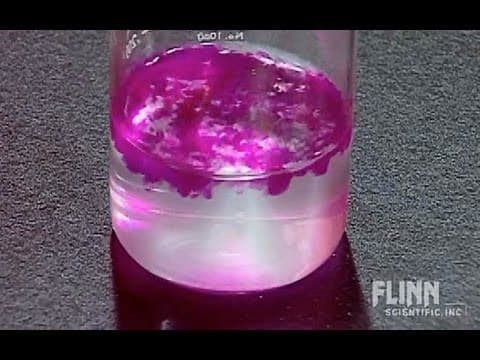
[9:37]Although not totally yet. And again, this was a small piece. So you want to keep that in mind whenever you're working with the alkali metals especially. is scale is very important. Another thing that we may as well talk about is we're focusing on that reaction of the lithium is to remember all of the safety precautions. Whenever, whenever you're working with any of the alkali metals, you want to be sure that not only you have protected your eyes, but that everyone in the audience has as well. That all of the students, any other teachers are all wearing their goggles. It's just about done, almost, not quite. Let's go ahead and we'll just add the phenolphthalein to it just to basically, you know, confirm that we have the same general reaction occurring. And so you have lithium hydroxide in this case. We saw the bubbles, the hydrogen gas. A very fast reaction, not quite as fast as the sodium. I'm basing that pretty much on the fact that with the sodium, you did see the sparks, which is the ignition of the hydrogen, suggesting that you're getting a higher build up or concentration of the hydrogen gas. So both very reactive metals, but definitely we know that the lithium is a little bit less reactive than the um, than the sodium. Okay, I have the calcium metal now and again, this is not soft, this is a hard metal. Okay, I'm not going to be able to cut this with a knife or scissors and I have that piece of calcium metal. And again, what are we looking at here? We want to compare the rate at which they react. We're looking at the reactivity trend or pattern and we see an immediate reaction. Notice that it sunk first to the bottom. Okay, so calcium is not less dense than water, but rather more dense, but as soon as it started to react, then it actually rose to the surface. Okay, because I think you're actually melting some of the calcium from the heat that's heat that's produced and you actually see that with all of those metals. So lithium and sodium, the heat of that reaction is enough to melt the metals. Quite a bit. Notice that in this case it's cloudy. That's because in analogy with producing sodium hydroxide and lithium hydroxide, now we're producing calcium hydroxide. Calcium hydroxide is not soluble in water, so we have that cloudy solution that's produced. Clearly, we were getting a lot of bubbles there immediately. It was pretty vigorous. Hard to compare there between the lithium and the calcium. You know, we we'd have to do a little bit more if we wanted a quantitative comparison. I would say they were pretty similar. I think probably the lithium just a little bit more similar. I think we had a little bit uh a little bit of smoke there from the hydrogen. In this case it was more of a controlled reaction. We didn't have exactly equal size pieces or equal mass. And so, you know, if you're it's a little bit apples and oranges, but I think we can still pick out a general trend. And so that's the calcium. We let's go ahead and prove that it's calcium hydroxide. Um and that and of course it's pink so we know that it's basic, we were producing hydroxide ions. And we have one more that we're going to do and that's the magnesium. And so we're going to take our, remember the magnesium came as a shiny metal ribbon. This is really, really shiny magnesium. You know, if you're working with magnesium in the lab and you see that it's kind of dark, black or whatever, you're not going to get very good results especially if you're doing like a quantitative molar volume of hydrogen or empirical formula of magnesium oxide. So you want to take a look at the quality of your magnesium ribbon, it should be shiny. We're going to go ahead and add that to water. Now, I have a long strip there as opposed to kind of a chunk or whatever. But I think you can tell immediately that uh there's really nothing going on. It floats at first just because of that large surface area, but it is more dense than water. It's there on the bottom of the beaker. I'm not even sure you can pick up that picture. It's just a a piece of magnesium ribbon there on the on the bottom of the beaker. And I think we can probably confidently say here that this is the least reactive of the four metals that we looked at, right? And in fact, magnesium will not react with water at room temperature. If you add hot water, the the it it temperature does increase, higher temperature does increase the rate of the reaction. So magnesium will react with hot water but not with room temperature or cold water. So, we've seen the reactions, so now we have to explain what we've seen. So, the first thing that we're going to do because I said that we wanted to talk about the periodic activity of metals. So, what did I mean by that? Well, let's first of all look at the position of these metals on the periodic table and I'm going to use my forceps here as a pointer.
[16:26]Um we had lithium and sodium, magnesium and calcium. I want you to pay attention to their position both within a column, that is, within a family, the alkali metals, lithium and sodium, magnesium and calcium. What I want to do now is write those on the board and I want to kind of draw arrows for how fast they reacted. So, let's reproduce them on the board here in basically their corresponding positions to how they're located above and below and to the right and to the left on the periodic table. So, first of all, let's compare lithium and sodium. Which one was most reactive or more reactive? The sodium was the most reactive of the four and it was more reactive than the lithium. Okay? And was that same trend true here with magnesium and calcium? The calcium reacted. It was pretty vigorous reaction. The magnesium did not react at all. So obviously the same trend there. So the arrow basically shows the activity increasing. Okay? So you have a more reactive metal as you proceed down a column in the periodic table. Now, how about comparing across a row, that is, across a period? Now, obviously we didn't compare. We didn't do beryllium, which is right above next to lithium in the periodic table. Where can we do a basically a right to left comparison? We can do it here between sodium and magnesium. No comparison though, right? The magnesium unreactive, the sodium extremely reactive. I'm going to draw my arrow up here, okay? So, we know that in terms of the activity this way, that the activity increases from right to left in the periodic table. So, I'm going to write activity increases. Now, this is for metals because I'm comparing all metals, okay? So, you can't use When you talk about trends in the periodic table, what we've just done is we've physically illustrated a trend in the periodic table. When you talk about the importance of the periodic table in chemistry, fascinating story in terms of the history, in terms of predicting undiscovered elements, all sorts of things, in terms of their order and correlating with electron structure. But the full value of the periodic table to a chemist has to do with periodic trends in activity. This trend and the activity that the activity of a metal increases as you go down, has really mirrors a trend or a reverse trend in ionization energy. Okay? The lower the ionization energy of a metal, the easier it is to pull off an electron. Therefore, the more easily or the faster it reacts. So, what we're really seeing is that we have a reverse trend in ionization energy. And all of you probably teach that trend in ionization energy. The graph is in every textbook and so on where the ionization energy increases as you go up a column in the periodic table and also increases as you go from left to right. So this reactivity trend in metals is the reverse of the ionization energy, but it makes perfect sense. The lower the ionization energy, the easier it is to oxidize the metal to pull off electrons, the faster they react with water. So, the periodic activity of metals, a terrific lesson in terms of really the value of the periodic table, exciting chemistry to watch, students love to see it. Pay attention to the safety at all times. And you can make your lessons both exciting and memorable and uh effective, which is what we all want in the chemistry classroom.