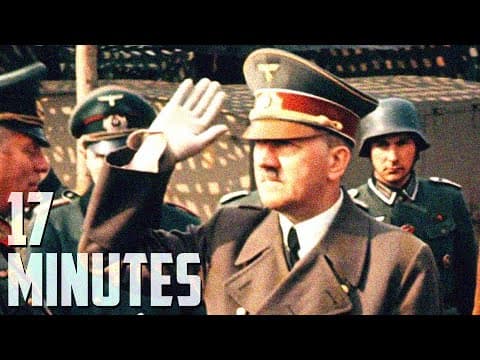
[0:05]It's 1918 and after four years of what was known as the Great War, later renamed to World War I, the German Empire surrendered to the Allied forces of Great Britain, France, Russia, Italy, Romania, Canada, Japan, and the United States. The King of Germany, Kaiser Wilhelm II, was forced to abdicate his throne and flee to Holland as many Germans felt they hadn't been defeated, but betrayed by their leaders. Among them was a German soldier called Adolf Hitler, who had been a frontline soldier for the vast majority of the war after being rejected from art school. Germany's defeat in World War I ultimately led to the collapse of the German monarchy, and Friedrich Ebert became Chancellor of Germany's new government. What became known as the Weimar Republic or Weimar Germany was born. At the time, a man called Woodrow Wilson was president of the United States, and he proposed a treaty in order to reduce the chances of a further war. On the 28th of June 1919, Woodrow Wilson of the United States, David Lloyd George of Britain, and George Clemenso of France, sat down together at a table at the Palace of Versailles. The three men came to an agreement and what became known as the Treaty of Versailles was created. Before we cover the treaty's terms, we first need to understand a bit about what the three men who created it actually wanted from it. Woodrow Wilson of the United States did not want to punish Germany too hard.
[1:29]He felt intense punishment towards an already defeated Germany would provoke another war, which he did not want US involvement in. David Lloyd George of Britain disagreed and felt Germany needed to be punished to an extent, but he wanted Germany's economy to thrive so that Britain and Germany could trade. George Clementso of France wanted Germany to be punished severely so that it couldn't attack France again. France had lost about double the soldiers of Britain and more than ten times as many as the United States, who joined the war in 1917. Many of the trench warfare battles had taken place on her soil and large amounts of northeastern France and the main agricultural and industrial industries had been devastated, inflicting great suffering on the people of France, which Clement so wanted justice for. The agreement these three men made was as follows. Germany's army was to be restricted to just 100,000 men, their navy limited to six battleships, and they were forbidden from having submarines, tanks, or an air force. The Rhineland, a German area which bordered France, was also demilitarized to create more security in France. Germany was forced to give up 13% of its territory and prohibited from uniting with Austria, a close ally of Germany. Furthermore, Austria-Hungary was home to 12 million native Germans and it had been split into 13 sovereign countries after World War I. This wasn't part of the treaty, but it left many German minority groups feeling isolated and unsupported, especially with the restriction to reunite in place. The treaty then ordered Germany to claim 100% accountability for starting World War I and left them with a reparations bill of 6.6 billion pounds, which their war-torn country had no hope of paying. Germans felt insulted by the Treaty of Versailles and despite Woodrow Wilson proposing it to prevent a future war, the final treaty would lay down the foundation for World War II, as later on, when Hitler entered politics, he would constantly bring up the treaty to remind Germans that they weren't welcomed.
[3:27]As time went on, resentment in Germany built. While democratic, Weimar Germany's government was unstable and Friedrich Ebert was replaced by Philip Scheidemann after just 96 days in office. Scheidemann then spent just 127 days in office before Gustav Bauer became Chancellor. This cycle continued, and between 1918 and 1933, Weimar Germany had 16 different Chancellors, not a sign of political stability. In 1920, it was common that right-wing revolutionists and communists would fight in large groups in the street in a series of failed attempts to start a revolution. Then in 1922, Germany missed a reparations payment. France argued that Germany could afford to pay it, while Germany argued they had already paid every available fund in their first payment. As instability increased within Weimar Germany, many workers felt underpaid and neglected by their own government and work strikes became routine, reducing the production of industrial goods and weakening the German economy further. The Weimar government was stuck between a rock and a hard place. They didn't have the money to pay people what they wanted, nor did they have the respect of the German people to order them about, but they knew that without people working, economic collapse was inevitable. To combat this, they began printing more money to meet the workers' demands. As more money was printed, the true value of each individual unit of currency decreased and prices began to rise massively. Honest, hard-working German people quickly lost all of their savings as inflation commonly reached hundreds of percent per month.
[4:59]In fact, it got so bad that people would walk down the street with a wheelbarrow full of money, and when they weren't looking, someone would tip the huge pile of money out from the wheelbarrow and steal the wheelbarrow. This is how worthless the money became. With a huge economic depression sweeping Weimar Germany, desperate Germans began turning to extreme politicians for answers, as Weimar Germany seemed to offer no security. Among the many extreme politicians operating in Germany at the time, Adolf Hitler, who had discovered a natural public speaking gift in 1919, had a following of 55,000 party members by 1923. Initially, he had joined the DAP or German Workers Party in 1919 as its 55th member. But had since become the leader of this small party and changed its name to the National Socialist German Workers Party, or Nazi, for short. Performing speeches on street corners and in beer halls, Hitler and his right-wing ideology had grown to a respectable level by 1923, but his party was still nothing in size compared to the other right-wing parties in Germany at the time. In late 1922, an Italian politician by the name of Benito Mussolini had marched on Rome with more than 30,000 men and successfully seized power of Italy. Hitler was inspired by this, but he had nowhere near enough manpower to successfully overthrow Berlin. Instead, he targeted Munich, the capital city of the German state of Bavaria, and what became known as the Munich Putch or the Beer Hall Putch, on the 8th of November 1923 took place. Hitler's plan was to interrupt a meeting held between Bavarian State Commissioner General and head of the Bavarian Army. Hitler wanted to use Weimar Germany's hyperinflation crisis to the Nazi party's advantage, and he wanted to take power of the German state of Bavaria by force and then pressure Berlin to give him power of Germany. But he knew this was a bold move. Hitler was heavily relying on other Bavarian right-wing politicians supporting him, and when they didn't, his 2,000 men were incapable of taking the Bavarian state by force. Hitler fled the scene and was arrested two days later. When he appeared in court on the 24th of February 1924, he was charged with treason, which was punishable by execution. But the judge was sympathetic towards him and his cause and gave him a five-year prison sentence instead, of which he only served nine months. During his time in prison, Hitler wrote a book. It was titled Mein Kampf, which in German means, "My Struggle." The book laid out his political views and ideas for what a prosperous Germany would look like, as well as heavy criticism of Jews and communists, who he blamed for the weak state of Weimar Germany, and placed extra emphasis on Jewish people, who he claimed had stabbed Germany in the back by making financial gains from World War I. Hitler didn't create antisemitism, but he used it to give his followers a common enemy. When he was released from prison on the 20th of December 1924, he had been banned from public speaking until 1927. In the meantime, Germany had begun to recover. From here until 1929, these were known as the Golden Years of Weimar Republic. Previously, in 1923, Gustav Stresemann had founded a coalition government in Weimar Germany, which just means a government of multiple parties where the vote a party wins is proportional to the number of seats it receives in parliament. He had previously been Chancellor and was forced to resign from lack of support within the government and became Weimar Germany's Minister of Foreign Affairs instead. He had used this role to secure American loans and help rebuild the Weimar Republic's economy. Gustav also changed Germany's currency to the Rettenmark to combat the hyperinflation crisis. This series of decisions had great results for Germany. Factories began opening again and as the economy made a remarkable recovery in a short space of time, people's confidence in Weimar Germany went up, and despite there still being a lot of political instability within the government itself, most German citizens were a lot happier with the way things were. During this period of time, parties with extreme political views such as the Nazis and the communists did exceptionally bad in the elections. In 1928, the Nazi Party won less than 3% of the Reichstag seats, Germany's Parliament building. But there were still some issues. The Treaty of Versailles was still in place and still very harsh on Germany, and the land Germany had lost after World War I had been made permanent thanks to the Locarno Pact. Also, many German military and law makers were still unconvinced about Weimar Germany, the country's first ever democracy. But the Golden Age of the Weimar Republic would unfortunately not be permanent. Perhaps if Germany was able to keep flourishing as it had been for the past five years, World War II could have been avoided. In October of 1929, the United States stock market crashed. This event is now known as the Wall Street Crash. It sent the US economy into financial ruin. Gustav Strazman's work was undone overnight as American banks began recalling the loans he had arranged to rebuild Germany's economy. As a result of this, Germany suffered far more than any other country with a total collapse of its economy. Hitler's moment had come. This was the second major failure in Germany's new Weimar government in six years, and Germans were fed up with it. Desperate times called for desperate measures, and the far-right and left parties, such as the Communist and the Nazis, began thriving once again. But compared to the Nazi party, the communists were in a constant state of volatility, with arguments within the party preventing them from fortifying who was in charge and what their goals were. By 1931, the Nazis had an extremely large following. The democratic elections of Weimar Germany were still in place and Hitler was attempting to become German Chancellor by democratic means. In 1932, the Nazis became the largest party in the Reichstag, as the hardships of life had not improved. They won 214 of the 608 available seats, but the presidential elections of Weimar Germany had seen Hitler lose to Paul von Hindenburg with 36% of the vote to Hindenburg's 53%. Then in 1933, political advisors and business leaders managed to convince Hindenburg to appoint Hitler Chancellor of Germany, despite Hindenburg avidly disliking Hitler.
[11:21]The idea was to use Hitler's policies to their advantage and help them achieve their own goals, the main policy of which was to destroy communism, which pretty much everybody looking to make lots of money from business hated. Hindenburg initially thought, if he gave into the pressure, he could control Hitler. He was wrong. Now appointed democratic Chancellor of Weimar Germany, Hitler took steps to solidify his position. At this point in time, many Nazi supporters were forming paramilitary groups, which are essentially illegal armies formed of citizens, and these groups would regularly fight protesters in the streets. Hitler then used the disorder to his advantage, claiming that a communist uprising was inevitable and that he was the only one who could restore law and order in the streets. Then on the 27th of February 1933, the Reichstag, Germany's Parliament building, caught fire. Once again, Hitler used the event to his advantage and blamed the communists, demanding emergency powers from Hindenburg. Many believe the fire was intentionally started by the Nazis, and Walter Gemp, who was head of the Berlin Fire Department at the time, said there had been a delay in notifying the Fire Department of the fire, and he was forbidden from using all of his resources to fight it. Furthermore, he was dismissed from presenting evidence to the press of Nazi involvement, and was ultimately arrested in 1937, and found dead in his prison cell in 1939. His cause of death was strangulation, which could suggest a staged suicide by hanging. A few hours after the fire, Nazi propaganda spread fears of a communist revolution, and Hitler managed to convince Hindenburg to invoke Article 48 of the Weimar Constitution, which, if granted, would give him temporary dictatorial powers. When Hindenburg signed this agreement and declared a national emergency, this gave Hitler the legal right to persecute and oppress any opponent, which he used to arrest more than 4,000 people the day after the fire. The SA, Hitler's main paramilitary group, were then ordered to run a violent campaign against any opponents. When Hitler initially lost to Hindenburg, he had called for another election to try and strengthen his position. The two months leading up to the fire had seen a massive Nazi election campaign, and now that he had temporary dictatorial powers, as well as a national terrorist attack to blame on the communists, Hitler ran another election on the 5th of March 1933. This time the Nazis won just under 44% of the vote. Then on the 23rd of March 1933, Hitler proposed an Enabling Law in the Reichstag, which, if passed, would grant him the ability to pass laws without putting them through the Reichstag first. For the vote to be passed, it needed a two-thirds majority support. Hitler had already banned left-wing parties from attending the vote with his emergency powers, and many left-wing supporters had been arrested and sent to Dachau concentration camp, which opened just three days earlier. When the vote went ahead on the 24th of March, 444 voted in favor and 94 voted against. Hitler could now pass laws without anybody questioning them. He had also appointed Joseph Goebbels propaganda minister of the Nazi Party on the 13th of March. Now we need to turn our attention to the two groups within the Nazi Party. These were the SA and the SS. The SA had been created in 1920 and was the original paramilitary wing of the Nazi Party, which helped him with the Munich Putch in 1923. The SS was created in 1925 after Adolf Hitler was released from prison, and was originally used as Hitler's personal bodyguards and later on became the replacement for the SA and the perpetrators of the Holocaust. Hitler had now removed most of his competition, who were unable to run against him. He was becoming increasingly concerned with the essay, who he saw as his new biggest threat. Ernst Rohm, leader of the essay, had been a member of the original German Workers Party in 1919 before it became the Nazi Party. Despite this, Hitler was worried about the essay as many of its members were more loyal to Rohm than to Hitler. On June 30th, 1934, what became known as the Night of Long Knives, took place. Hitler was paranoid and wanted to ensure nobody threatened his position. Rohm was arrested along with many other high-ranking SA members. The essay members were executed without trial, and Rohm was given the option for an execution or suicide. On the 1st of July 1934, he was executed by two SS guards. Then, on the 2nd of August 1934, Hindenburg died. Hitler still had access to his temporary dictatorial powers, which were in place for four years, and with Hindenburg unable to stop him, he ran an election asking the people of Germany if they wanted him to fulfill the role of President and Chancellor. When the vote came back with a questionable 89% in favor result, Hitler declared himself Fuhrer of Germany. Weimar Germany was no more, and he was now absolute ruler of the new Nazi Germany, which would go on to commit some of the worst atrocities the world has ever seen and start the deadliest war in human history, which killed more than 50 million people. To put that into perspective, with that amount of people, you could fill Wembley Stadium in London 555 times. Thank you for watching.


